
Acanthodians
Jawed fish

Life in the USA is not normal. It feels pointless and trivial to be talking about small looks at the fascinating natural world when the country is being dismantled. But these posts will continue, as a statement of resistance. I hope you continue to enjoy and learn from them. Stand Up For Science!
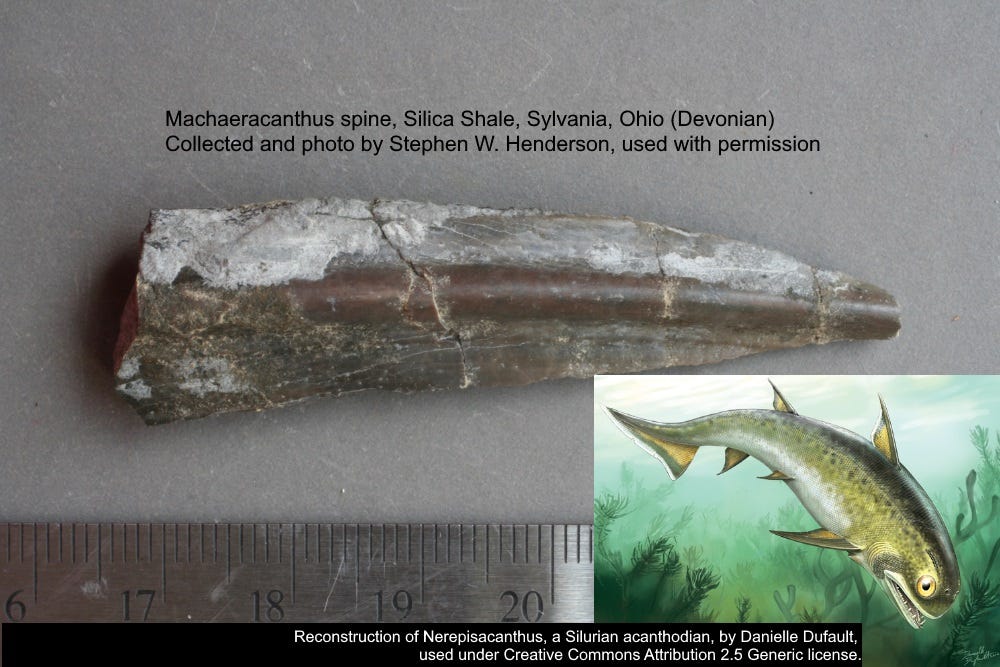
Acanthodians were among the first jawed fishes, sometimes called spiny sharks for the long, strong spines that supported their fins. The specimen in the photo, from my friend Stephen Henderson, is one of the spines of a large acanthodian, Machaeracanthus, from Devonian rocks called the Silica formation of northwest Ohio. It is about 390,000,000 years old, and by most estimates the entire fish would have been at most a meter long.
Machaeracanthus swam in a shallow sea that occupied the Michigan, Illinois, and Appalachian Basins, with a low-lying land area dividing it in what is now central Ohio (the Cincinnati Arch). The region was just south of the equator at the time, so the waters were tropical to subtropical, and they abounded with life. The Silica Shale is famous for trilobites and pyritized brachiopods, but many other fossils are found. The sea was somewhat restricted by various adjacent land areas, so the sediment on its floor tended to be somewhat anoxic. That helped with the preservation of some of the fossils, and in some cases enhanced the production of pyrite (iron sulfide) which replaced the shells of some of the brachiopods and other fossils.
Acanthodians share features of both bony fishes and cartilaginous fishes (sharks), and their precise phylogenetic placement is debated.
The group name acanthodian is from a Greek word for a thorn, in allusion to the sharp spines.