
Allanite
No connection with Mozart

Life in the USA is not normal. It feels pointless and trivial to be talking about small looks at the fascinating natural world when the country is being dismantled. But these posts will continue, as a statement of resistance. I hope you continue to enjoy and learn from them. Stand Up For Science!
As most of you probably know, the rare earths are neither really rare nor are they ‘earths’. They are metals, and most of them are more abundant in the crust of the earth than gold, silver, mercury, molybdenum, tungsten, arsenic, or tin. Cerium is more abundant than copper, neodymium is more abundant than lithium, niobium is more abundant than lead, and dysprosium is more abundant than iodine.
The atomic radii of the rare earth elements are such that they don’t form many minerals nor produce concentrations, ores, that are easy to exploit despite their widespread nature, so to that extent they are indeed rare.
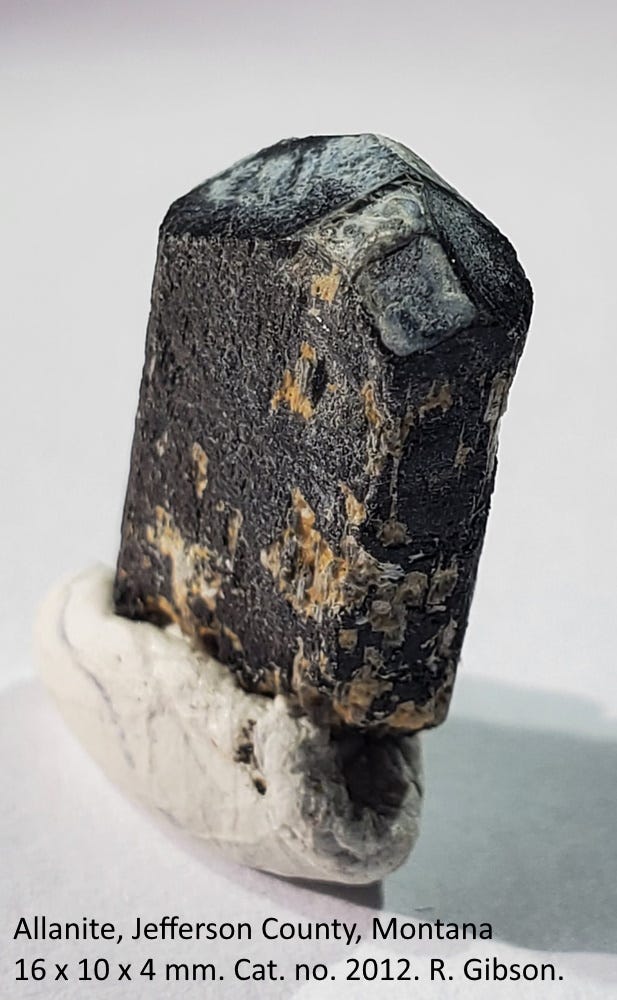
The photo at top is a crystal of allanite, one of the most common rare-earth minerals. It was named in 1810 by Thomas Thomson of the University of Glasgow for Thomas Allan (1777-1833), a Scottish banker and mineralogist who was a prominent collector and student of mineralogy. His collection is now largely at the British Museum of Natural History. In 1987 the International Mineralogical Association, as is their wont, redefined the mineral as a group, with suffixes indicating the dominant element. Thus we have allanite-(Ce) for the cerium-dominant variety, -(La) for lanthanum, -(Nd) for neodymium, and –(Y) for yttrium. There are solid solutions, mixtures in various proportions, among those elements.
My specimen from the Boulder Batholith in Jefferson County, Montana, was sold as allanite-(Ce) and it came from the collection of the late Chris van Laer, Butte collector, who had similar specimens (and maybe this one, too) analyzed, so I don’t doubt that it is allanite-(Ce). Its complete formula is (CaCe)(AlAlFe2+)O[Si2O7][SiO4](OH).
Other elements, such as strontium, manganese, and magnesium, can also substitute in various positions in the crystal structure of the allanite group minerals, and uranium and thorium are also commonly incorporated into allanite. That makes allanite often slightly radioactive, and sometimes, over time, the radioactivity of the uranium and thorium destroys the crystallinity of the mineral, a condition we call metamict (from words meaning ‘changed mixture’). I don’t know if my allanite crystal is metamict or not, but in any case it retains its crystal shape, a tabular monoclinic prism parallel to the {100} zone, for the three crystallography nerds out there. It is 16 x 10 x 4 mm in size.
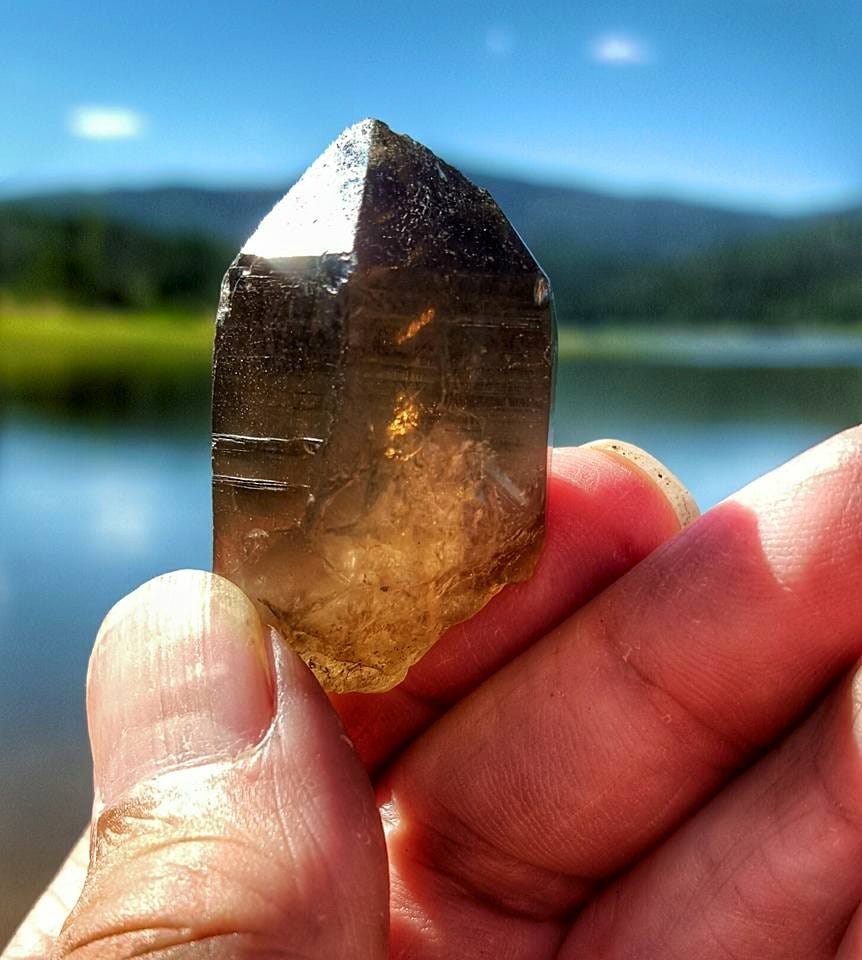
That there is radioactive uranium in the Boulder Batholith is not news. Most of the famous smoky quartz is a result of this radioactivity, caused when gamma radiation knocks an electron off aluminum impurities in the quartz, transferring it to some other metal, such as lithium. The resulting aluminum-lithium oxide is a small color center in the quartz, and enough of them make it look smoky. The smoky quartz from the Boulder Batholith isn’t radioactive but is the result of 76 million years of extremely low-level radiation from the uranium in the surrounding rocks (such as that presumably in my allanite crystal).
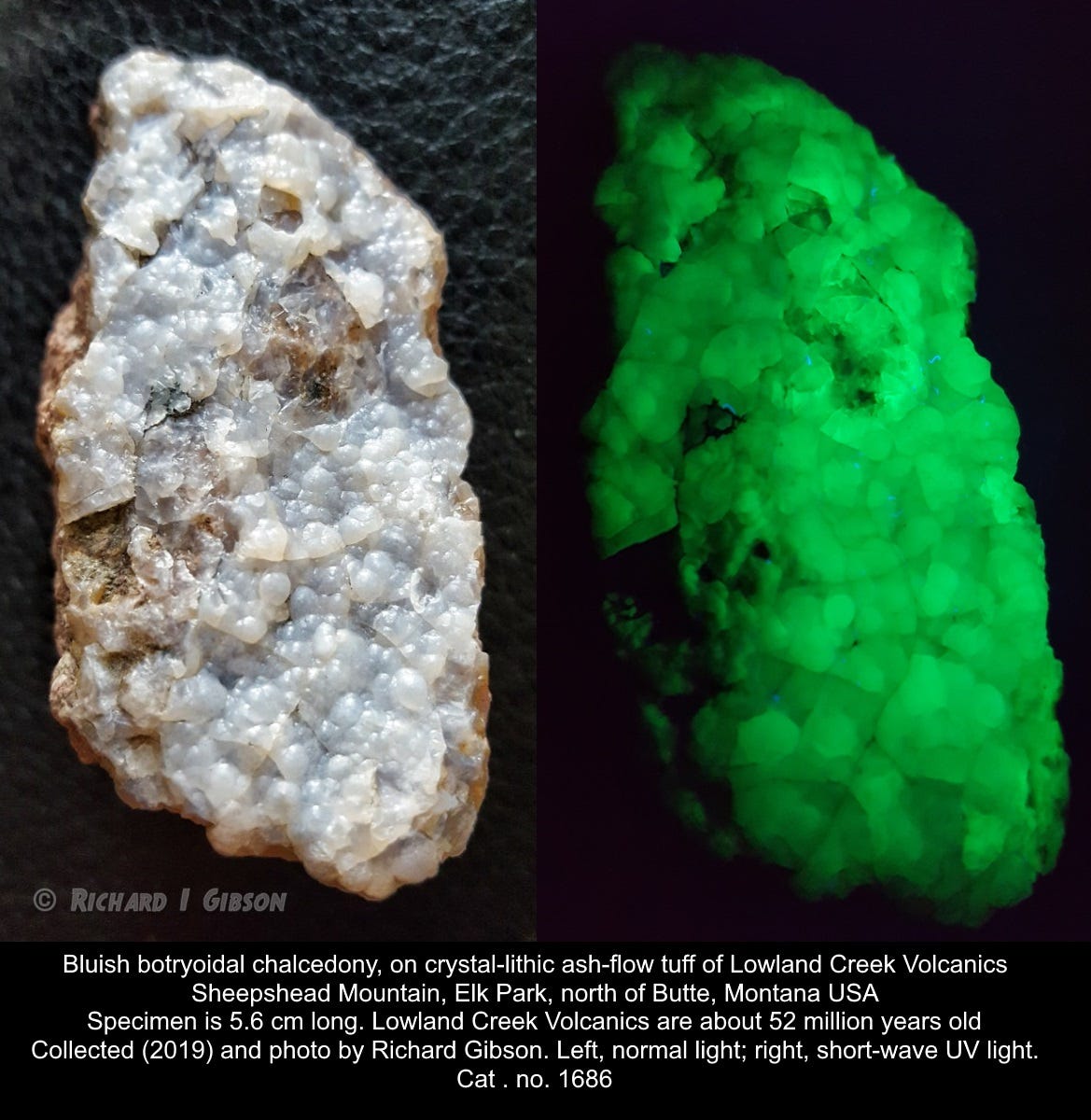
Other evidence for uranium in the geologic system in southwest Montana is the bright green fluorescence in some chalcedony (fine-grained quartz) such as is common in the Lowland Creek Volcanics. They are about 25 million years younger than the granitic rocks of the Boulder Batholith; they comprise Big Butte and are extensive north and west of Butte. That green fluorescence is often, but not always, the result of uranyl ions, UO2 2+, in the chalcedony. Similar green fluorescence is also often seen in petrified wood from the Tertiary sediments in southwest Montana.
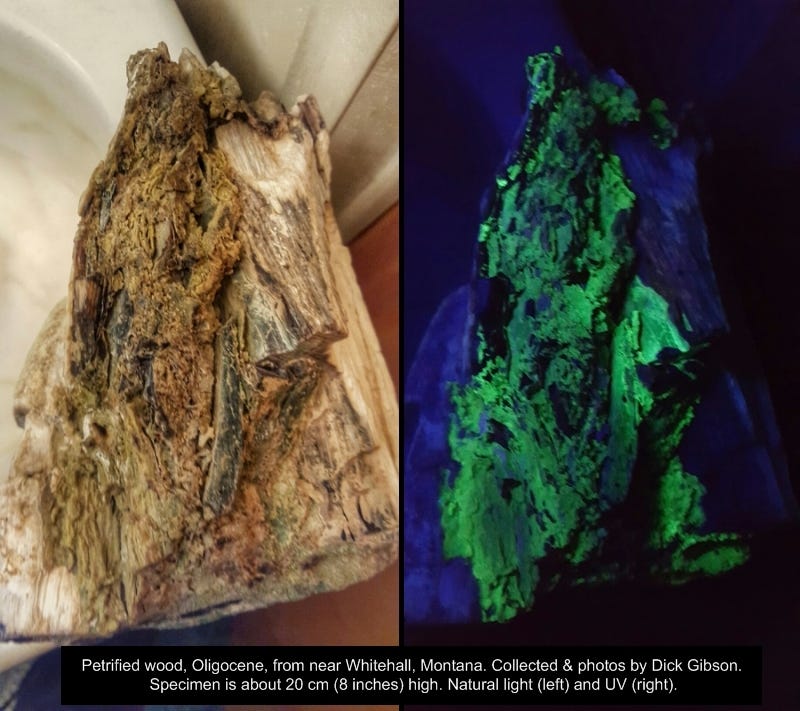
None of this uranium and radioactivity is enough to cause any concern. Smoky quartz forms after millions of years of low-level radiation, and the amount of uranyl needed to cause fluorescence is tiny. I don’t know, but I bet my allanite crystal is radioactive enough to be noticeable with a Geiger counter, but I’m not worried about it.
The common mineral epidote, (CaCa)(AlAlFe3+)O[Si2O7][SiO4](OH), has the same formula as allanite, except there is a second calcium (Ca) in the position where the cerium (Ce) is in allanite and the iron is in the +3 state to balance the charge properly. According to Chris Gammons, there is a solid solution between allanite and epidote, but neither of us have seen them in association.
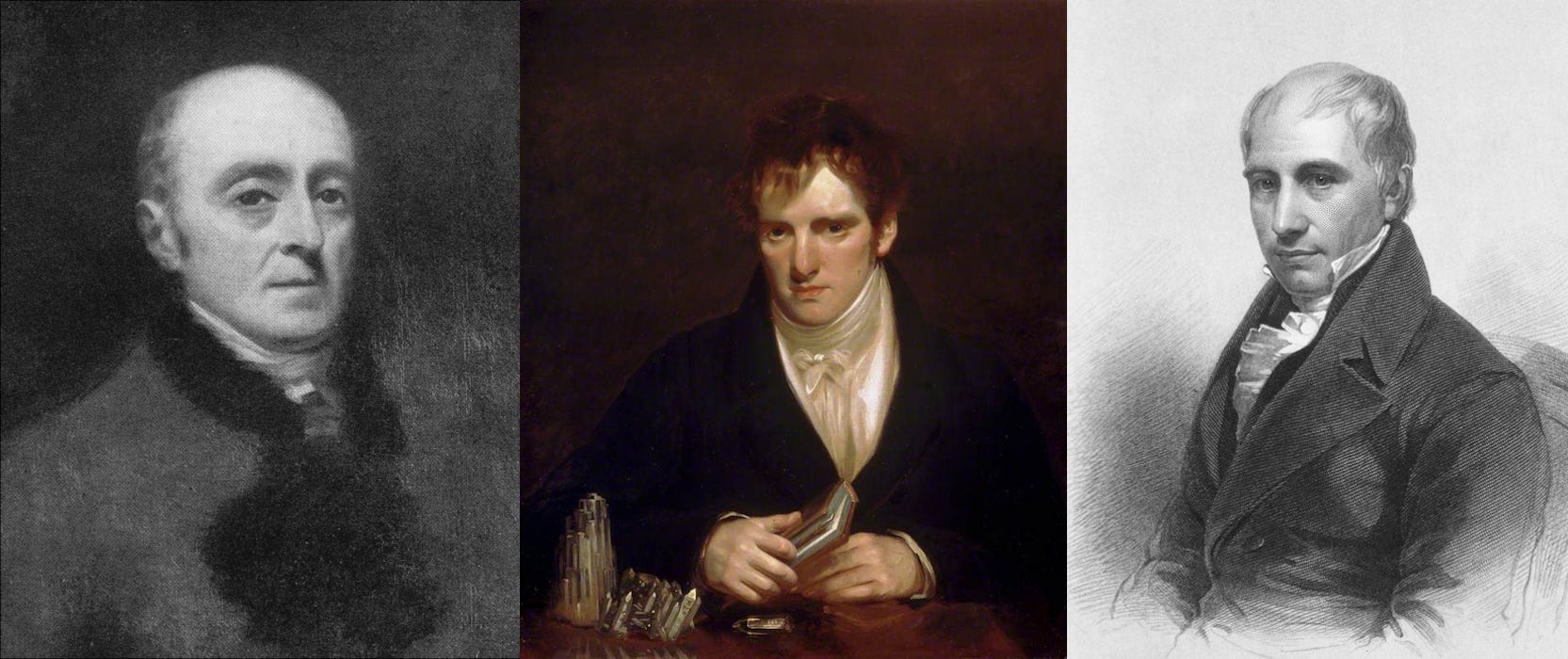
Although Thomas Thomson (1773–1852) described this mineral, it was discovered in 1806 on Qáqarssuatsiaq (or Qeqertarsuqq), an islet off Aluk Island near the southern tip of Greenland, by Karl Ludwig Giesecke. Giesecke was born Johann Georg Metzler in 1761 in Bavaria. He worked as an actor, and changed his name when he was 20 years old for mysterious reasons, perhaps to hide his Protestant ancestry.
Giesecke had a diverse life, and it was suggested for many years that he was the actual librettist for Mozart’s The Magic Flute, a claim that was eventually debunked. He traveled extensively in Greenland – more extensively than he wanted to, thanks to the Napoleonic Wars, which kept him there for seven years during which time he found the mineral that was eventually named allanite.
Minerals Giesecke collected in Greenland and shipped to Denmark were captured by the British navy; studies of his rocks in Britain ultimately led to his appointment as a professor of mineralogy with the Royal Dublin Society in Ireland, and Thomas Allan helped Giesecke secure a membership in the Dublin Philosophical Society. Giesecke died in Dublin in 1833, six months before Thomas Allan.
I spent a long time trying to find the reported allanite -La from Paritu, NZ. I finally gave up but came across some unusual purple needles some years later and decided to to do an EDS which confirmed them as allanite-Ce (see Mindat, Paritu NZ)
Monazite and lesser xenotime have been produced as a coproduct of ilmenite and zircon production by Southern Ionics Minerals since 2016. I obtained a nuclear export license and we sold a rare earth mineral concentrate to a chinese customer. In 2019 we were purchased by Chemours (a spinoff from DuPont). We continue to produce a rare earth mineral concentrate but now have a domestic customer - Energy Fuels in Utah. They purchase our monazite concentrate as a uranium feed. They can crack it enough to get the U, but do not yet have the capabilities to process the RE byproducts into commercially useful compounds. Hopefully soon! The separation of monazite from the heavy mineral concentrate that our mines produce is challenging. Like zircon, it is nonconducting, nonmagnetic, and has a high specific gravity. Careful gravity separation w shaker tables is pretty effective, but our monazite concentrate ends up w some intermixed zircon and staurolite. Any epidote or allanite present would likely be rejected with lighter minerals and sent back to the mine w tails.