
Ammonites
and the Western Interior Seaway

Life in the USA is not normal. It feels pointless and trivial to be talking about small looks at the fascinating natural world when the country is being dismantled. But these posts will continue, as a statement of resistance. I hope you continue to enjoy and learn from them. Stand Up For Science!
Extinct ammonites comprised a subclass of cephalopods (“head foot”), part of the phylum of mollusks. The only surviving members of the cephalopods, octopuses, squids, cuttlefish, and nautiluses, are actually not that closely related to ammonites and are in a separate subclass.
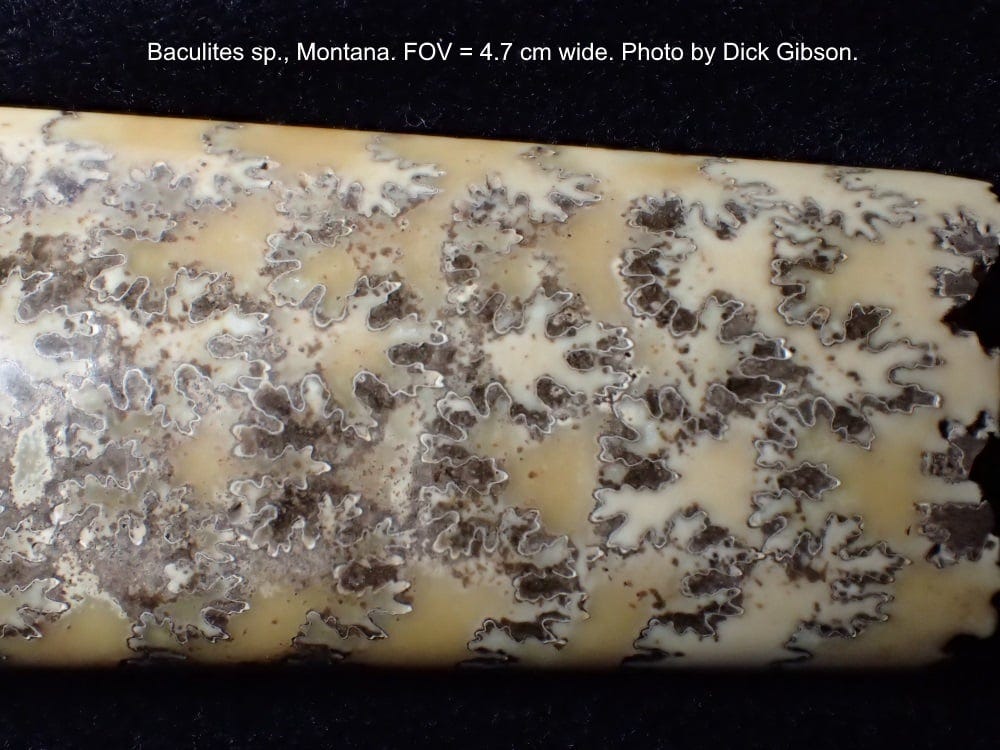
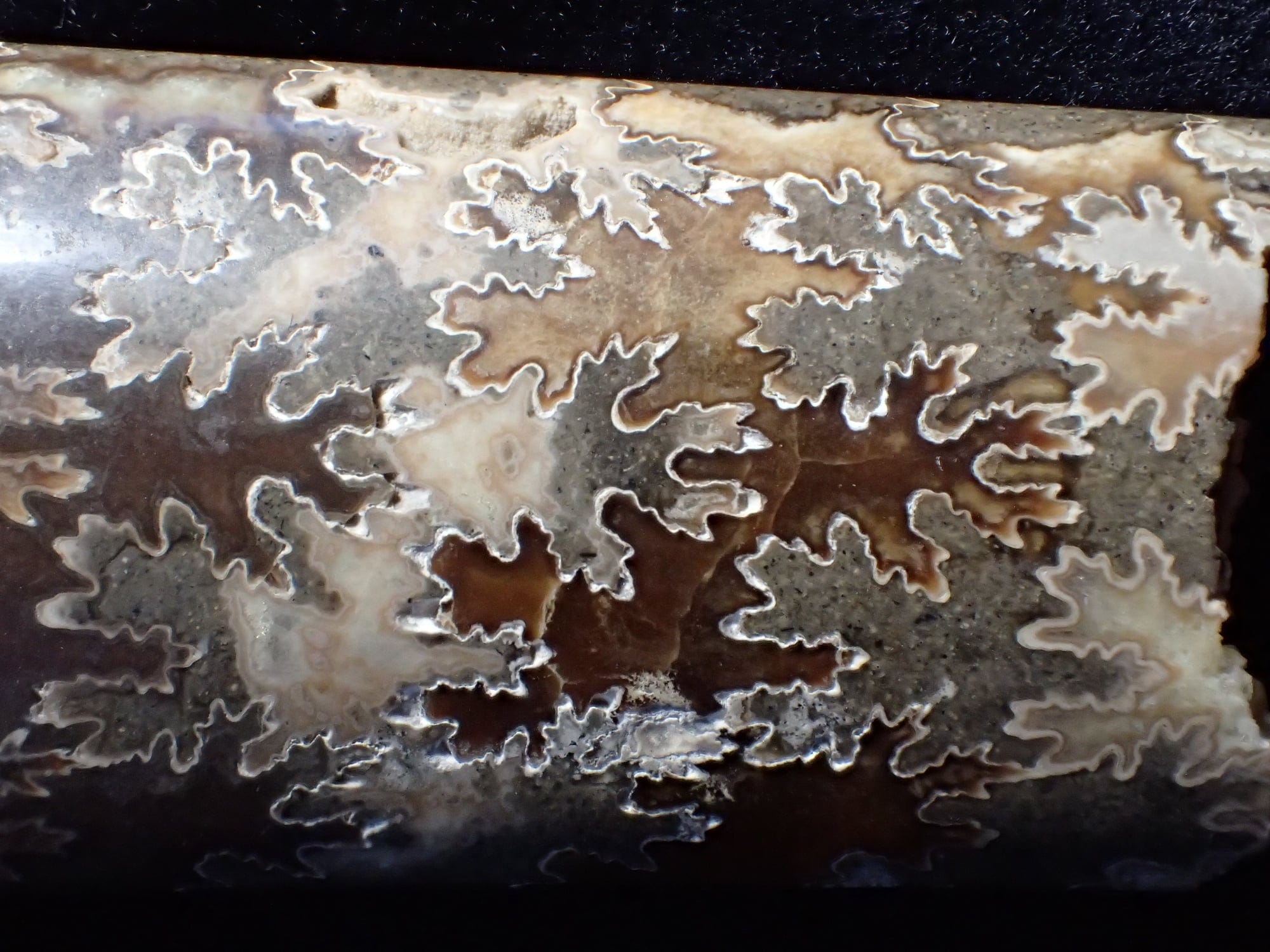
There are many subdivisions among ammonites, but probably the most familiar are coiled and straight shells. Baculites, a straight-shelled genus, was abundant in Montana (and worldwide) during the Cretaceous period. The two in my photos above come from the Bearpaw Shale of eastern Montana, and date to the Campanian Stage, which ranges from about 83 to 72 million years ago.
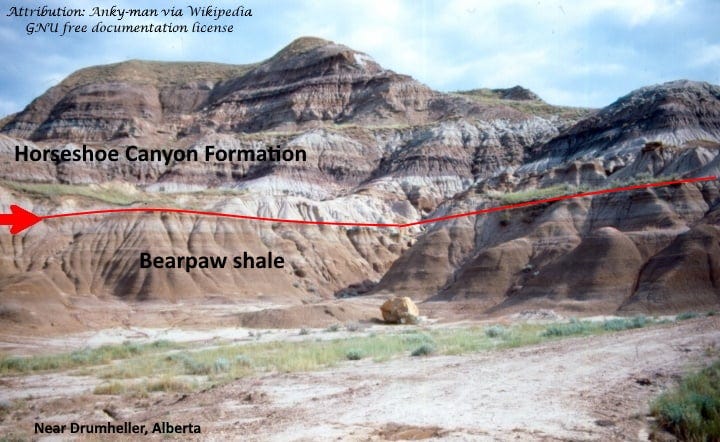
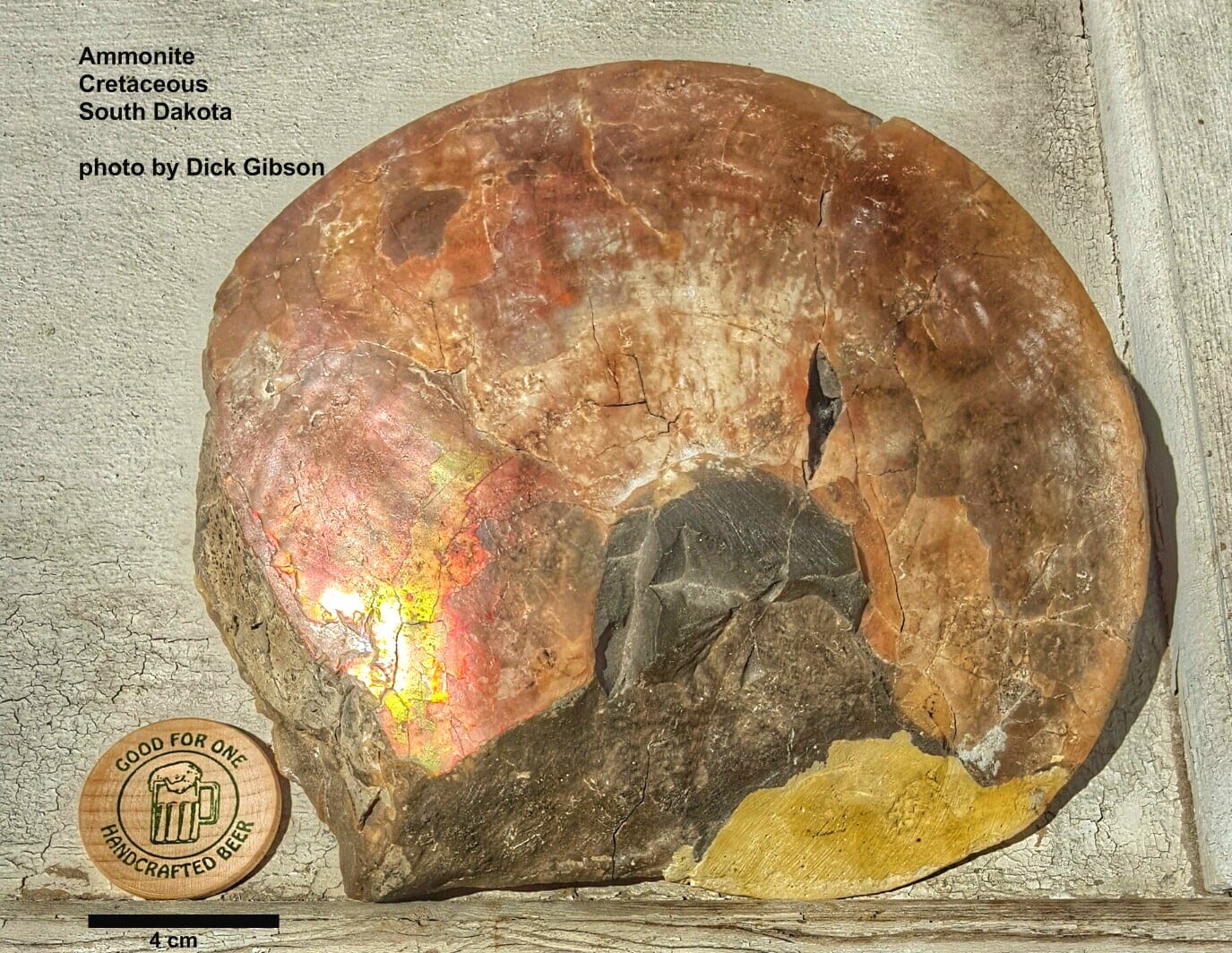
The coiled ammonite at top is probably Placenticeras and this one is probably from the Pierre Shale of South Dakota (I got it in Rapid City in 1970) but it is identical to examples from Montana. The Bearpaw Shale is the equivalent of the upper part of the Pierre Shale. Both shales were deposited in the Cretaceous Western Interior Seaway of North America.
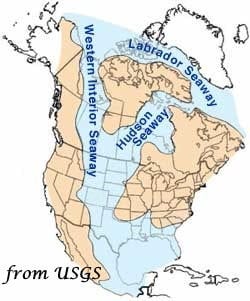
The Western Interior Seaway was a shallow sea that developed in response to the rising highlands in western Montana, Idaho, and Utah, and extending to the north and south. The crust east of the collision zone that created the highlands was depressed beneath the rocks that were tectonically thrust upon it and was further depressed by the pile of sediment shed off that highland into the adjacent lowland (the depression is called a foreland basin).
The seaway began to develop about 100 million years ago and ultimately extended the length of the tectonic orogenic (mountain-building) belt from the Arctic to the Gulf of Mexico, and at times it was as wide as from western Montana to Minnesota, and New Mexico to Arkansas.
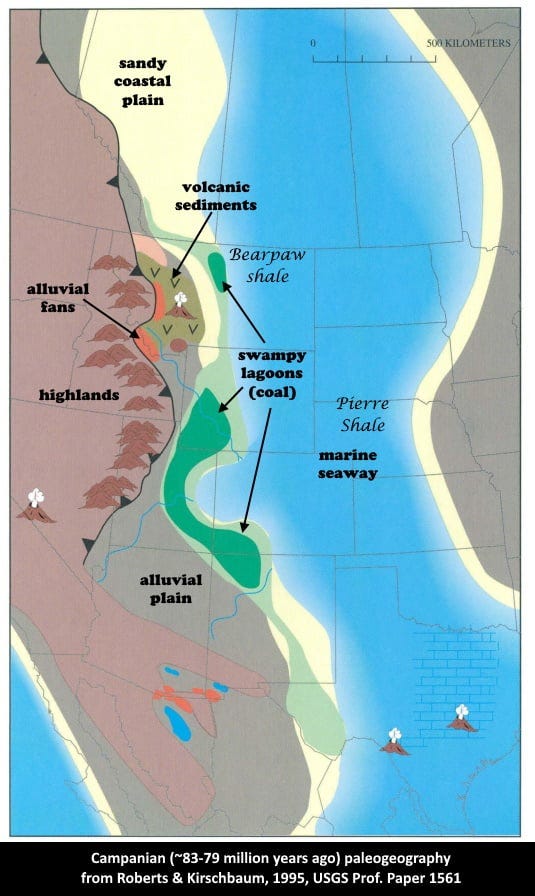
The name “seaway” makes it sound like it was just an ocean, but the system included a wide range of environments, which you can see on the map above from the USGS. From the eroding mountains and volcanoes in the west, streams flowed eastward onto a wide alluvial plain, and the associated rocks record stream channels, mud flats, lakes, and alluvial fans there. Further east the low coastal area included (at diverse times) sandy beaches, lakes and coal swamps, and deltas of the rivers. The true marine environment, where the ammonites lived, was even further east. Much of the sea received fine-grained mud as sediment, which ultimately solidified into the Bearpaw and Pierre Shales. When ammonites and other swimming creatures in the sea died, they settled onto the muddy sea floor where they were preserved.
The Western Interior Seaway lasted around 40 million years. When it had lasted about 30 million years, around 70 million years ago or so, ongoing tectonic activity began to break the crust beneath the seaway’s basin. Huge uplifts, which persist today in the Uinta, Wind River, Big Horn, Beartooth and other mountain ranges, and in the Black Hills, began to segment the basin and change the depositional patterns. Ultimately the floor of the basin was above sea level, roughly 60 million years ago, and marine deposition ceased.
Ammonites had gone extinct before the demise of the Western Interior Seaway. You commonly hear that they expired in the end-Cretaceous extinction, the same event that marked the end of the non-avian dinosaurs, but there is some controversial evidence that at least one Baculites species may have survived perhaps 200,000 years into the Paleocene, after the extinction event (Machalski and Heinberg, 2005, Evidence for ammonite survival into the Danian (Paleogene) from the Cerithium Limestone at Stevns Klint, Denmark: Bulletin of the Geological Society of Denmark, Vol. 52, pp. 97–111).
Ammonites are typified by their intricate and beautiful suture patterns. The convoluted patterns called sutures are the intersection between the internal septa, layers bounding the chambers within the shell, and the layer just below the outer surface. My coiled specimen does not show the sutures because it still has much of the original outer shell material (nacre), which is iridescent in places. The Baculites specimens show the sutures well.
We don’t fully understand either how the suture patterns developed, nor exactly what their purposes were in the living animals. Except for the initial chamber, where the animal lived, the chambers in the shell were empty, and it is usual to infer that the animal changed the water-air ratios in those chambers for propulsion and buoyancy. But how the exceptional convolutions of the septa dividing the chambers developed is still being researched.
Inoue and Kondo (2016, Suture pattern formation in ammonites and the unknown rear mantle structure: Nature, Scientific Reports 6, no. 33689) used the almost fractal projections that develop on modern sea slugs, unshelled mollusks, as analogies for the growth of ammonite bodies that would control the development of the septa and sutures. However they formed, the suture patterns are so distinctive that ammonites can be used to establish high-precision relative dating of stratigraphic layers, especially during the Mesozoic era.
“Baculites” is from Latin and Greek words meaning “walking stick rock.” Some varieties reached two meters in length so could indeed have served as walking sticks although they tend to break apart into smaller segments along the septa. Several Baculites species from Montana’s Bearpaw Shale were described by William A. Cobban, a USGS geologist and paleontologist descended from the same family whose name is commemorated in Cobban Street in Butte, Montana (Cobban, 1962, New Baculites from the Bearpaw shale and equivalent rocks of the Western Interior: J. Paleo. 36:1, p. 126).
“Ammonite” derives from Pliny the Elder (who died in the 79 AD eruption of Vesuvius) who called the fossils ammonis cornua (”horns of Ammon”) because the Egyptian god Ammon or Amun was typically depicted wearing rams’ horns that looked similar to coiled ammonites. The common suffix in ammonite names, -ceras, as in the Placenticeras specimen in my photo, also means “horn.”
We’ve looked at aspects of the Western Interior Seaway of North America previously, here and here.
Nice photos, Dick, of the patterns on your ammonite shells. They are utterly beautiful.
In the Pennsylvania cyclothem sediments of southeastern Ohio where I grew up, I once found a piece of an ammonite at a coal strip mine. An Ohio University paleontologist identified it for me as a section of one of the giant ammonites that were as much as nine feet in diameter. What a clunky monster that must have been.
I much enjoyed your photos of the Black Pine minerals on this morning's sub stack, which vanished from my desktop. That's a remarkable collection with unusual minerals that you have.
I love ammonites! Thank you for writing this post, I recently saw one at the museum Caracol in TJ MX and it was probably the biggest one id seen.