
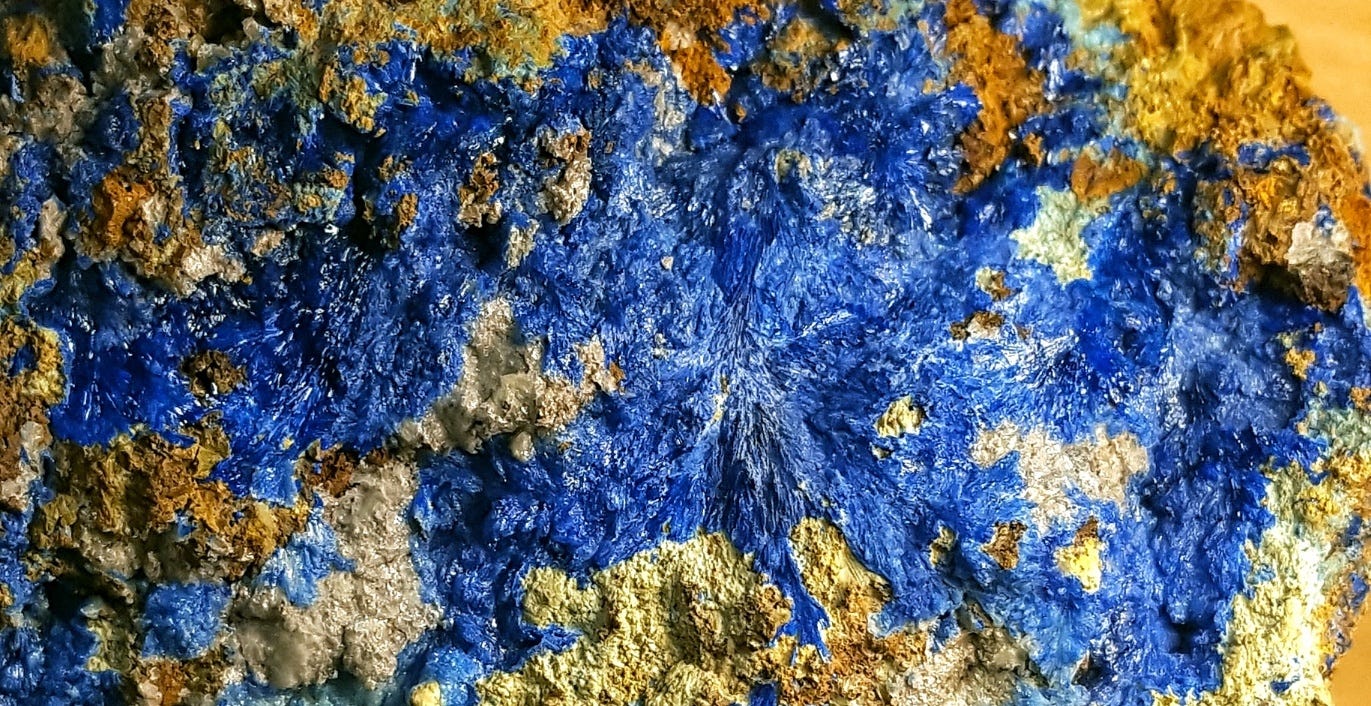
Azurite?
Nope

Life in the USA is not normal. It feels pointless and trivial to be talking about small looks at the fascinating natural world when the country is being dismantled. But these posts will continue, as a statement of resistance. I hope you continue to enjoy and learn from them. Stand Up For Science!
If there’s anything that looks like azurite, it’s linarite. If someone told me they could discriminate between the two by color, I’d try to be polite, but I would scoff. I certainly can’t distinguish them by color, even though MinDat says linarite’s color is “Similar to azurite but not as deep.”
They are even both monoclinic crystallographically and share the same class, 2/m – prismatic, and have quite similar habits, often prismatic crystals, often in radial sprays. But you should not think linarite is just a variant of azurite: azurite is copper carbonate, Cu3(CO3)2(OH)2, and linarite is lead-copper sulfate, PbCu(SO4)(OH)2.
So how do you tell them apart? As a carbonate, azurite will effervesce (give off bubbles) in weak hydrochloric acid (HCl), and linarite, a sulfate, will not. But be careful if you have nice specimens: linarite will still react with HCl (if it is strong enough) to produce a gray coating of lead chloride, mineralogically probably the mineral cotunnite – interesting, but you can destroy the brilliant blue color and luster that way.
Azurite is well-known while linarite is much more obscure, except probably to mineral collectors and mineralogists. Both form in oxidized zones of ore deposits but obviously linarite is more typically found associated with other lead minerals. It was named in 1839 for its type locality, Linares, in southern Spain, a historic lead-mining district.
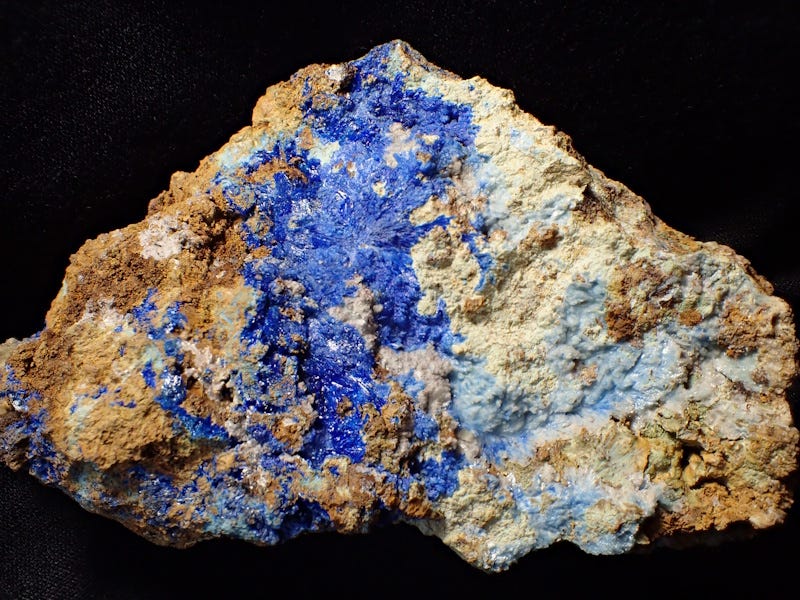
But some of the finest examples have arguably come from the Blanchard Mine, Socorro County, New Mexico USA, which is where my specimen is from. It was acquired (and probably collected) by my mineralogy professor Carl Beck (1916-1971), probably in the 1950s.
The ores at the Blanchard Mine, part of the Hansonburg Mineral District, are basically hydrothermal barite-fluorite-galena deposits mostly in the Pennsylvanian Madera Limestone, probably emplaced by hot mineralized fluids related to the Rio Grande Rift in just the past 8 million years (Rakovan and Partey, 2009, Mineralization of the Hansonburg Mining District, Bingham, New Mexico: New Mexico Geological Society Guidebook, 60th Field Conference, Geology of the Chupadera Mesa Region, p. 387-398).
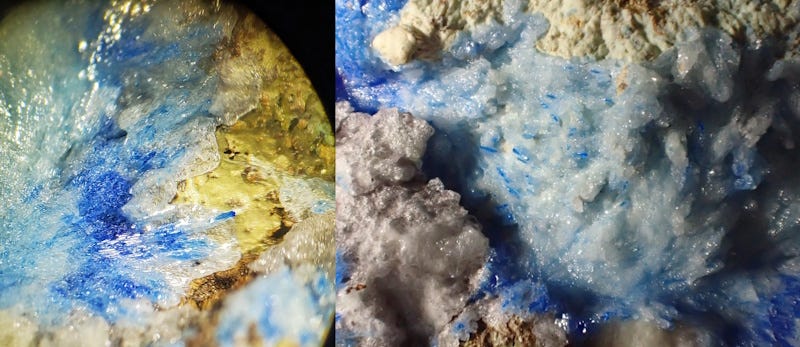
The white-colorless to light blue patches in my specimen are probably either anglesite, lead sulfate, or cerussite, lead carbonate, colored by inclusions of linarite or encrusting linarite, whose color shows through. Anglesite and cerussite are challenging to discriminate visually; cerussite, a carbonate, does effervesce in acid but really slowly, nothing like calcite or azurite. I think the white-colorless material in my specimen is anglesite. Both are common at Blanchard.
I dont know, but I spotted a litte azurite in a shop for $20 about 8 years ago. I had a gut feeling since the blue "wasn't quite right", bought it, hoping it was linarite. Later, a geologically much sharper friend said: "Cool Linarite!" which i thought too.
I looked it up on mindat, they are both monoclinic, but linarites just seem not exactly the same shape, at least most of the time. Ive studied some xl-lography, but it gets deep fast. Too fast.
Lol.
Well said.
I figure that since I "lucked out" twice in total, im an expert.