
Barite with inclusions
From Cumbria

Life in the USA is not normal. It feels pointless and trivial to be talking about small looks at the fascinating natural world when the country is being dismantled. But these posts will continue, as a statement of resistance. I hope you continue to enjoy and learn from them. Stand Up For Science!
Barite (as spelled in the US, but the official International Mineralogical Association spelling is baryte) is a common mineral, barium sulfate, BaSO4. As a common mineral, it nonetheless sometimes exhibits interesting and diverse complications.
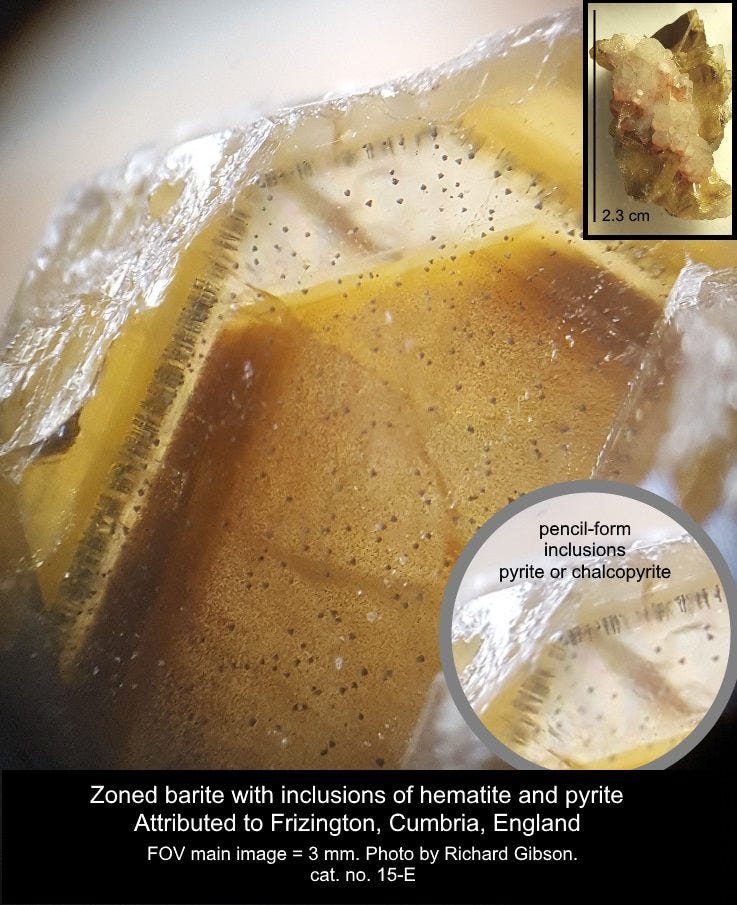
The brownest zones of the barite in my photo here result from dense inclusions of deep reddish material, probably hematite (iron oxide), in blebs smaller than a hundredth of a millimeter barely visible in the image. The larger inclusions you can see here are brassy spheres, triangular prisms, and elongate pencils, which are probably pyrite (iron sulfide) but chalcopyrite (copper-iron sulfide) is possible. In either case, the pencil forms are not typical of the geometries and crystal forms pyrite and chalcopyrite usually display. The lower right inset shows the pencil forms perhaps a little better than the main image. They clearly follow particular crystallographic positions in the barite, and they are about a fifth of a millimeter long or a little less.
The upper right inset is the entire 2.3-cm specimen. I don’t have a definite locality, but I attribute it to Frizington, Cumbria, England, because of the barite forms and inclusions, the associated white calcite (colored pink in places by hematite), and the presence of a few tiny hematite blades on the surface. Frizington is a well-known barite locality (231 photos on MinDat) where the barite is often tinted brown to red by hematite inclusions.
Zoning in crystals results from changes in the environment while the crystal is growing. In this case there were variations in the iron (and maybe copper, if some of the inclusions are chalcopyrite) content in what was otherwise a solution dominated by barium and sulfur.
Zoned crystals are common, although this one is kind of dramatic and I think the pencil-like inclusions, standing in ranks perpendicular to the crystal faces, are unusually weird and cool. It would be more difficult for such things to form than for a barite crystal surface to be coated with something and then have more barite deposited over that coating, resulting in a phantom, a crystal shape showing within a larger crystal and often mimicking the form of the whole crystal. It’s certainly fair to call the expressions in my photo phantoms, but they are not like typical coatings on a crystal surface.
I have difficulty visualizing the conditions that led to vertical pencils of a sulfide growing on a barite substrate, or in a barium-sulfate solution, especially with such uniformity of both size and spacing.
Recommendations
You can find all the other Substacks that I recommend on the home page of The Geologic Column. I don’t make recommendations lightly; each of them appeals to me in non-trivial ways, and I hope they will for some of you as well. In this occasional feature, I intend to highlight my recommendations to further encourage you to explore them.
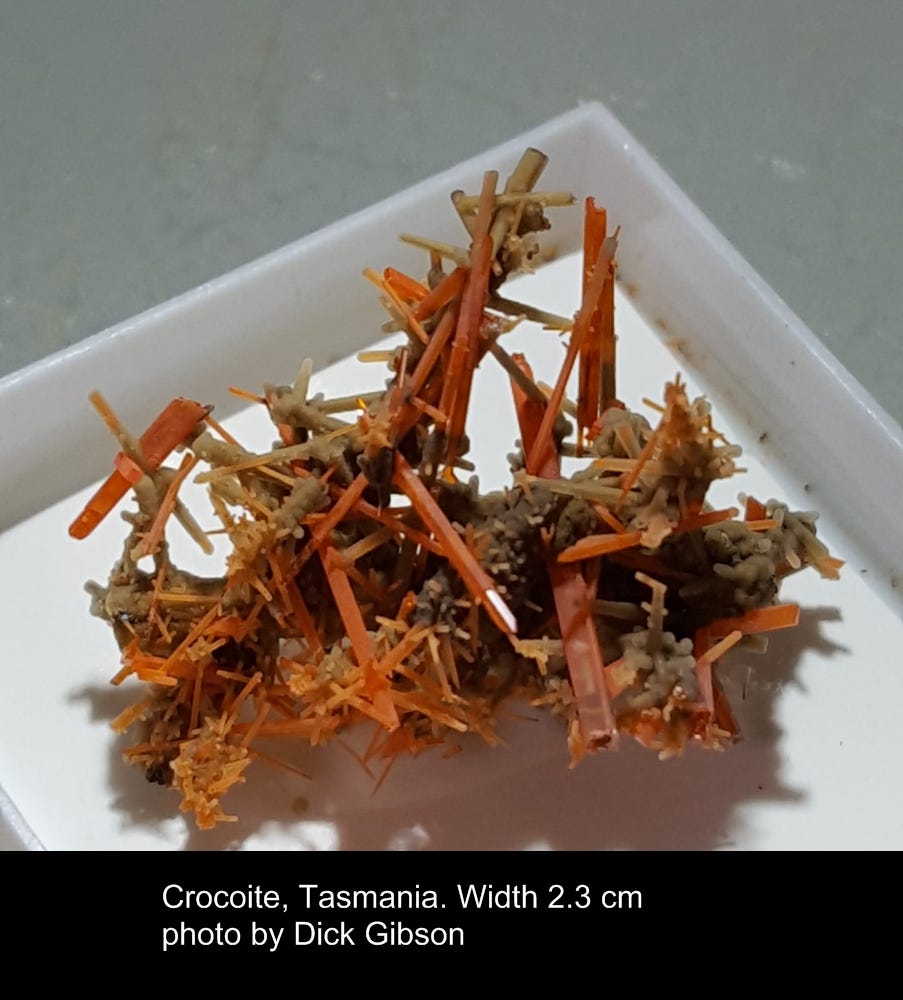
Link: Mineral Matters
Australia-based Steve Sorrell was the primary influence that encouraged me to begin The Geologic Column. His daily Mineral Matters posts are often short stories about a particular mineral with a fine photograph, but you’ll also encounter historical connections from the Bronze Age to the Victorian Era, and things like the Word of the Week (such as heteropolyhedra).
At its heart this is a venue for learning about minerals, but it goes well beyond that. There are more than 1000 posts to explore at Mineral Matters.
The site has links to Steve’s other Substacks, including his fiction writing, photography, and mineral sales.
An interesting inclusion for sure Richard. I wonder if the sulphide and the additional layer(s) of barite crystallised formed at the same time, crystalising out from either a fluid or a gaseous phase.
And thanks for adding the link!
Richard, you know about Niels Stenson, who figured if animals and plants grow by fluid supply, why not xls? ( tho a trivial difference is they are nonliving, lol)
I just read that tonight thanks to Steve Sorrell's presenting, a few weeks back, a list of minerals books available online.
But just today with a gentle breeze and gentler incoming tide, I noticed that the broken sea grass blades weren't scattered everywhere like usually. They were lining up in amazing order, end to end, barely at the surface o the water, rows about 2 feet apart, extending many feet, tho I didnt measure. In the deeper water there were 2 lines of trees up ahead; maybe the very small waves were influenced by the tree rows to affect the broken leaves with their specific gravity being so precise?
Whatever, it was COOL, and reminded me of your bar(y,i)te phenomenon.
I wished I had my camera, but was swimming, and the shore was far away. The gradient for depth there is almost nil. You walk a long way to be just knee deep. I'll go back. Its a mere 2 miles away.
Mike