
Brucite
In an ophiolite

Life in the USA is not normal. It feels pointless and trivial to be talking about small looks at the fascinating natural world when the country is being dismantled. But these posts will continue, as a statement of resistance. I hope you continue to enjoy and learn from them. Stand Up For Science!
Post #368
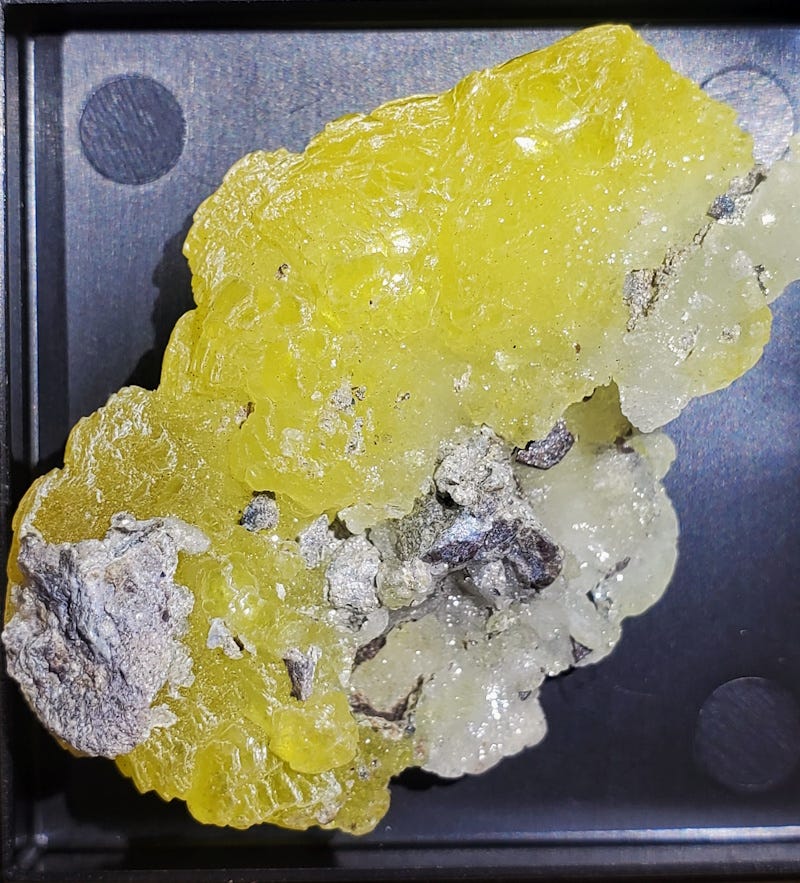
About 2015 and 2016, bright lemon-yellow brucite specimens began to appear on the collector market, considered by many to be the finest yellow brucite in the world. Prices were very high, with even small (4-5 cm) specimens commanding many hundreds to thousands of dollars. Good examples with intense color still can be a few hundred dollars, but prices have come down somewhat. Consequently, I was very pleased to find this decent 52 mm piece for $2.50 in 2024 at the Butte mineral show. I have not photo-enhanced the color; the photo is about how it appears to the eye.
The location is normally given as the Killa Saifullah District of Balochistan, Pakistan, but the actual mining area is about 15-20 miles (24-32 km) west of the town in the hills containing the Muslim Bagh Ophiolite Complex. You recall that an ophiolite is a slice of oceanic crust tectonically emplaced onto continental material during tectonic activity.
Pakistan is located where the northwestern corner of India impinged on Eurasia, with that corner severely deforming the pre-existing rocks of Pakistan. The resulting curved mountain belts are called oroclines, from words for mountain and bend or incline.
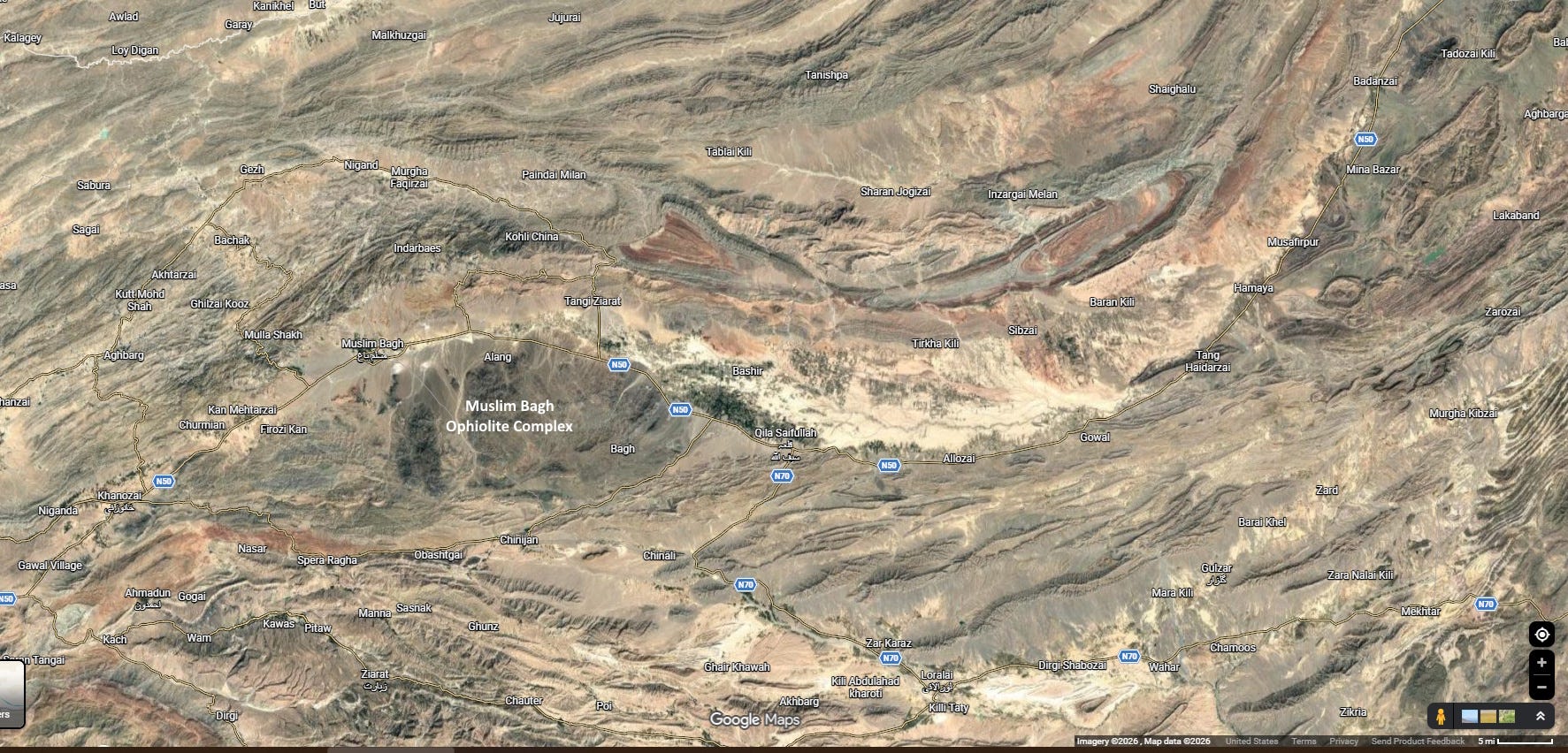
You can see some of the oroclinal bending in the Google image above, as well as the dark oval that is the Muslim Bagh Ophiolite where the brucite is found. It’s no surprise that brucite, magnesium hydroxide, Mg(OH)2, is associated with the ophiolite. Oceanic crust is dominated by iron and magnesium minerals, and when the material reaches the surface after being thrust upon the continent, alteration produces a suite of magnesium and iron minerals such as brucite and magnesite, MgCO3.
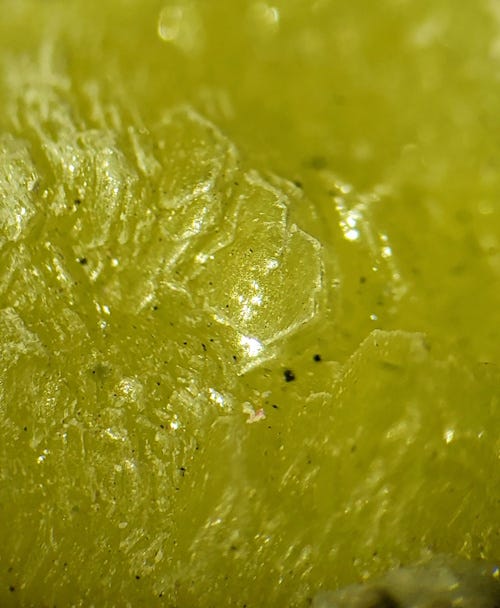
Brucite can be many colors, but non-descript gray and white masses are probably quite common. Reports indicate that the lemon yellow in the Pakistan specimens is from inclusions of iron, whether as iron ions or as particles of some iron mineral, I have been unable to determine. In my specimen, the gray material on the lower right side is also brucite, and the granular whiter material is probably part of the magnesite matrix.
The ophiolite was probably emplaced between 65 and 70 million years ago (Mahmood and others, 1995, 40Ar/39Ar dating of the emplacement of the Muslim Bagh ophiolite, Pakistan: Tectonophysics 250 (1-3), p. 169-181). That time is earlier than the collision of India, which began about 40 to 55 million years ago. Mahmood and others (1995) think the ophiolite represents an early interaction between this part of Eurasia and part of the Tethys Ocean that was “ahead” of India as they both came toward Eurasia. But some (maybe much) of the oroclinal bending is indeed a result of the indentation and squeezing that resulted from the collision of India.
Brucite was named in 1824 by François Sulpice Beudant (the prolific namer of minerals who we have met previously) for Archibald Bruce (1777 - 1818), the physician and American mineralogist from New York who first described the species. We saw artinite, a magnesium carbonate-hydroxide, from an ophiolite in California, in this recent post.
Thank you 😊