
Cantwell Formation
Central Alaska

Life in the USA is not normal. It feels pointless and trivial to be talking about small looks at the fascinating natural world when the country is being dismantled. But these posts will continue, as a statement of resistance. I hope you continue to enjoy and learn from them. Stand Up For Science!
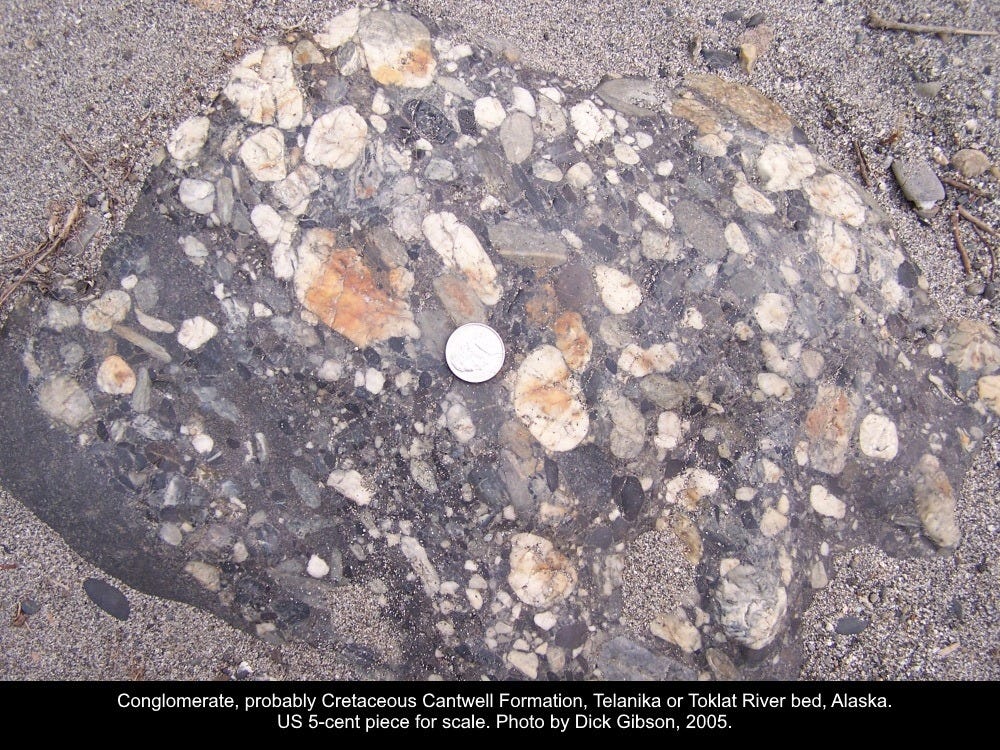
If you showed this rock to a geologist familiar with the geology of southwest Montana, he or she might say it looks like the basal conglomerate in the Cretaceous Kootenai Formation. And while there is no physical or geographic continuity, and the Kootenai was deposited about 40 million years earlier than this material, the sediment that became this rock was laid down in a setting much like that of the Kootenai.
The rock posed for me in the bed of either the Telanika or Tolkat River in Denali National Park, Alaska, northeast of Denali itself. It’s almost certainly part of the Cantwell Formation, originally cobbles, pebbles, sands, and silts that were shed off the rising Alaska Range about 80 to 70 million years ago. The uplifted mountains and associated magmatic arc were the result of complex collisions in south-central Alaska, in part the collision and amalgamation of the Wrangell Terrane with North America (in what is now central Alaska).
The northward-directed collision thrust rocks up and over the edge of the continental craton in a manner similar to what happened in Montana 40 million years earlier, where the push was east-directed. The materials eroded off the uplifts in both cases were so voluminous that they (and the related thrust sheets) warped the crust downward, forming a subsiding Foreland Basin into which more and more sediments were dumped. The basin in Alaska ultimately held around 4 km (2.5 miles) of mostly Cretaceous sediment.
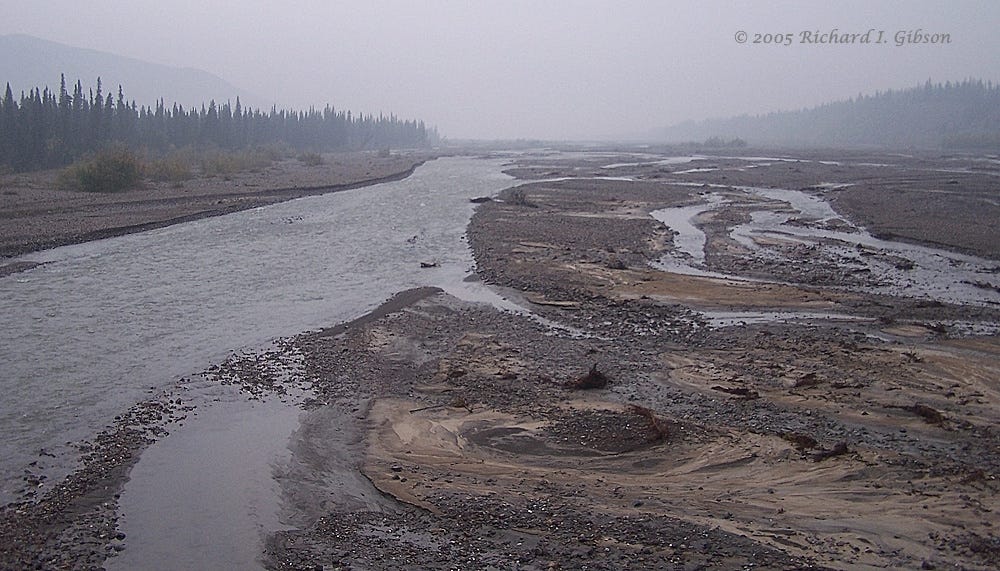
The modern setting along the north side of the Alaska Range is quite similar to the Cretaceous environment in which the Cantwell Formation was deposited. In the photo above, you see the braided stream that would in times of flood carry cobbles comparable to those in the Cantwell. It was a misty, rainy, smoky day when we were there in August 2005.
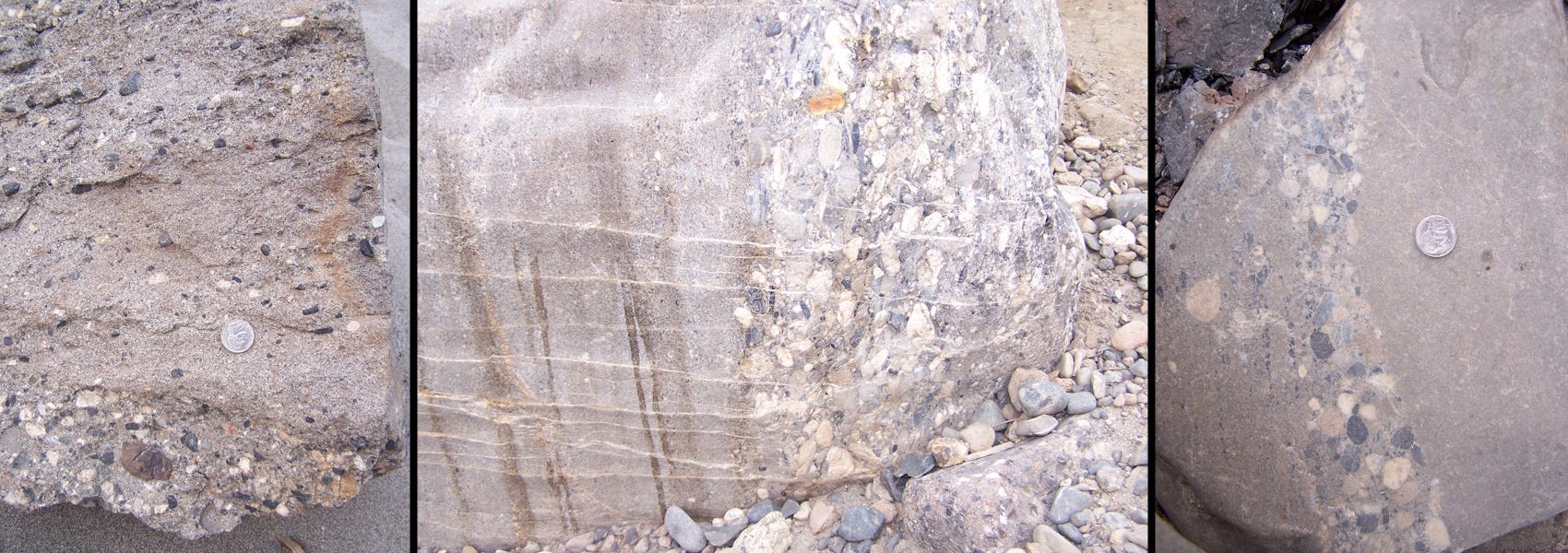
The earliest deposits, near the uplifts, and at a time when the uplifts were not yet eroded down, contained coarse pebbles and cobbles like those you see in the rock photos. As the uplift reduced in relief through erosion, and as sediments were carried by rivers to more distant locations, the rocks’ constituents were finer, sands and silts rather than pebbles, and that’s what you find both interbedded with the conglomerate and higher up (younger) in the stratigraphic section. Volcanic rocks become prevalent in the upper Cantwell Formation as well.
The rocks originally deposited in streams, lakes, and alluvial fans of the Cantwell Formation contain the highest diversity of bird fossils known in the world, together with dinosaur footprints. Although this part of Alaska was perhaps not quite as far north in late Cretaceous time as it is now, it was still near the Arctic. But the overall Cretaceous climate was much more moderate across the planet, and generally considerably warmer in Arctic settings than today. Life thrived.
The Alaska Range and Denali today are high rugged mountains in large part because the collisions and subduction (and volcanoes and earthquakes) continue there, whereas in Montana, the driving forces behind uplift here have largely ceased. But it would be reasonable to suppose that in early Cretaceous time, highlands comparable to Denali were present in western Montana and Idaho. It was the continuing uplift in Alaska that put the old Cantwell formation rocks in positions on the flanks of the modern uplift (Denali) where they could be eroded and dumped into the modern river systems where this boulder sat in 2005.
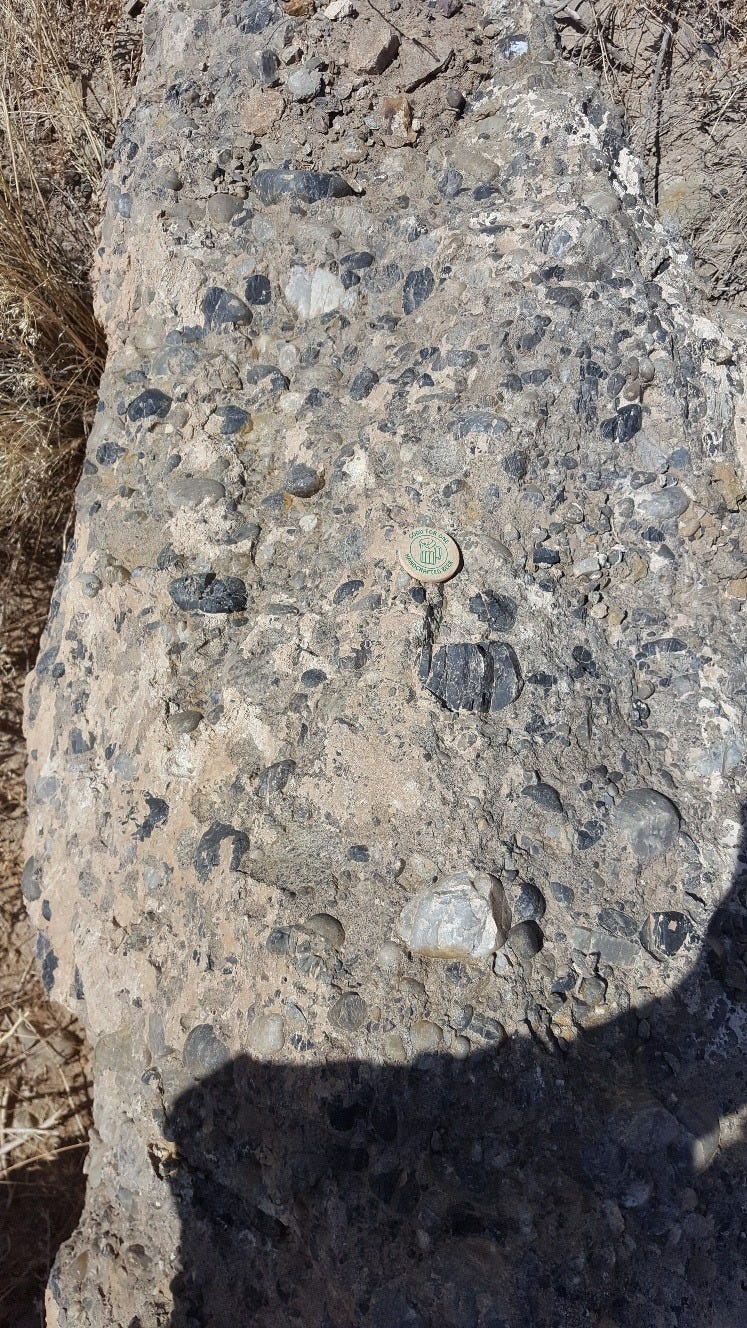
For comparison, here's a look at the Kootenai conglomerate along the Burma Road, east of Glen, Montana. There are perhaps more black clasts because the primary source of the pebbles in the Kootenai was the uplifting and eroding black Phosphoria chert. This rock is also quite poorly sorted, though it was almost certainly river-laid sediment.