
Clinochlore
Or chamosite

Life in the USA is not normal. It feels pointless and trivial to be talking about small looks at the fascinating natural world when the country is being dismantled. But these posts will continue, as a statement of resistance. I hope you continue to enjoy and learn from them. Stand Up For Science!
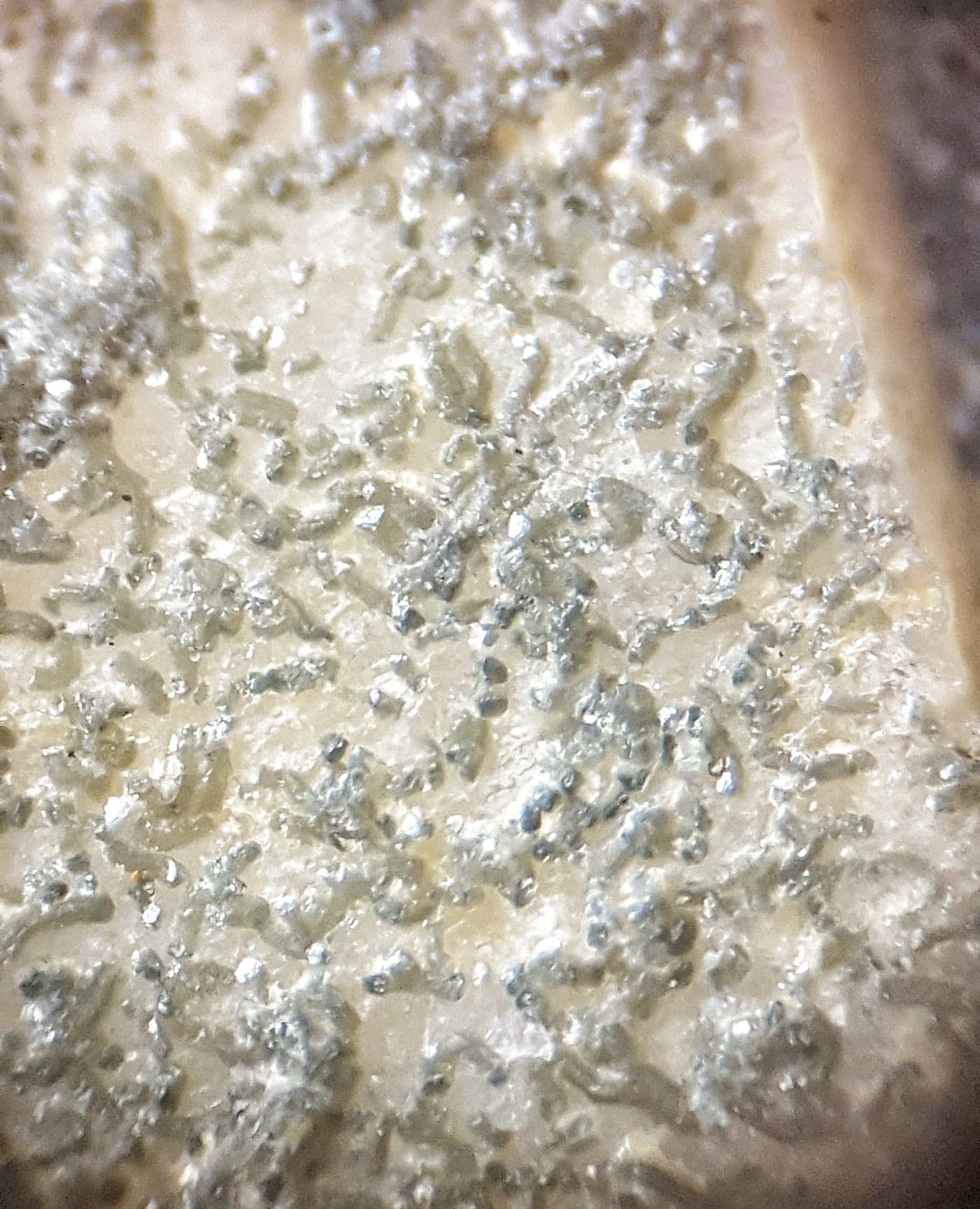
These little greenish worms are clinochlore, or at least somewhere in the chamosite-clinochlore series, more generally known as chlorite. Clinochlore is a magnesium aluminosilicate that’s pretty typical in low-grade metamorphic rocks. The worm-like elongate things are essentially long books of thin sheets parallel to each other, aligned to make the “worms.” The color variations from light to dark green may indicate differences in iron content.
Clinochlore is Mg5Al(AlSi3O10)(OH)8 and chamosite is Fe2+5Al(AlSi3O10)(OH)8. Without analysis, most geologists would probably just call this chlorite. Clinochlore was named in 1851 from Greek κλινειν klinein, “to incline,” referring to inclined optic axes visible in thin section, plus Greek χλωρο chloros, for “green,” its typical color. Chamosite’s name goes back to 1820, for the type locality Haut de Cry, near Chamoson, Valais, Switzerland.
The white substrate is the mineral meionite, Ca4Al6Si6O24CO3, the calcium end member of the scapolite group of aluminum silicates.
The rock is from an outcrop along the Pipestone-Delmoe Road east of Homestake Pass, east of Butte, Montana, USA, where the Butte and Rader Creek Plutons of the Boulder Batholith trap between them a zone of formerly sedimentary and/or volcanic rocks that were metamorphosed and metasomatized (which means there was chemical exchange) by their contact with the granites of the batholith. The zone, informally called the Screen, contains some interesting complex mineralogy because the chemicals in the rock were remobilized by the heat from the molten rock of the batholith about 76 million years ago.
We’ve visited the Screen in this previous post, and there’s some more information in my paper in Scarberry, K.C., and Barth, S., editors, 2018, Proceedings of the Montana Mining and Mineral Symposium 2017: Montana Bureau of Mines and Geology Open-File Report 699.