
Diamond
From Russia

Life in the USA is not normal. It feels pointless and trivial to be talking about small looks at the fascinating natural world when the country is being dismantled. But these posts will continue, as a statement of resistance. I hope you continue to enjoy and learn from them. Stand Up For Science!
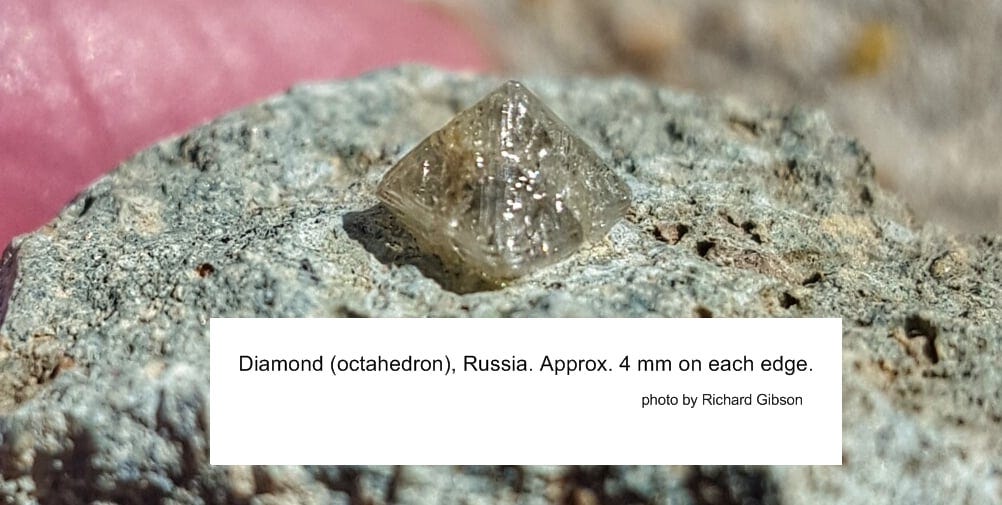
This diamond is 4 mm on each edge, probably equating to around a third of a carat or so. It was labeled only “Russia” when I acquired it in 1987, and it is glued to the matrix, but they did a pretty good job of it, and the rock looks sort of like kimberlite. The vast majority of diamonds in matrix offered for sale are glued on, so this was not a surprise to me even though I think the original purpose was to deceive. A diamond in matrix of this size and quality might be expected to be offered for 10 to 100 (or more) times the $50 I paid, but I think it was a fair price in 1987 even though that was the most I had ever paid for a mineral specimen at the time. It’s a nice little natural octahedron.
Russia is the world’s leading producer of natural, mined diamonds, with more than $4 billion worth in most years. That value is second to DeBeers (mostly producing from Africa) but by volume Russia leads with around 39% of world production (2024). Most of it comes from the Sakha Republic (formerly Yakutia) in northeastern Siberia, where dozens of mantle-derived kimberlite pipes are known. They formed mostly during Devonian time, about 355-360 million years ago (Ashchepkov and others, 2017, Geoscience Frontiers 8:4, p. 671).
The ultimate tectonic reasons explosive diamond pipes developed in this region during the Devonian is not clear, but it seems to relate to crustal thinning above a doming mantle. It might also be related to a rift in the continental Siberian craton called the Vilyuy Rift, a fracture system on the east side of the Siberian Craton that developed about the same time. That’s a failed rift – the continent did not break apart – but the associated faulting may have been extensive enough to help tap magmatic sources within the mantle.
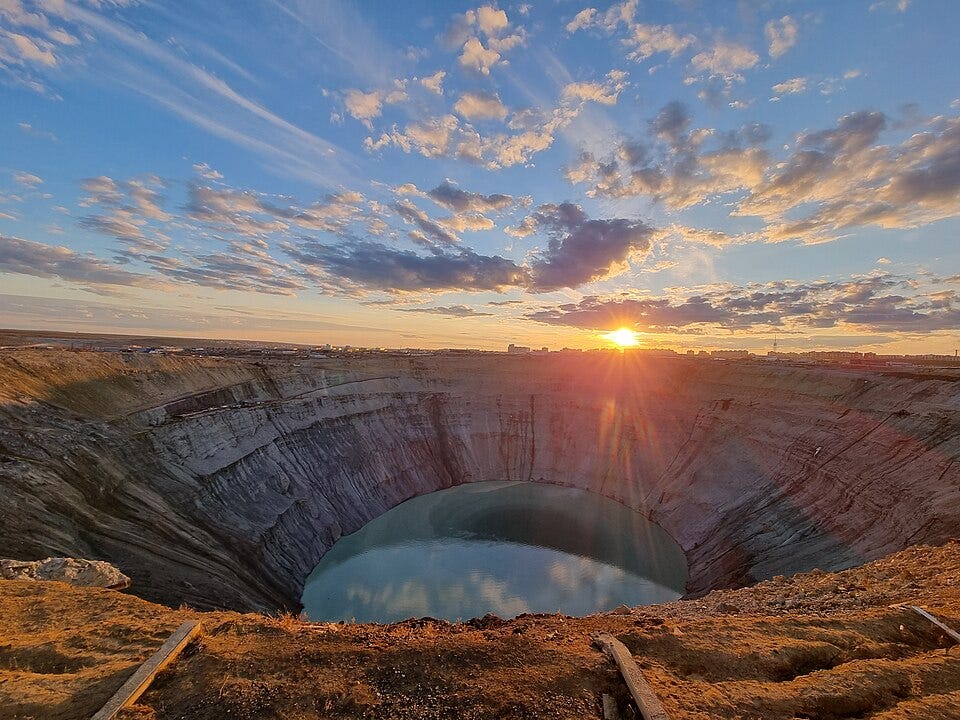
Diamonds were discovered at what became the Mir mine in 1955. It was the Soviet Union’s first developed diamond mine and became its largest, after open-pit mining began in 1957. The pit is more than 525 meters (1,722 ft) deep, and has a diameter of 1,200 m (3,900 ft). (Information from Wikipedia)
Most diamond mines today typically produce only 0.3 (the size of my specimen) to 5 carats per ton or less. A grade of 4 to 6 carats per ton would be considered excellent.
After Russia, the world leaders in natural industrial diamond production (by volume) are Botswana (20% of the world total) and Congo (17%). The other primary producers of natural industrial diamonds are all in southern Africa – South Africa, Zimbabwe, and Angola. But 99% of the industrial diamonds consumed in the world are synthetic, and China is the leader in synthetic diamond production and is the primary source of U.S. imports. In the US, the greatest use of diamonds (natural and synthetic industrial stones) is the highway construction business, where milling and other forms of abrasion and stone cutting use diamonds. Drilling for oil, natural gas, and mining also use diamonds in drill bits, and they are used for other cutting and polishing purposes as well as in computer chip production.
The US does produce gemstones of various types, but few diamonds, and total import dependency for all gemstones in the US is 99%+. India is the main supplier to the US of gem diamonds (47% of imports), followed by Israel, 26%, and Belgium, 11%, both of which ship stones they have imported from other sources, mostly Africa.
I think the only in-situ places in the conterminous US where diamonds are known are the Crater of Diamonds in Arkansas (rare gem-quality stones have been found) and the State Line District along the Wyoming-Colorado border in the Laramie Mountains (mostly small, but one yielded a cut stone of almost 17 carats, the largest faceted diamond from the U.S.). And one microscopic diamond was found in rock southeast of Lewistown, Montana, in 2004 (Ellsworth, P.C., 2000, Homestead kimberlite: New discovery in central Montana: Guidebook of the 25th Annual Tobacco Root Geological Society Field Conference, p. 14–20). Diamonds have also been found in the glacial drift across the Midwest, in Indiana, Michigan, Wisconsin, and elsewhere. They were carried from Canada by the glacial ice.
About 1993, I did a proprietary interpretation of high-resolution aeromagnetic data in the Shelby, Montana, area, for diamond exploration, totaling 35,213 line km (21,832 line miles). Although several features were identified that are very likely kimberlite pipes, all were at depths of more than 500 meters, making them uneconomic even if they did turn out to be diamond-bearing.
And now, the weather report for Detroit, Michigan, 22,000 years ago. The ice sheet is anticipated to move only slightly, but the Detroit area will remain completely buried for at least a few thousand years more. There will be no weather at ground level to speak of.
I was lucky to see the Colorado 17 carat diamond on display in a jewelry store back in the 1980's. I believe there were some non-gem stones also displayed. I have a hand specimen of the Kelsey Lake pipe kimberlite; interesting rock but no diamonds.
My mineralogy final exam was on a kimberlite diamond thin section from Wisconsin. Fun memories!