
Drain Oregon
Not an imperative!

Life in the USA is not normal. It feels pointless and trivial to be talking about small looks at the fascinating natural world when the country is being dismantled. But these posts will continue, as a statement of resistance. I hope you continue to enjoy and learn from them. Stand Up For Science!
The Bear Creek Quarry at Drain, Oregon, produces basalt for crushed rock for road surfacing, but it’s famous as a collecting locality for zeolites. The zeolites occur in cavities in basalt flows of the Paleocene to Eocene Roseburg Formation which is about 55 million years old.
The town of Drain is in the southern Oregon Coast Ranges, and this basalt is not part of the well-known but much younger Columbia Plateau Basalts, which are mostly 17 to 15.5 million years old. The Roseburg basalt didn’t even start out as part of North America. The basalt includes pillow lavas (erupted underwater) and interfingers with rhythmically alternating sandstones, mudstones, and siltstones that were probably deposited by turbidity flows. All this suggests that the rocks, both lavas and sediments, were deposited in a relatively deep-sea environment.
The setting was probably a small area of land with a steep continental slope. The accretion, or addition, of various materials including some oceanic crust, deep-sea deposits, and sediments in the accretionary pile ended up as significant parts of the Coast Ranges. The Umpqua Group, which includes the Roseburg Formation and others, is 5,000 to 10,000 meters (16,000 to 33,000 feet) thick (Perttu & Benson, 1980, Deposition and deformation of the Eocene Umpqua Group, Sutherlin area, southwestern Oregon: Oregon Geology 42:8).
The basalts and other rocks of the Roseburg formation were erupted and deposited about 55 million years ago, and the Siletz terrane of which they were part was accreted to the North American continent within a few million years after that, mostly by about 49 million years ago. Elements of the Siletz and related Crescent Terrane extend from Vancouver Island, Canada, to Cape Blanco in southern Oregon. The origin of the Siletz-Crescent Terrane is poorly understood; it might have been an offshore island arc fragment, maybe something like the island of Sumatra today, or possibly an oceanic igneous province similar to the modern Hawaiian chain. Its amalgamation with North America is about contemporary with major tectonic plate reorganizations in the Pacific region.
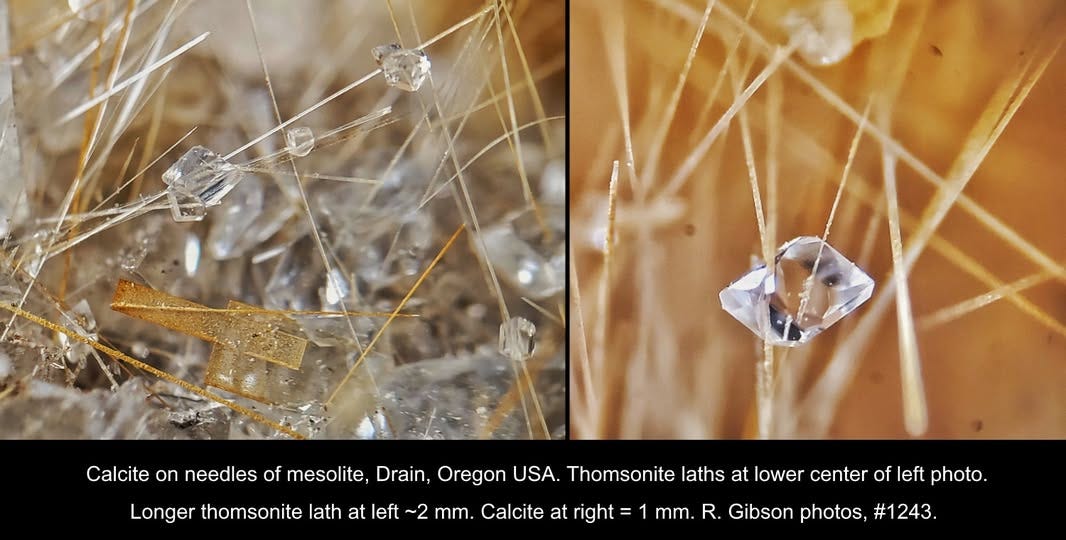
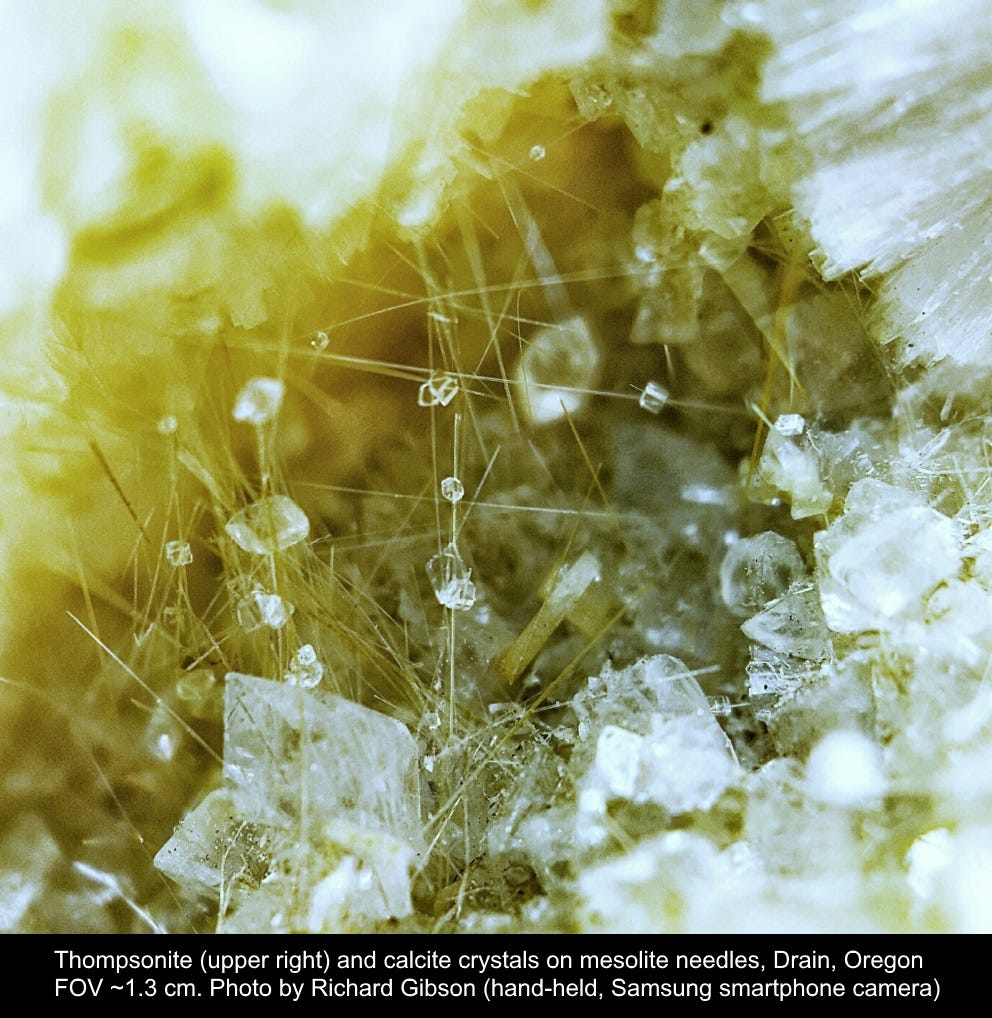
The water-clear calcite crystals in my photos grew on needles of the zeolite mesolite, Na2Ca2Si9Al6O30 · 8H2O, which in turn occupy a cavity lined by radial balls of thomsonite, NaCa2[Al5Si5O20] · 6H2O. Only a few laths of thomsonite are visible here, and they are later than the cavity-lining thomsonite. Both the thomsonite laths and some of the mesolite needles are colored slightly by a light coating of brownish hematite.
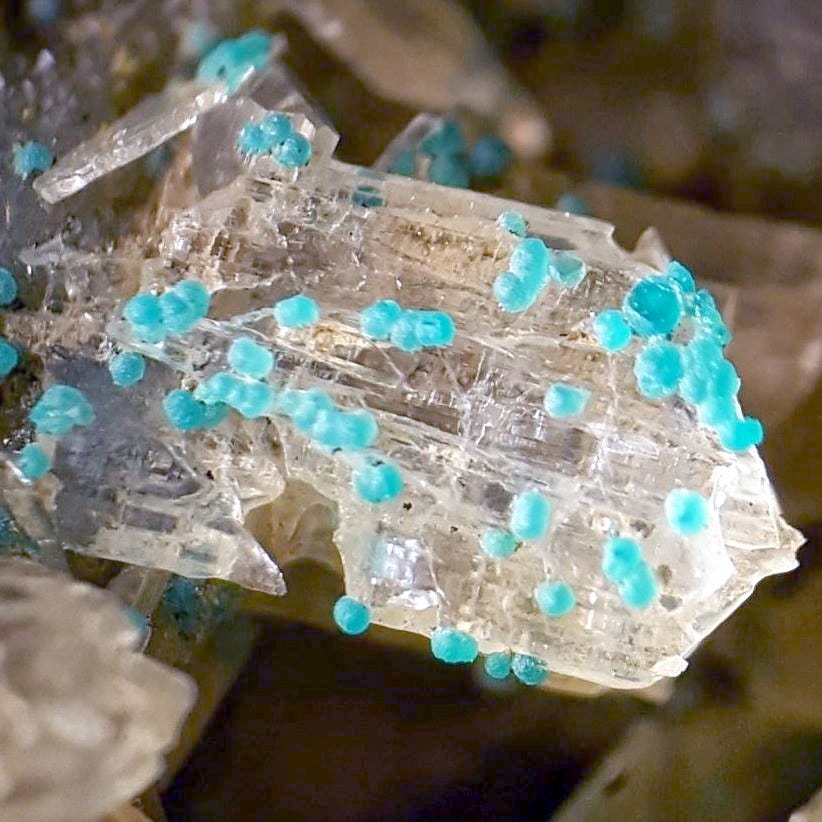
The town of Drain was named for its founder, Charles J. Drain. The Bear Creek Quarry was discovered as a collectible locality by Al McGuinness in the 1950s. He’s the namesake of mcguinnessite (below) and spent time in Butte as a dealer.
Very interesting, as I live a couple miles from the Oregon border. Although I feel surrounded by the great basalt flows of the Columbia Basin Group and Hood and St. Helens on the eastern horizon, there is all this accreted terrain. I have seen/heard a few studies that Siletzia is still involved in some rotation, which is why Mt. St. Helens is not in line with the other Cascades volcanoes, and why the Boring volcanic field is recent and so far west of the line of classic" peaks.. All the little "buttes" of east Portland are cores of those small, temporary cones. Much to study.