
Galena
Lead Ore

Life in the USA is not normal. It feels pointless and trivial to be talking about small looks at the fascinating natural world when the country is being dismantled. But these posts will continue, as a statement of resistance. I hope you continue to enjoy and learn from them. Stand Up For Science!
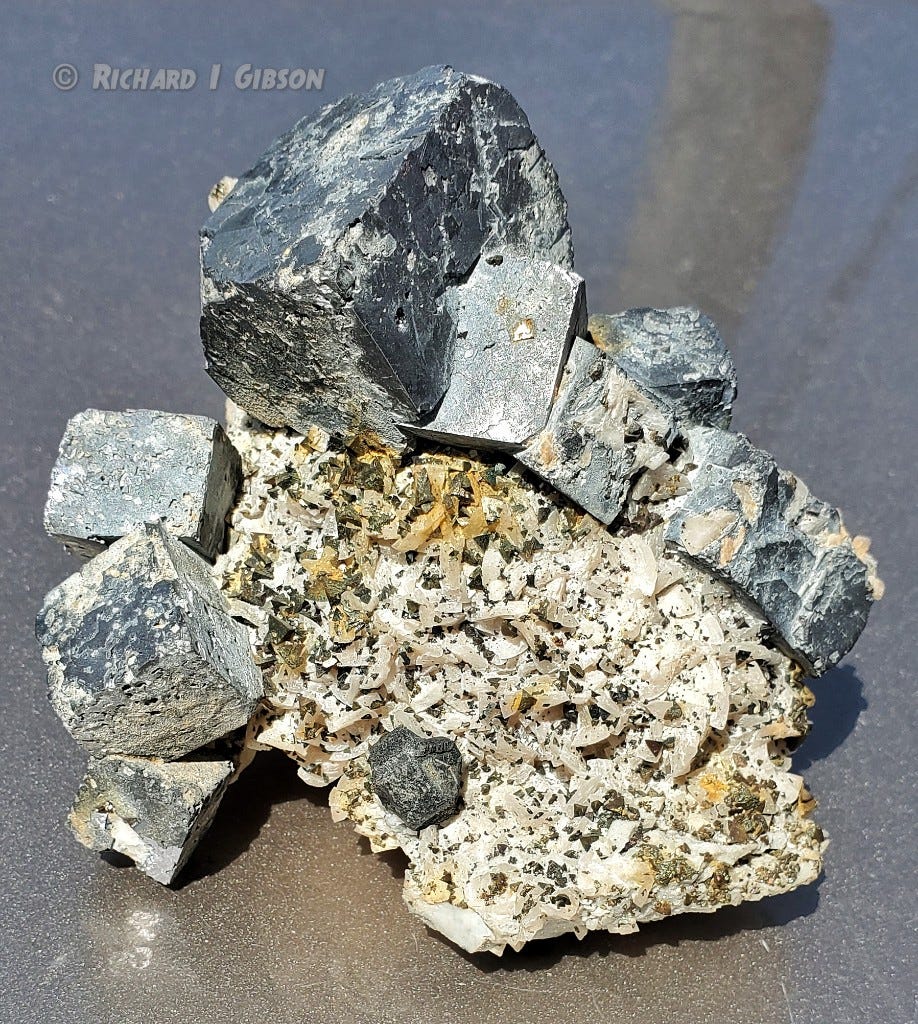
Galena, lead sulfide, is the primary ore of lead. Native lead exists and looks a lot like galena, but it is softer, malleable, and lacks galena’s distinctive cubic cleavage.
Even though lead ranks #36 in abundance of the elements in Earth’s crust, lower than zirconium or gallium or rare-earth elements like lanthanum and niobium, lead and sulfur are reactive enough that they often form galena, which in turn makes common metallic mineral deposits. Lead was smelted from galena in what is now Turkey about 8,500 years ago – probably not to get lead, but to isolate the silver that was typically associated with it. By Roman times, it was cheap and readily available and was in common use for water pipes. Latin plumbum for lead gives us the word plumbing and lead’s chemical symbol, Pb.
Galena is usually one of the minerals students learn in their first geology classes. It’s heavy, and the lead-gray to silvery-gray (on fresh surfaces) color and sharp cubic cleavage make it easy to identify.
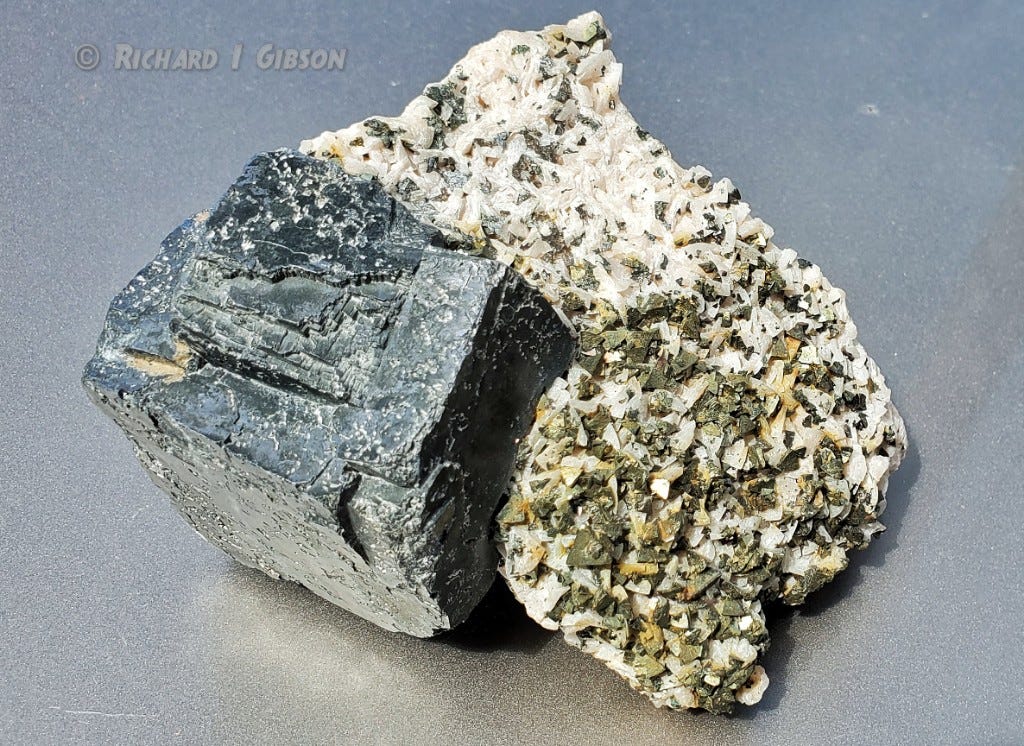
My two specimens here are from the Tri-State District of the US, around the common corner of Kansas (near the town of Galena), Missouri, and Oklahoma. This area was historically one of the greatest producers of lead and zinc, extending from the 1850s to the late 1960s-early 1970s.
The deposit is a Mississippi-valley type deposit in which the ores have migrated in hydrothermal solutions, typically brines, that often originate in deep basins heated by underlying magmatic sources. The mineralized fluids migrate through porous rocks, or along conduits such as fault zones, until they reach conditions of temperature, pressure, and host rock that allow minerals to precipitate. This often happens on the flanks of a regional uplift adjacent to the brine-bearing basin. For the Tri-State District, that regional uplift is probably the Ozarks in Missouri.
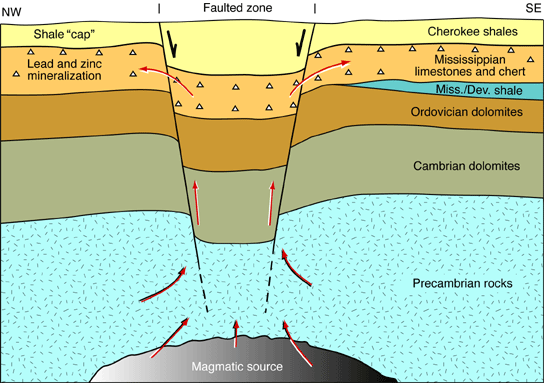
Today, the Tri-State District is being reclaimed as multiple Superfund sites, but Missouri is still the leading producer of lead in the US, from the Viburnum Trend on the other flank of the Ozarks in southeastern Missouri.
Together with Alaskan production (where lead is a byproduct of zinc mining) and Idaho (a byproduct of silver mining), the Missouri lead contributes to make the US the 4th leading lead miner in the world, approximately in a 5-way tie with Peru, Russia, India, and Mexico, each producing about 4% to 6% of world lead. As usual, China leads with 42% and Australia is #2 with 11%.
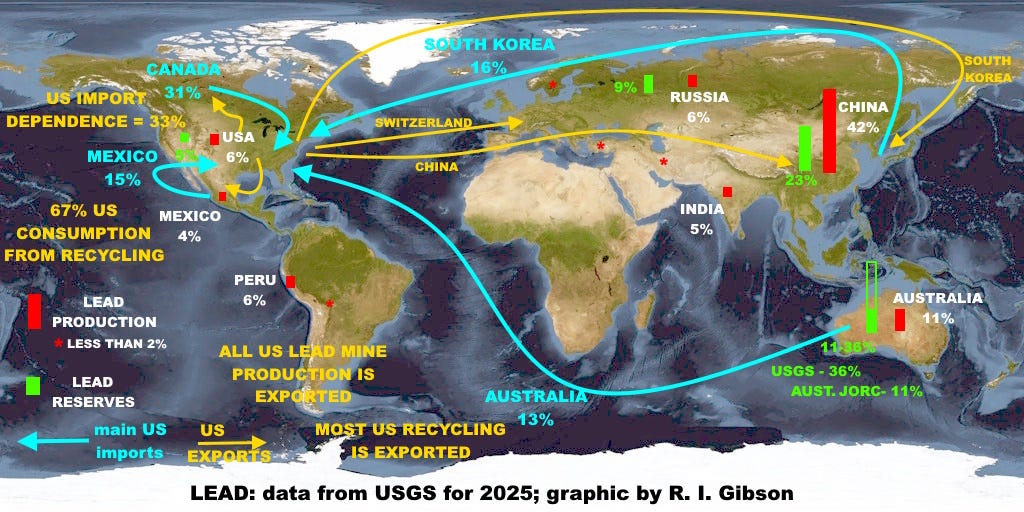
Almost all US lead mine production is exported, because the US has not had an operating lead refinery since 2013. Export destinations for the ore and concentrates include China, South Korea, Canada, Switzerland, Mexico, Japan, and Australia. Their refined product comes back to the US as part of a 33% reliance on imports, mostly from Canada, South Korea, Mexico, and Australia. The other 67% of US lead consumption comes from recycling.
China and Australia control most of the world’s lead reserves. On the map above, differences in Australia’s reserve number reflect two estimates: USGS at 36% of world reserves, and Australia’s more conservative Joint Ore Reserves Committee at 11%, based on a higher grade than the USGS number.
The primary use of lead is in lead-acid batteries for vehicles, on the order of 88% of total consumption. Recycling those batteries is a big part of the lead industry; US recycling consists mostly of exporting more than 30 million lead-acid batteries per year to the countries listed above. This makes for a complex global movement of lead ores and the metal: Mined and recycled material are exported from the US and other producers, refined in other countries along with their own mine production, then imported to the larger consumers, the US and China, to make more lead-acid batteries.
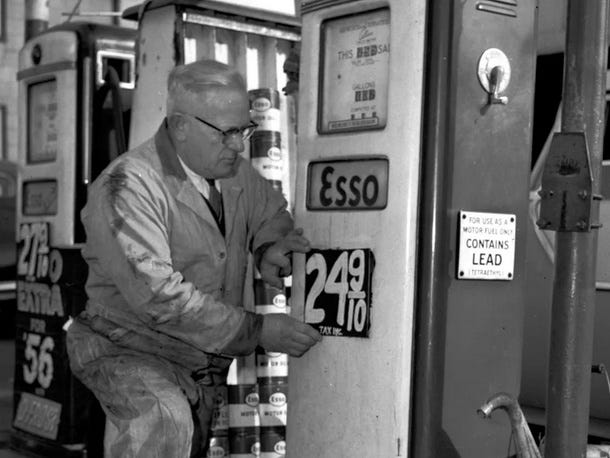
Other small uses for lead include ammunition, solders, and in glass and ceramics. One historically large end use, lead in gasoline, has been eliminated because of the negative health and environmental effects it caused. Algeria was the last country to ban leaded gasoline, in 2021. Another historical use that has diminished is lead in glass for cathode-ray tubes (as in old televisions) to block x-rays.
Just last week was inspecting galena and dozens more at the lead mining museum Wanlockhead, 18th century mines at Scotland's highest village. Slate roofs here feature lead flashings and Drumlanrig Castle features lead roof and rainwater gutters.
Back in grad school at KU, a bunch of us took a weekend to explore the old Tri-State district. There was one mine operating as a tourist attraction. We told the guy we just wanted to collect, not do a tour, so he sent us down in a metal cage and turned us loose. I collected several boxes of galena/sphalerite/chalcopyrite/dolomite specimens that look exactly like the one in your picture. The pillars (room and pillar method) were the best for collecting. As you can imagine, they had been whittled down by years of collecting. You could not pay me to go down there again at my current age.