
Gypsum from Saudi Arabia
with oil

Life in the USA is not normal. It feels pointless and trivial to be talking about small looks at the fascinating natural world when the country is being dismantled. But these posts will continue, as a statement of resistance. I hope you continue to enjoy and learn from them. Stand Up For Science!
The desert sands of Saudi Arabia are noted far more for their immense reserves of oil than for collectible minerals, but there are some of the latter.
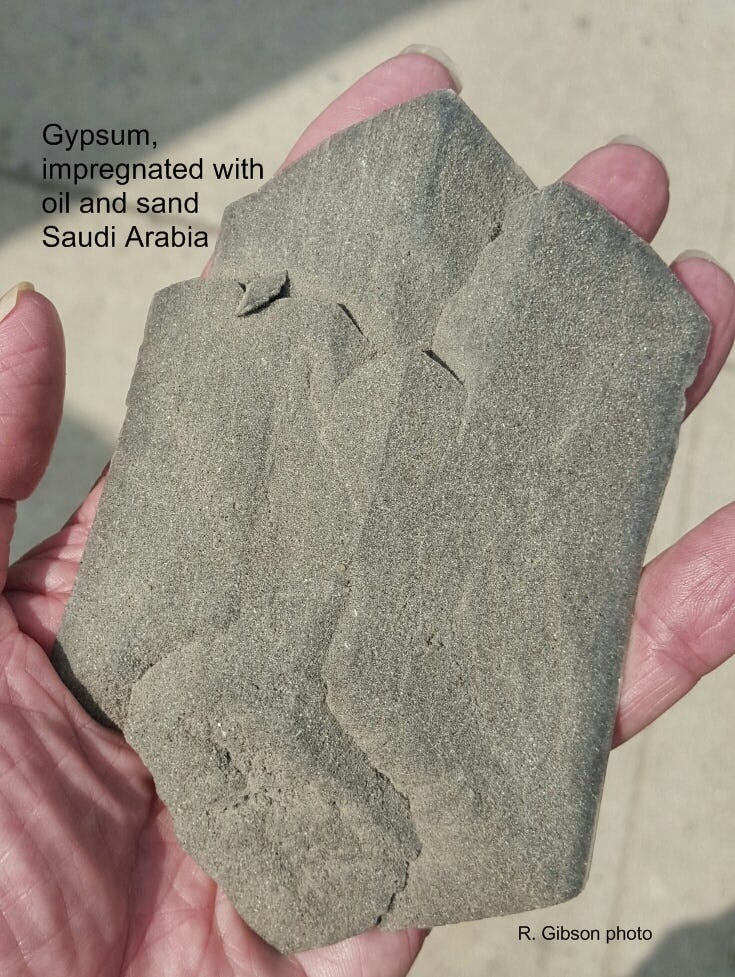
The specimen above is a large sharp crystal of gypsum, CaSO4·2H2O, a common enough mineral. But this one is gray-black because it is impregnated with sand and oil. It’s from the Dhahran area of Saudi Arabia’s Eastern Province (sometimes specified as Mintaqah Ash Sharqiyah) and was given to me in 1980 by my friend Linda Mussehl, who was working with Aramco at the time.
It’s likely that Linda’s specimens ultimately came from the same 1978 discovery reported by Rock Currier on MinDat, where he quoted Grieger's mineral and lapidary store in Pasadena, California, as saying “an engineer on assignment discovered an underlying black sand strata in an active tidal flat where desert roses were still forming....in oil bearing sands and taking on the rich charcoal color of oil." Grieger’s reportedly bought the entire discovery, but other pieces have appeared over time, and some certainly were still available in Dhahran where Linda got her specimens.
The salt flats of the Persian Gulf area are famous as sites for deposition of evaporite minerals such as halite and gypsum. The Arabic word sabkha, for these mud- and sandflats, has become a technical term in geology for such settings in the geologic past. I discussed similar salt flats in connection with an earlier post on Pecos Diamonds.
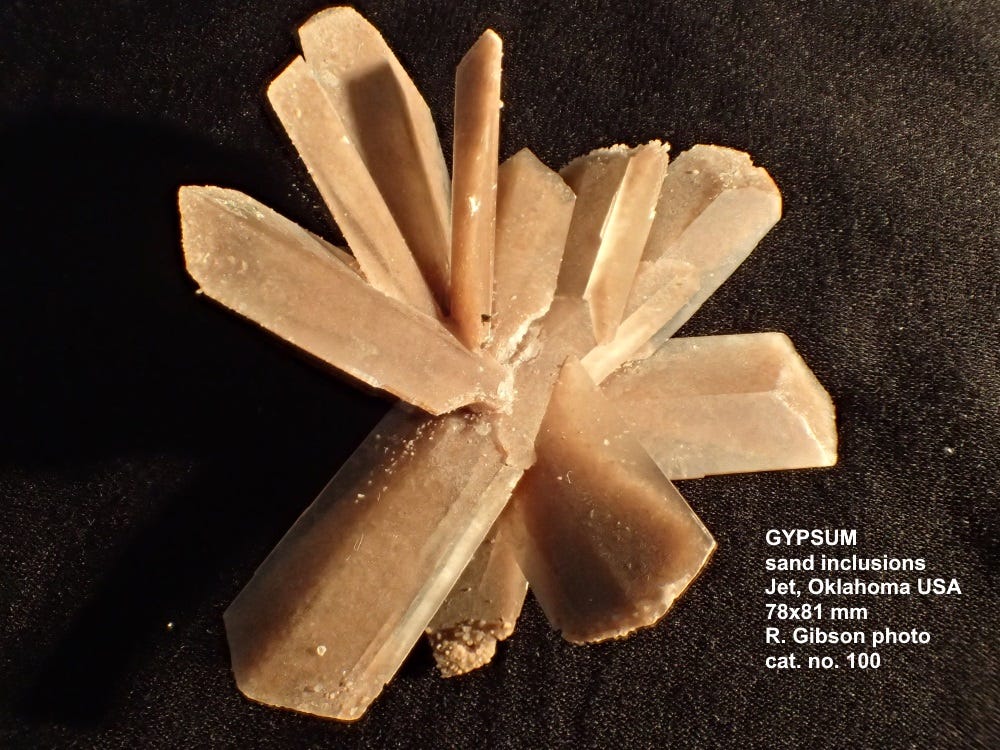
Because gypsum grows in suspension in the mud/slurry as its water evaporates, often enough you find their crystals as complete floaters, with no points of attachment, as with many of the gypsum crystals from Jet, Oklahoma, where the inclusions of sand and mud give a brown color to the gypsum, as in the cluster above. They often show classic hourglass-shaped inclusions related to the crystallography of gypsum.
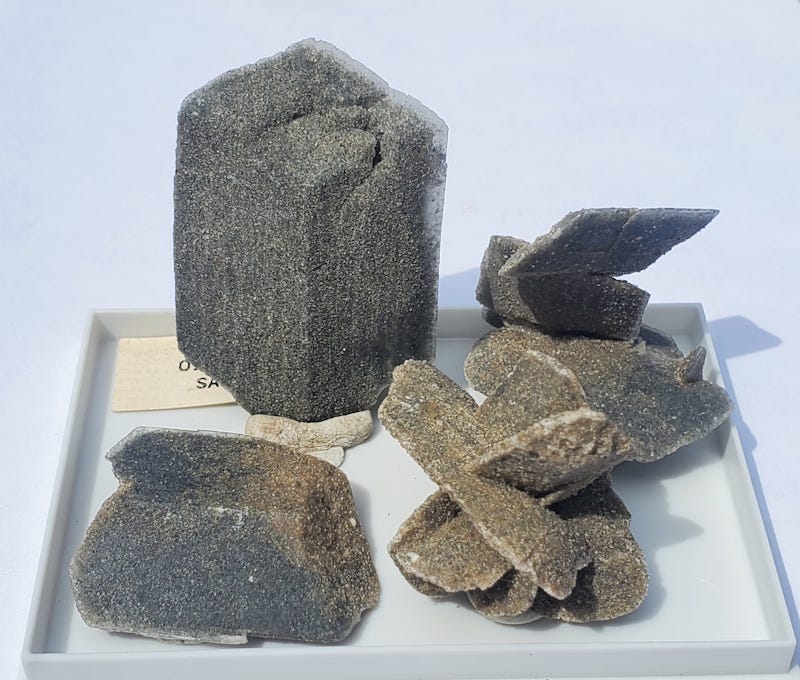
Clusters of gypsum also form in the sabkhas of Saudi Arabia. The smaller crystals above show both individual floaters and some combined crystals.
Cat. No. 135.
I had forgotten all about that! I still have some desert rose samples around here someplace. Also, a two foot sample of drill core, polished and drilled for use as a table lamp, a geode that looks like a human head. Strange, the stuff you pick up along the way.
We had students bring back sand crystals of gypsum from Desert Storm. They turned up when they dug earthworks. Did not notice any petroliferous material.