
Huanggang
The yellow hill

Life in the USA is not normal. It feels pointless and trivial to be talking about small looks at the fascinating natural world when the country is being dismantled. But these posts will continue, as a statement of resistance. I hope you continue to enjoy and learn from them. Stand Up For Science!
In technical geologic and tectonic terms, Inner Mongolia is a mess. It’s been collided, extended, intruded, and extruded so much, with an overprint from the relatively recent collision with India thousands of kilometers away, that it’s an area at the forefront of detailed tectonic understanding. Chinese scholars are driven by the presence of many diverse economic mineral deposits.
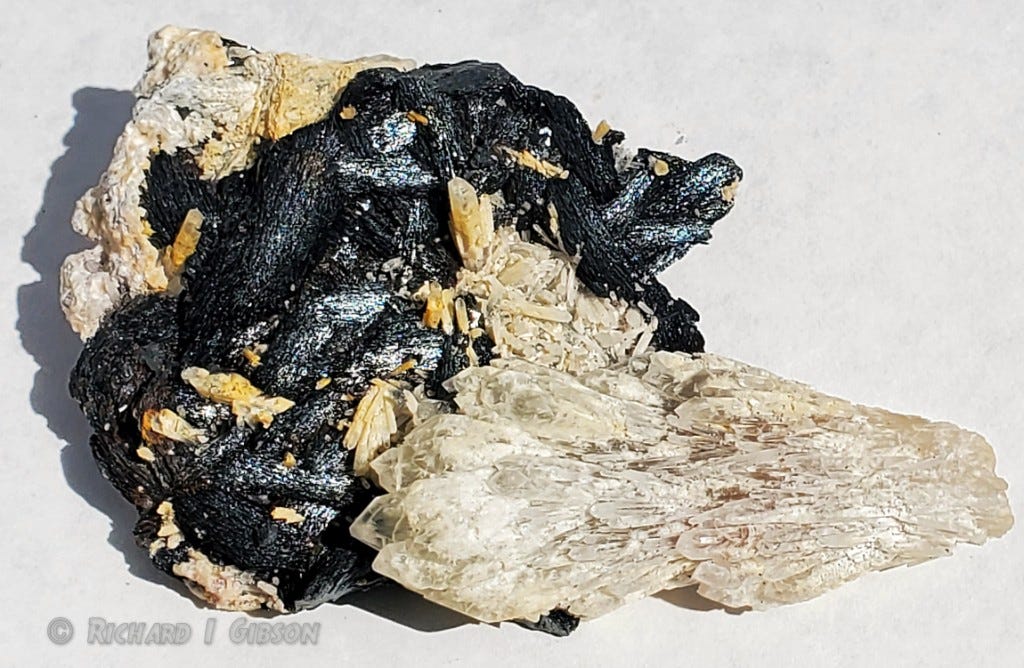
There’s more than one Huanggang in China. The name means “yellow hill,” of which there are probably plenty in China, with iron oxides coloring the surfaces. My specimen at the top of this post is from the one in Inner Mongolia, northeast China, home to an important iron-tin deposit.
Huanggang is famous with collectors for its fluorite, ilvaite, andradite, and arsenopyrite. The hematite in my specimen would probably be counted among the ore. The deposit is a skarn, affected both by metamorphism (heat and pressure) and by metasomatism (exchange of chemicals between country rock and intrusive rock). The age of the granitic intrusive and the mineralized skarn is about 132 million years, Early Cretaceous time (Xue and others, 2025, Ore Genesis of the Huanggang Iron-Tin-Polymetallic Deposit, Inner Mongolia: Constraints from Fluid Inclusions, H–O–C Isotopes, and U-Pb Dating of Garnet and Zircon: Minerals, 15(5), 518. https://doi.org/10.3390/min15050518). The country rock is mostly Permian sedimentary rocks, much of it now metamorphosed to marble.
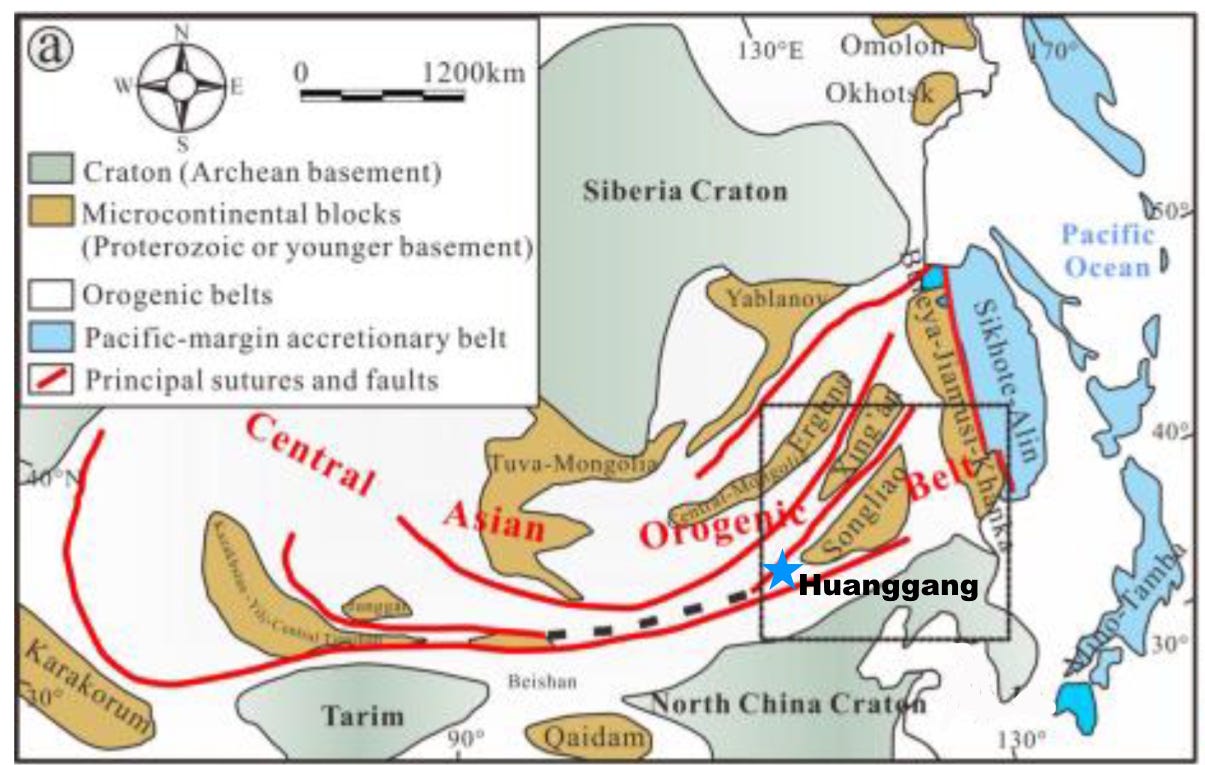
The igneous and tectonic activity that produced the Huanggang and many other mineral deposits in Inner Mongolia was ultimately related to a complex collision called the Central Asian Orogenic Belt. It represents an amalgamation zone more than 1,000 km wide between the dominant Siberian and North China Cratons. The zone includes many smaller terranes (called “microcontinental blocks” on the map above) separated from each other by regional fault systems that undoubtedly contributed to the fluid movements that produced the mineral deposits. The Central Asian Orogenic Belt has a very long history of deformation extending back at least to Carboniferous-Permian time (300 million years ago) with later major activity in the Early Cretaceous (132 million years), giving rise to Huanggang and dozens of other mineral deposits.
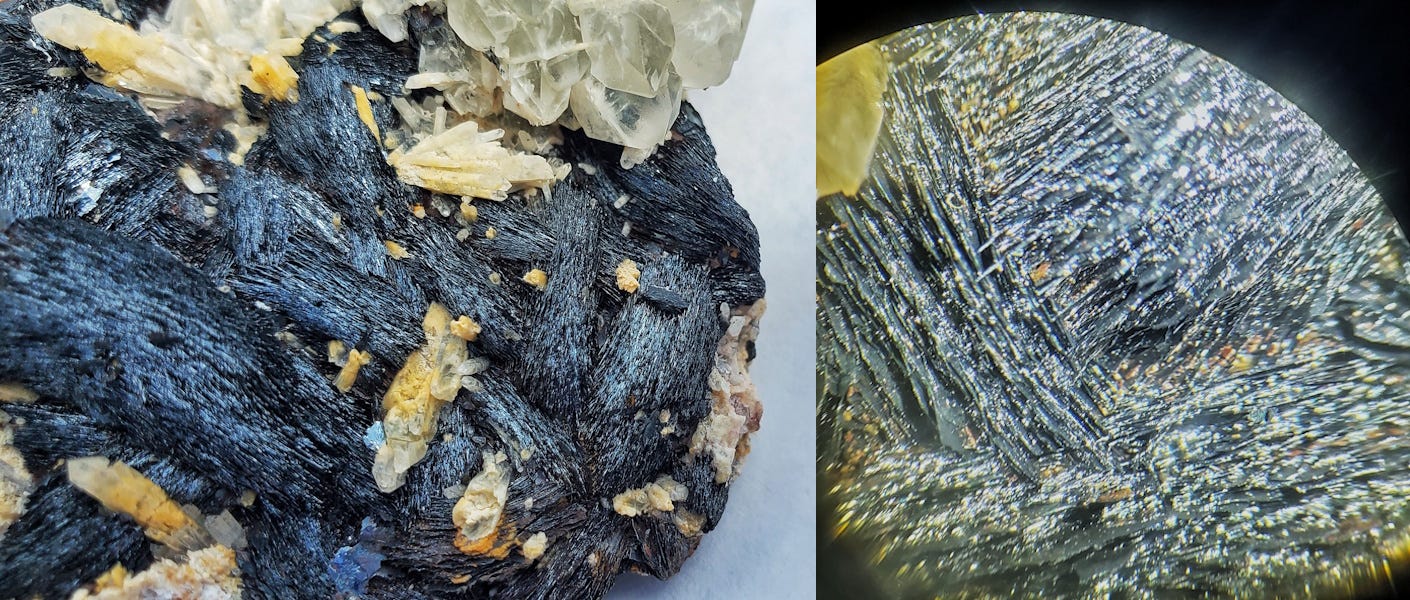
The hematite (iron oxide) in my specimen shows hundreds of stacked plates of hematite which together make rounded aggregates that are steely blue-black in color. The associated quartz forms a sheaf-like group with a very pale purplish tint in parts.
China is the #4 leading miner of iron ore in the world, after Australia and Brazil and just slightly behind #3 India (the US ranks tenth in iron ore mining). Much of the iron production from Australia, Brazil, Canada, the US, and elsewhere is from banded iron formation, mostly just iron oxide and quartz. China’s iron deposits are polymetallic, enriched in a wide diversity of metals including copper, lead, zinc, silver, tungsten, tin, rare-earth elements, and more, making them much more than simple iron deposits.
Nice description Steve. China also has giant REE deposits in clay, which i guess is easier to extract from than other sources. Is it harder to separate REEs from iron deposits?
If you do all the research, and write a grologic column on it, id be happy to lazily read it, and even comment!
Lol
Er, not Steve, I mean RICHARD.
SORRY
But Steve write cool stuff too...