
Hyaloclastite
Or something else

Life in the USA is not normal. It feels pointless and trivial to be talking about small looks at the fascinating natural world when the country is being dismantled. But these posts have been scheduled for over a month, and they will continue, as a statement of resistance. I hope you continue to enjoy and learn from them.
One of the best parts of being an old, moderately experienced geologist is the fact that there’s always more to see – in the wide world, of course, but even in my own backyard (or in this case, 14 miles from my backyard at a place where I regularly ride my bike). But "The best geologist is the one who has seen the most rocks," according to H. H. Read (1940), so we keep trying.
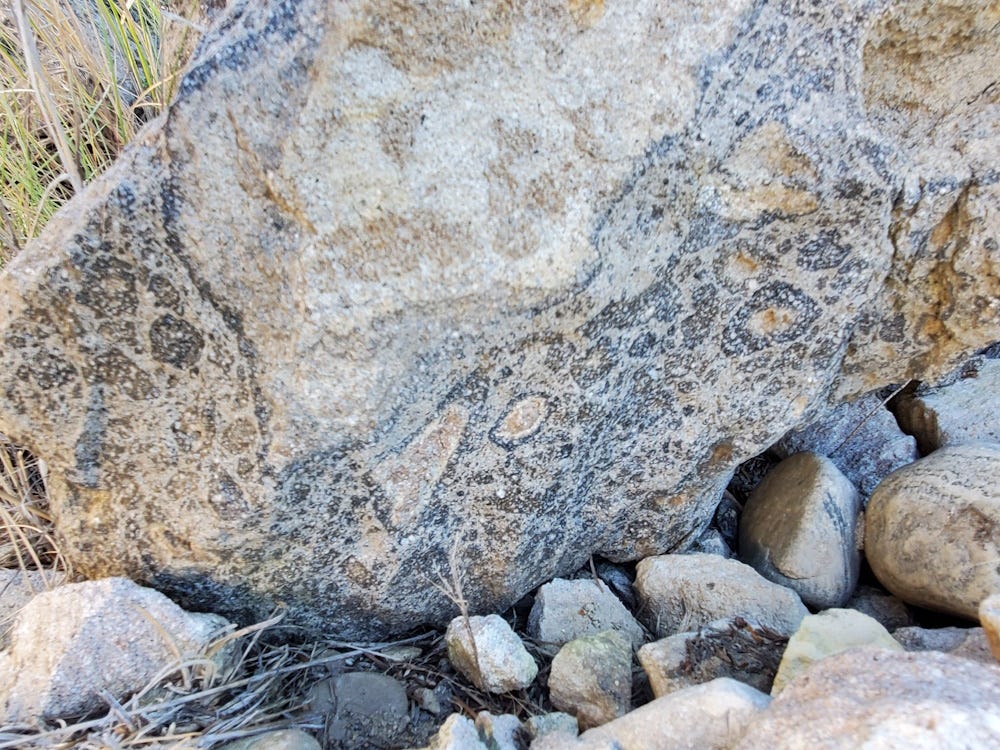
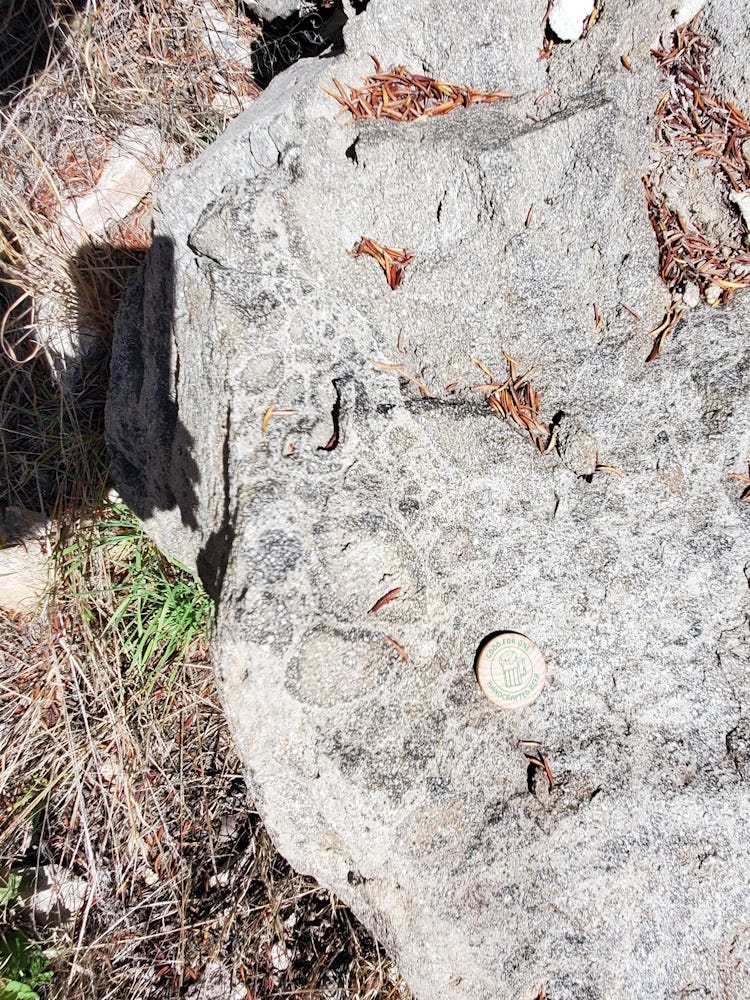
This weird rock is from the Lowland Creek Volcanics, which I’ve previously posted examples of, perhaps ad nauseam. It’s from along Silver Bow Creek, south of Gregson Station on the Greenway trail near Fairmont, Montana USA. It caught my attention because I’d never seen anything like it (well, orbicular granite is sort of like it, but this is REALLY far from being granite). The token in the photos is about 4 cm across.
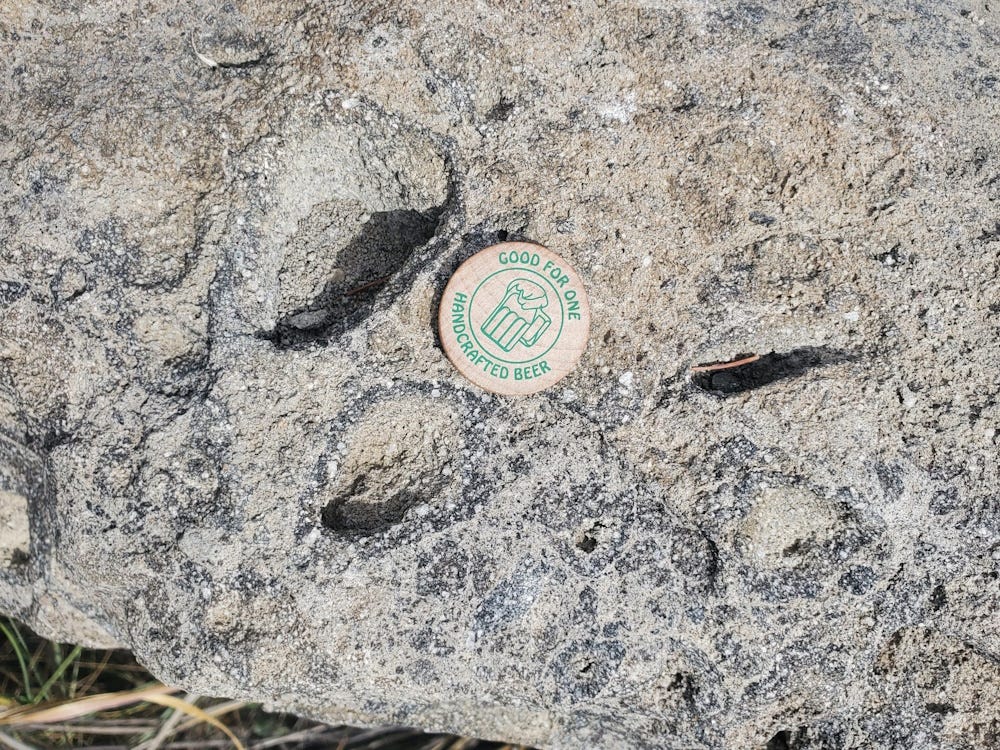
So first, what is it (meaning what is it made of)? You can see chunky little white crystals; the standard first guess would be quartz or feldspar for those. They are set in a gray to black matrix, something hard, that forms a sub-circular rind around a core of material that clearly weathers out more easily than the rest of the orbicules. The “orbicules,” relatively round bodies from about one centimeter to maybe 8 cm across, are set in a broader matrix of fine-grained, light-colored angular material.
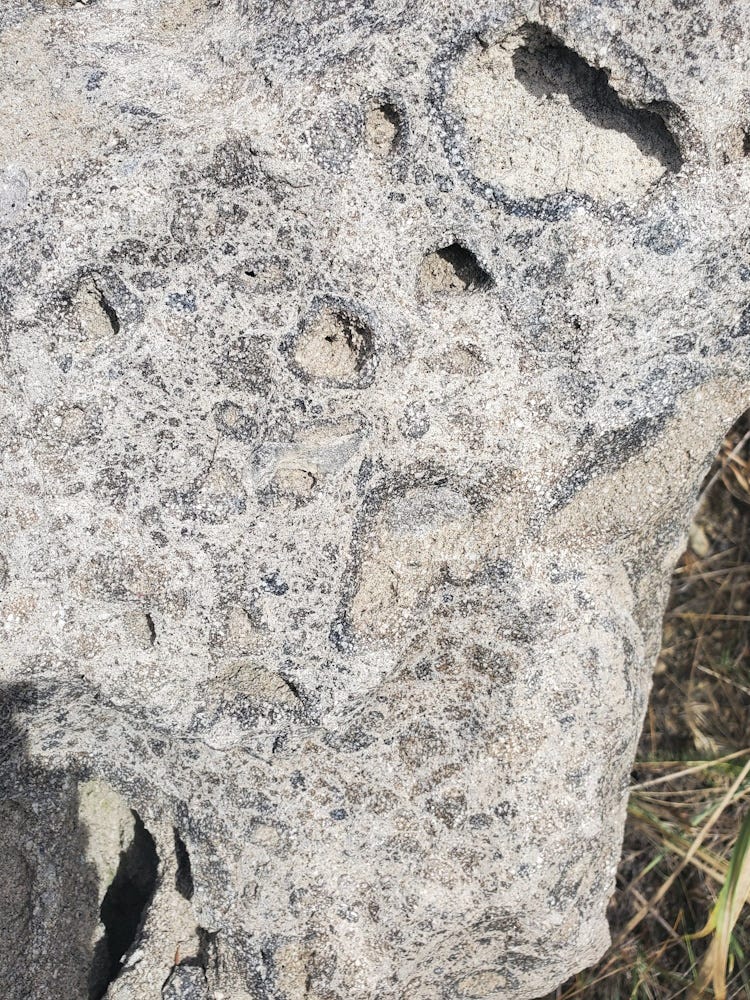
I’m pretty certain the gray matrix of the orbicule rims is glass, obsidian. That’s based on it being optically isotropic, black in crossed polarized light. I don’t have a polarizing microscope (they cost thousands of dollars) but I do have a binocular microscope and two pieces of polarizing film. I pulverized some of the rock; the pieces of crystals show the kinds of optical patterns typical of quartz (I won’t rule feldspar out completely, but they did not look like that to me). The gray matrix is transparent in normal light but black with crossed polarizers, indicating it to be isotropic. There are some minerals that are optically isotropic; garnet is a common one, but this is certainly not garnet, and since it is a volcanic rock, glass is the most likely composition. That make the orbicules, or at least their rims, vitrophyres, porphyritic glass.
One possibility might be that the rock is glassy slag, man-made from a smelting process, but the first piece I found is big (a couple meters across) and while it was clearly positioned where it sits as a landscaping rock, it’s doubtful if it is slag. Later I found two more big pieces a couple miles upstream, in positions that look like they fell from outcrops of the Lowland Creek Volcanics. So I’m confident it’s not slag.
So we have orbicules with crystal-rich obsidian rinds surrounding something more easily eroded, all in a broader matrix of light colored fine material. How they formed is more challenging, to me at least.
Visualize a volcanic eruption, explosively spattering blobs of semi-molten magma into the air. Think of the magma as molasses in January with granola mixed through it – the granola is the quartz crystals that have already crystallized, with the molasses starting to solidify but not there yet (and still relatively hot).
When the hot magma explodes into the colder air, the outside of each blob should quench, solidify almost instantly. When that happens, there isn’t time for the material to grow into mineral crystals, and you get amorphous (non-crystalline) glass, obsidian. The insulated inside of the blobs would take a little longer to cool, and might retain more of its volatiles (water and gases) long enough so that the interior had a slightly different (and less stable) composition and texture from the glassy rinds, so the interiors, once exposed to the atmosphere much later, would weather out differently, producing the void spaces in the cores of the orbicules.
An alternative that is maybe more likely is that the hot mushy blobs of spatter fell into either water or wet sediments. Such volcanic rocks are called hyaloclastic (from words meaning broken glass) because the shock of contact with water shatters the magma blob as it quenches, like a glass of very hot coffee set into ice water: if the temperature difference is great enough, the glass may crack or shatter. Broken glass shards are a hallmark of hyaloclastic rocks (they’re common in Iceland, where volcanoes erupt under glaciers), and while shattering might be here but invisible using my microscope, I don’t see any such shattering and the orbicules themselves are certainly nice and round-ish, not apparently shattered.
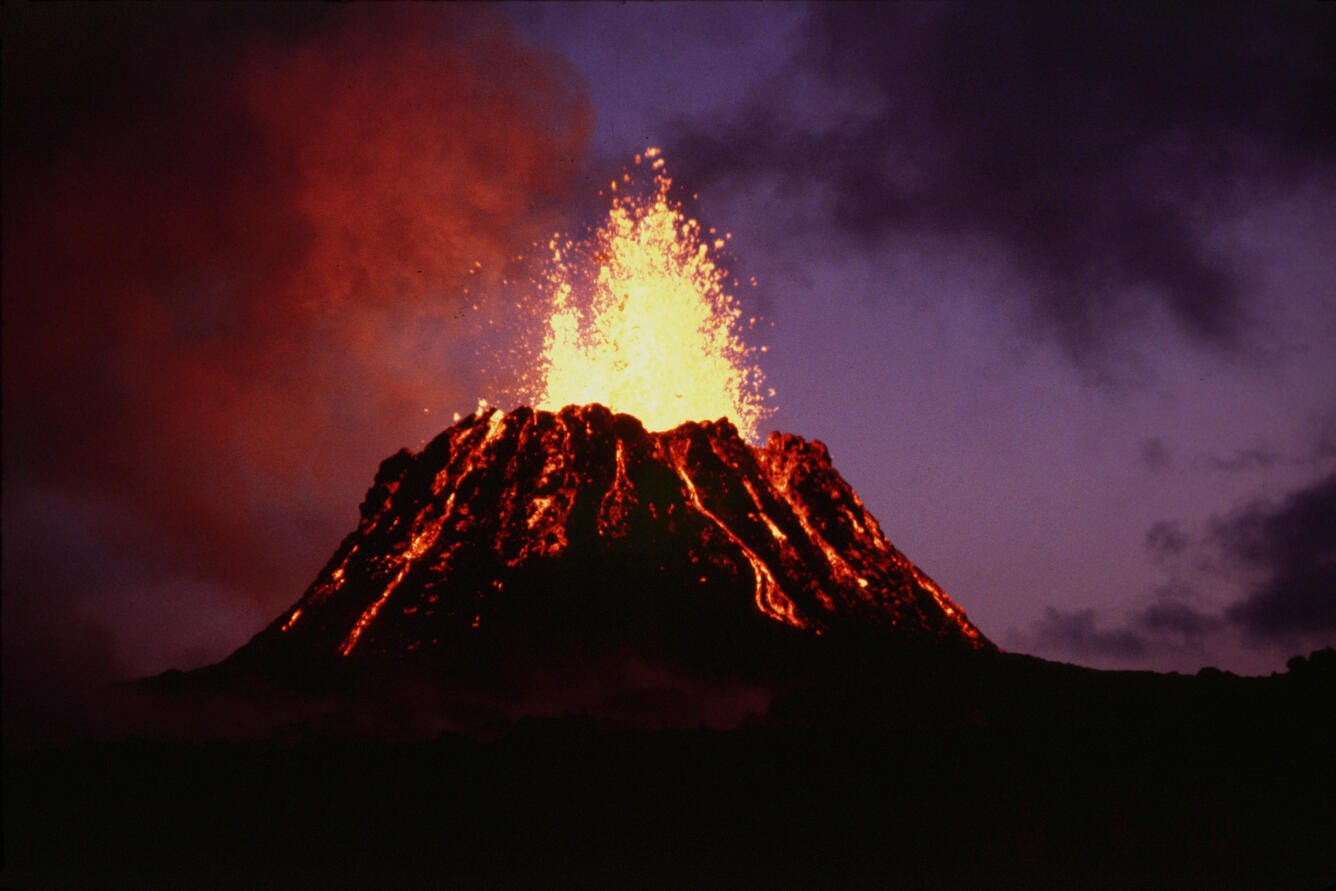
So another possibility is that the blobs of spattered magma fell into wet sediment, and the temperature differential was just right to quench the outer rind of the resulting orbicules but not enough to shatter them. A special case, but then rocks like this are not really that common. The wet sediment might have been previously erupted ash, which might still have been somewhat warm. Such as I can tell, the matrix around the orbicules does look like some kind of ashy material (solidified volcanic ash is called “tuff”).
Rocks resulting from that interaction between magma and wet sediment sometimes do produce rounded blobs like those in my rock. The general name for such rocks is “peperite.” Although they also often show shattered, brecciated textures, the blobs that make up peperites can also show chilled margins like the glassy rinds of my orbicules. The word peperite is from French descriptions of rocks with dark granules in a light-colored matrix, like pepper.
The orbicules in my rock are obviously much larger than pepper, and as I said above they lack the evidence of shattering that’s typical of hyaloclastic rocks and peperites. So I’m suggesting that this rock formed in some intermediate way, maybe initially by quenching in air as the spatter erupted, and also rounding as it flew through the air and solidified and cooled, like a small volcanic bomb that becomes somewhat streamlined as it erupts. Then the still-warm semi-solid blob falls into a mush of warm, wet volcanic ash where the quenching process completes the formation of the glassy rinds of the round blobs.
Yet another variety of volcanic material is called lapilli, which is largely a size term between ash (particles less than 2 mm) and bombs (greater than 64 mm). Some of my “orbicules” are larger than 64 mm but not many, so this could have formed as a lapilli-bomb mixture falling. Aggregates of lapilli sometimes form when ash adheres together in rain, like small hailstones, and such bodies could well develop the chilled obsidian margins like my rock has.
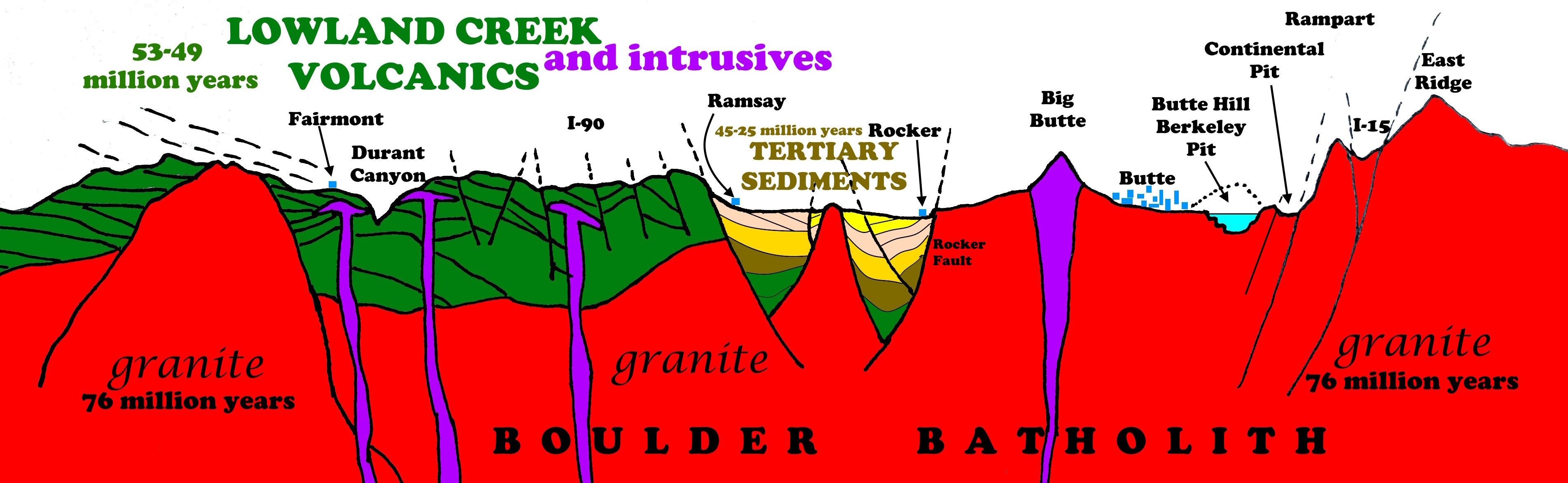
The big (1-meter+) blocks of this material were found within a kilometer of inferred vents in the Lowland Creek Volcanics (in the Hackney Lava Dome), erupted about 49 million years ago (Scarberry and Elliott, 2016, MBMG Open-File Report 683, Geologic Map of the Opportunity Quad). Scarberry and Elliott (2016) also describe abundant evidence for eruptions through, into, and associated with water columns, so the idea that the material in my photos is related to the interaction between magma and water is reasonable.
I won’t insist that the scenario I set forth above is absolutely the explanation for these weird rocks, but I’m confident it must be something like that.
Great rock! What do the quartz and feldspar microstructures tell you about the rheology of this mixed origins material.
Great orbicular two feldspar textures in the Lucerne granite in an outcrop on Rt 9 in Lucerne, Maine right near the hotel / golf course. Classic roadside geology outcrop!
Back East, we enjoy the presence of hyaloclastites in much older volcanic rocks--those found within the Carolina Terrane, an accreted island arc dated as latest Precambrian by current workers. Lapilli tuffs with fiamme, etc, are also common within the sequence. We old guys just called it the Carolina Slate Belt, recognizing the extensive volcanics having slaty textures due to mild metamorphism. Lots of Mississippian plutons intruded the volcanics, including an orbicular diorite near Lexington, NC, which our Igneous and Metamorphic Petrology classes visited annually. Aside from the age difference, the Lowland Volcanics can be explored without dealing with ticks, copperheads, and kudzu, one of the primary reasons I came to enjoy Montana geology over 46 years ago. Thanks for another fine and enjoyable post!