
Ilvaite
From Idaho

Life in the USA is not normal. It feels pointless and trivial to be talking about small looks at the fascinating natural world when the country is being dismantled. But these posts will continue, as a statement of resistance. I hope you continue to enjoy and learn from them. Stand Up For Science!
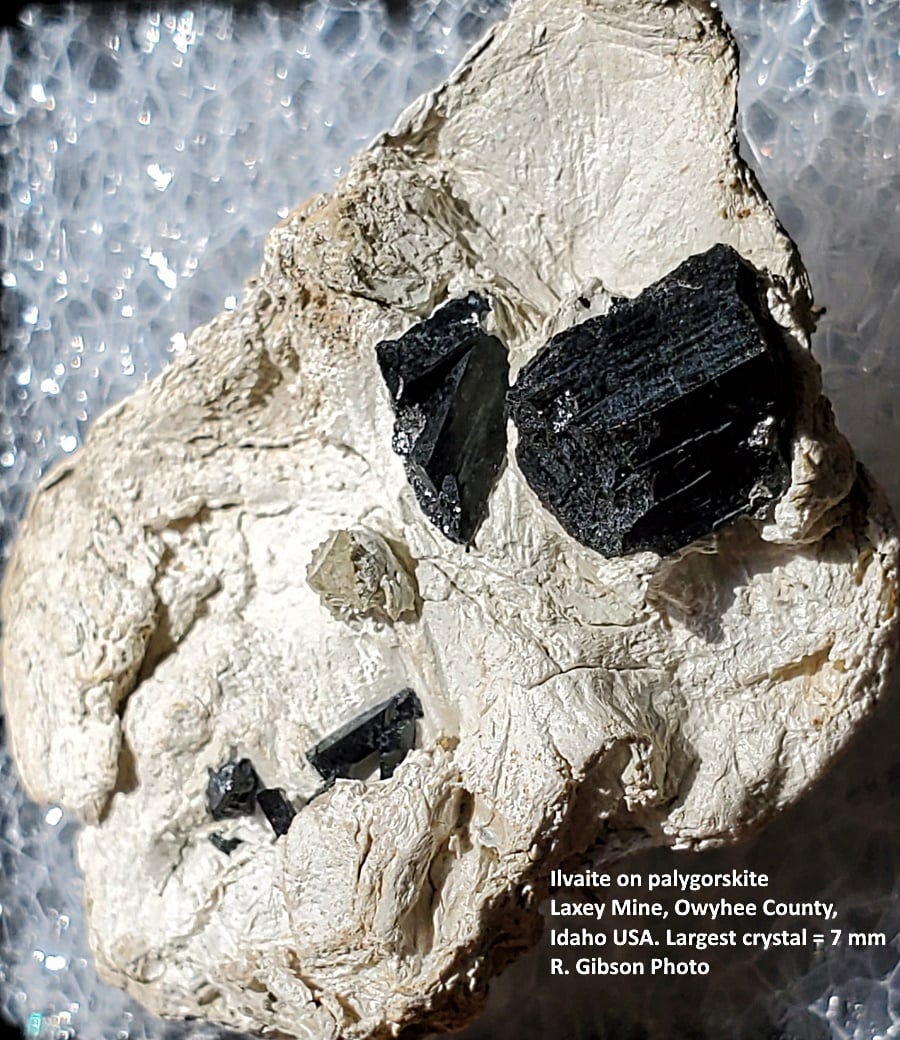
Ilvaite is a fairly unusual mineral, a hydrous calcium-iron silicate, CaFe3+Fe2+2(Si2O7)O(OH), typically with magnesium impurities. Although its name comes from occurrences on the island of Elba (in Latin, “Ilva”) between the Tyrrhenian and Ligurian Seas, one of its most famous localities is the Laxey Mine, Owyhee County, Idaho USA, where it forms sharp lustrous black crystals like these.
The mineralization there in southwestern Idaho is probably the result of fluids from a relatively young satellite of the Idaho Batholith that crystallized into granitic rocks about 45 to 52 million years ago, although the South Mountain Mining District is now separated on the surface from the Idaho Batholith by the Snake River Plain; it is probably nearby in the subsurface, however. There’s also a Jurassic intrusive nearby, about 160 million years old (Lewis and others, 2012, Geologic Map of Idaho: Idaho Geologic Survey).
The molten rock cooked an impure limestone and metamorphosed it. It’s now called the Laxey Marble, and its origin is uncertain because of all the changes it has undergone. Sounds like the best guess is that it was part of a small Precambrian-Paleozoic terrane that was accreted to this part of North America during the Mesozoic, then metamorphosed during the Eocene.

The marble that hosts the ilvaite and associated lead-zinc minerals has been interpreted as a roof pendant, a block of country rock sitting on the top of the intrusive igneous granitic body below. The mineralization forms a skarn, a metamorphic rock that has been changed by actual addition of new chemicals, not simply altered by heat and pressure. The ilvaite, which contains water in the form of the hydroxyl ion in its crystal structure, may represent a retrograde metamorphic event, a time when the heating was to a temperature lower than the highest temperature previously reached (high temperature metamorphic minerals are often anhydrous).
The largest of the crystals in my photo is 7 mm long. They lie on a substrate of palygorskite, an unusual magnesium-aluminum clay mineral, (Mg,Al)2Si4O10(OH) · 4H2O, that forms flexible masses. It is often called “mountain leather” because of that property. Here, it is probably an additional alteration product of the original impure limestone. The ilvaite appears to have deposited on the palygorskite, which would make it later, but I’m not certain from this single piece what the order of crystallization actually was.
The name palygorskite is from its type locality in the Palygorsk Range in the Ural Mountains of Russia. A synonym is attapulgite, named for the town of Attapulgus, Georgia (USA).
This area has been evaluated as a lead-zinc prospect as recently as 2019.
We’ve looked at ilvaite from Russia in this previous post.