
Lodestone
The natural magnet

Life in the USA is not normal. It feels pointless and trivial to be talking about small looks at the fascinating natural world when the country is being dismantled. But these posts will continue, as a statement of resistance. I hope you continue to enjoy and learn from them. Stand Up For Science!
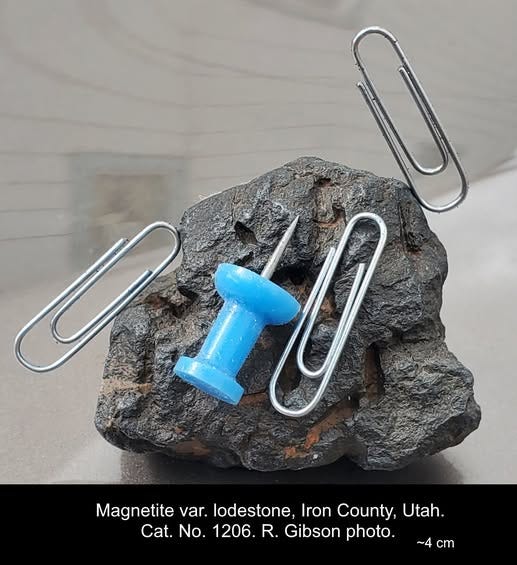
All magnetite is magnetic, but some magnetite is more magnetic than others. “Magnetic” means something is attracted to a magnet. But magnetite the mineral (iron oxide, Fe2+Fe3+2O4) doesn’t usually serve as a magnet itself, attracting iron or steel or other magnetic materials to it. When it does, it’s called lodestone. Magnetite is common, but lodestone is unusual.
Magnetic properties can be induced in rocks containing magnetite (and a few other, less common minerals) when the particles align in the present (or a past) earth’s magnetic field. But the earth’s field is not strong enough to create permanent magnets in rocks. The leading contender for the origin of lodestone is lightning strikes. Research by NASA scientist Peter Wasilewski (1999, Lodestone: Nature’s only permanent magnet—What it is and how it gets charged: Geophysical Research Letters, Vol. 26, No. 15, p. 2275-2278) supports this idea and suggests that not all magnetite can become lodestone – it depends on the crystallographic structure as well as impurities in the magnetite. Further, lodestones are only known from rocks at or near the surface of the earth, which also suggests lightning strikes as the origin.
The specimen in the photo at top, a gift to me from Steve Koehler, is from the Iron Springs District of southwestern Utah, the largest iron-ore-producing district in the western United States. The iron is related to contact metamorphism of Jurassic and Cretaceous sedimentary rocks by granitic intrusions (Bullock, 1970, Iron deposits of Utah: Utah Geol. Survey Bulletin 88).
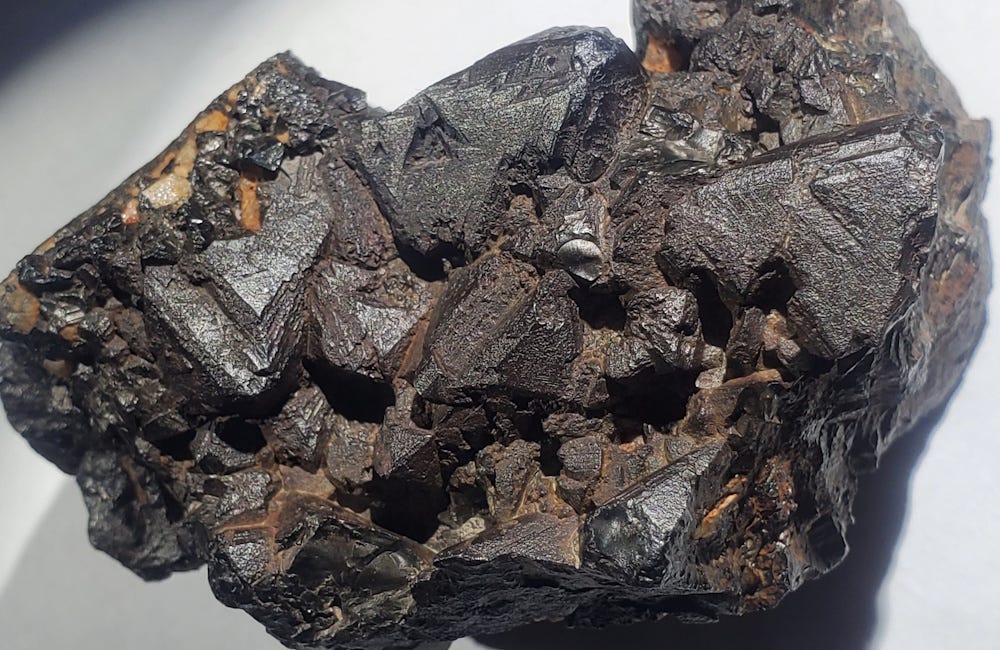
The example above, about 6 cm wide, was labeled martite, which is a name for hematite (Fe2O3) pseudomorphs after magnetite (Fe3O4). It’s from the Twin Peaks District, Utah, about 130 km north of Iron Springs, and well known for martite. But I don’t think this one is martite; no part of it gives a hematite streak, and it is strongly magnetic, so I think it is magnetite that is not replaced by hematite. It’s also not a lodestone – it does not serve as a magnet, even though it’s magnetic.
We talked about magnetite pseudomorphs after garnet in this previous post.
Greeks knew of the magnetic properties of lodestone by the 5th century BC, and Chinese navigators likely used it in compasses by the 2nd century BC. “Lodestone” means “leading stone,” in the sense of pointing a direction.
The origins of the word magnet are uncertain, but likely relate to occurrences of lodestones in one of at least three places in what are now Turkey and Greece, particularly Magnesia, in Thessaly, Greece. That’s also the likely origin of the names of the elements manganese and magnesium, unrelated to magnet except for that similar geographic origin. Magnesia is the co-type locality for magnesite, magnesium carbonate. Magnesia the region was named for the tribe living there, the Magnetes. In Greek mythology, Magnes was a son of Zeus and Thyia, and gave rise to the Magnetes tribe. His brother Makednos gave rise to the Macedonians. According to Homer in the Iliad, the Magnetes fought with Athens in the siege of Troy. Thyia’s brother, Hellen, is the mythological progenitor of the Hellenes, the Greek peoples generally.
Relating to the comment you put at the top of every post, I do think of Kepler and Descartes doing the best work during the awfulness of the 30 years war. Good science matters in bad times. Maybe more.
I believe that residual magnetism in rocks was one of the clues towards continental drift. Does this imply that the natural lodestone forms magnetic field directed towards the current magnetic North? Or maybe the residual magnetism is in some more subtle form. Especially interested as I've just been inside an MRI machine... The Chinese called their first lodestones " navigational spoons"