
Mullite
From Germany

Life in the USA is not normal. It feels pointless and trivial to be talking about small looks at the fascinating natural world when the country is being dismantled. But these posts will continue, as a statement of resistance. I hope you continue to enjoy and learn from them. Stand Up For Science!
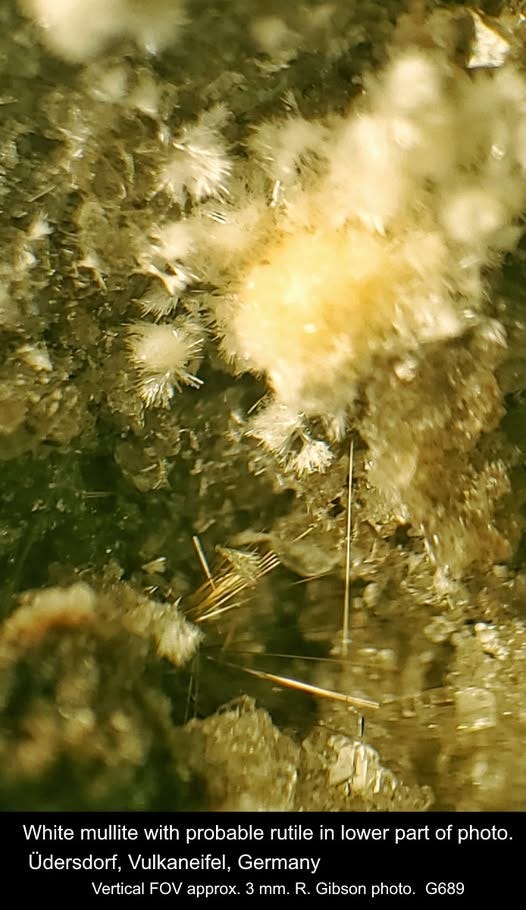
Mullite is a fairly rare aluminum silicate named for the Isle of Mull, Scotland. This specimen is from Üdersdorf, Vulkaneifel, Rhineland-Palatinate, Germany, and if you understand German, you’ll recognize Vulkaneifel as “Eifel Volcano.” The minerals form in cavities in a lava flow.
In the specimen here the mullite is the white radial fibrous stuff. The spiky brown minerals in the lower part of the photo are probably rutile (titanium dioxide) although there are other possibilities; the Eifel Volcano is home to 203 known different mineral species, including 10 for which it is the type locality. Vertical field of view about 3 mm. For the story of the volcanic activity in the Rhine Graben, see this previous post on halloysite.
Although mullite is a pretty uncommon mineral, you have plenty of synthetic mullite in your home. Toilets, sinks, and other ceramics are essentially mullite, made by roasting mixtures of kaolin (aluminosilicate clay), kyanite (aluminum silicate), quartz, feldspar, and talc (a quarter of the talc mined in the US, with Montana the leading producing state, goes to making “porcelain” toilets and similar ceramics).
Synthetic mullite was made by 1865 Henri Étienne Sainte-Claire Deville (1818-1881), a French chemist born in the Danish West Indies, now the US Virgin Islands (Deville and Caron, 1865, Annales de chimie et de physique, 5: 114). Deville was the first to produce aluminum on an industrial scale, in 1856, but it was still prohibitively expensive until other techniques were invented. He is also the namesake of the mineral devilline, a calcium-copper sulfate.
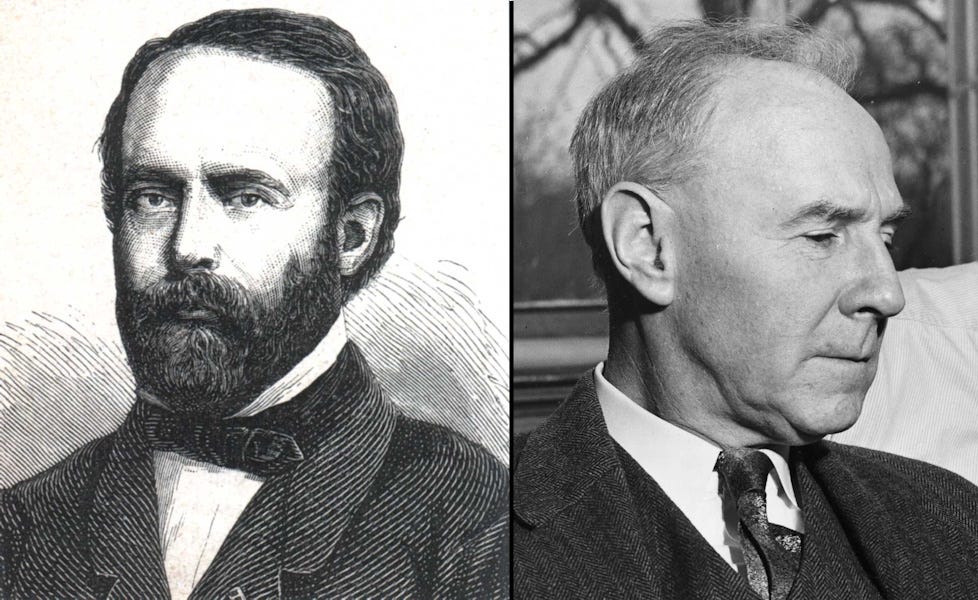
Mullite was not recognized in nature and named until nearly 60 years later (Bowen and others, 1924, Mullite, a silicate of alumina: J. Washington Acad. of Sciences 14:9, p. 183-191; the same Bowen of Bowen’s Reaction Series). It had previously been identified as sillimanite, Al2(SiO4)O. It is crystallized synthetically at high temperatures between 1400°C and 1600°C, but it is stable at surface conditions and has good thermal stability and mechanical strength, making it ideal for ceramics.
When Bowen and others defined mullite in 1924, they gave the formula as 3Al2O3.2SiO2, which can be re-cast as Al₆Si₂O₁₃. But later studies showed that the ratio between alumina (Al2O3) and silica (SiO2) can vary in natural mullite, so its official formula now is strange-looking: Al4+2xSi2-2xO10-x where x is about 0.4.
The etymology of the name “Eifel” is rather contentious; it may have its origin in language groups as diverse as Celtic or Slavic, or it may come from Frankish and Germanic languages. Although spelled differently, Gustave Eiffel of Eiffel Tower fame traces his family’s origin and name to the Eifel region. Depending on exactly how you define it, the Eifel includes parts of France, Belgium, and Luxembourg, as well as Germany.
While the word mull, the English form of Gaelic maol, means a bare, rounded headland (as in Mull of Kintyre), mullite was named for occurrences on the Isle of Mull, whose name has a pre-Gaelic, pre-Viking, possibly Pictish (now extinct), origin whose meaning is unknown. The name was recorded by Ptolemy in the 2nd Century as “Malaios.”
Devilline ought to be a brimstone derivative found only in the afterlife