
Ostrea
The oyster

Life in the USA is not normal. It feels pointless and trivial to be talking about small looks at the fascinating natural world when the country is being dismantled. But these posts will continue, as a statement of resistance. I hope you continue to enjoy and learn from them. Stand Up For Science!
“An oyster has hardly any more reasoning power than a scientist has.”
—Mark Twain, Was the World Made For Man? (1903)
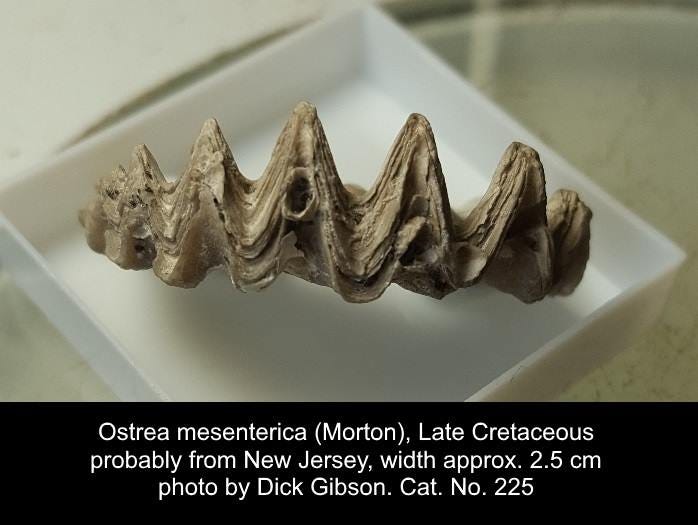
This is Ostrea mesenterica (Morton 1834), an oyster from the Maastrichtian, the last age of the Cretaceous Period, from 72 to 66 million years ago. It is almost certainly from the Navesink Formation of New Jersey, but I don’t have a definite location. But the “teeth,” the plications in the edge of the shell, are distinctive for this species. The hole in the middle was probably caused by some critter that bored into the shell.
At least it used to be Ostrea. Nowadays that particular genus of mollusk is usually restricted technically to a group that probably originated during the Eocene, around 35 to 50 million years ago. My specimen has been reassigned to the genus Agerostrea, sometimes cited as Lopha (Arctostrea) mesenterica. I’m not enough of a systematic paleontologist (by which I mean I’m not a bit of one) to understand the gyrations among Ostrea, Agerostrea, Arctostrea, and Lopha, but irrespective of that and because of long historical usage, Ostrea is often applied to similar mollusks dating all the way back to the Permian, 260 million years ago or more.
And even if Ostrea sensu stricto applies only to the Eocene and later genera, the family (Ostreidae), Superfamily (Ostreoidea), and Order (Ostreida) all clearly have the same name origin: Latin ostrea, from Greek “ὀστρεῖον” ostreion, both of which mean oyster, related to a Greek word for shell. Are we accepting Mark Twain’s characterization of a scientist yet?
Latin ostrea was in common use as the word for oysters by the time of the naturalist Pliny the Elder, who died in the eruption of Vesuvius that destroyed Pompeii in 79 A.D. Modern taxonomic use dates to the Swedish biologist Linnaeus in 1758.

To ostracize does not mean to cast someone into a giant clam, but the origin is ultimately from related Greek words for shell-like potsherds used as voting tokens whereby someone could be expelled from a city for ten years. Thus ostracize means “to banish using potsherds [that are shaped like oysters].”
You may encounter statements that ostrich comes from the same source as the Ostrea oyster, from words relating to “shell,” but I think this is incorrect. The etymology of ostrich goes through French ostruce from Latin avis (bird) + struthio (ostrich). Greek struthion for ostrich comes from struthos, sparrow, but the Greeks supposedly referred to ostriches more fully as struthokamelos, camel-sparrow, for the size of ostriches which are usually larger than sparrows. The camel part got lost over the years.
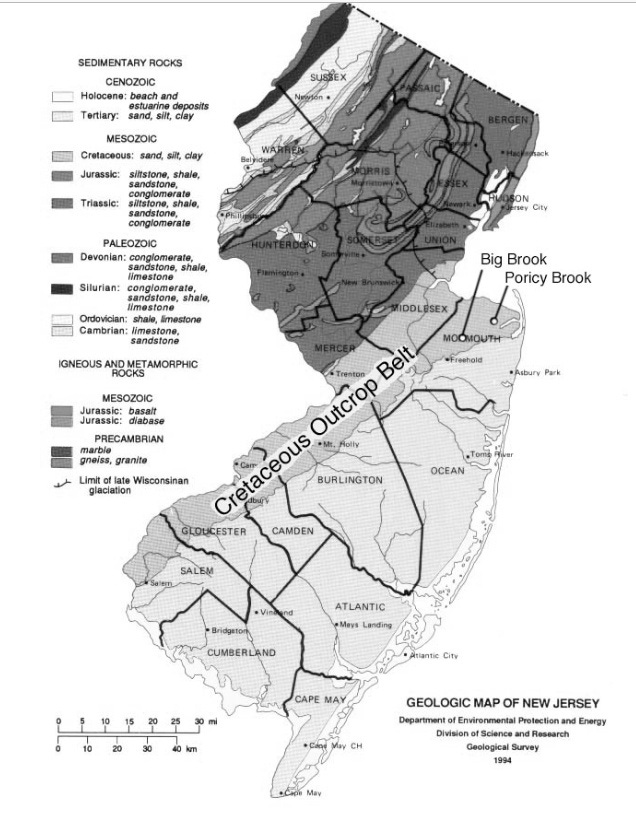
The Cretaceous Navesink Formation occupies a belt in central New Jersey (“Cretaceous outcrop belt” on the map above) that represents one of at least six positions of the margin of the Atlantic Coastal Plain during the Cretaceous (map from Bennington, 2003, Paleontology and Sequence Stratigraphy of the Upper Cretaceous Navesink Formation, New Jersey: Long Island Geologists Field Trip, SUNY Stony Brook). The changing positions of the shoreline were related to sea-level changes, which were most likely ultimately related to tectonic activity such as the ongoing opening of the Atlantic Ocean (there were no glaciers to melt and freeze and change sea level).
Fragments of dinosaur bones have been found in the Navesink. The formation was named for the town whose name recalls a group of the indigenous Lenape people who lived in New Jersey.
I used to teach geology in Mississippi, and would encounter the occasional creationist student. Most were quiet and skeptical; a few were loud. One guy I remember well - He was argumentative in the way that he had a sharp and bright, but enclosed mind: energetic, persistent, and deeply invested in his conclusions. He was arguing with me in class one day about our discussion of Steno's laws of stratigraphy. The retorts were familiar - age cannot be known, assumptions compounded upon assumptions, the whole conversation resting on circular reasoning. I became a bit flustered and told him to go outside to the school parking lot. Out the classroom window was parking lot, bordered by a small road-cut exposure of the Prairie Bluff Formation, which trends roughly north-south through Mississippi (also late Cretaceous I think). I gave him no indication of what he would find there, but the Prairie Bluff has fossiliferous beds of oyster (and other) fossils. The next day he came back holding one of the oysters. He had the same dismissals, push backs, but there was also this uncertainty in him that persisted for the rest of the semester: a mind registering, against its resistance, that the world was larger and more interesting than his previous experience suggested. I’d like to think that there was some revelation, I’m not really sure there was, but that’s how I prefer to remember it. all down to an oyster fossil hundreds of miles from the sea - in a boring parking lot that people walk by every day.
I enjoy your etymological wanderings! Do keep posting 😊