
Perfins
Stamps with geological connections

Life in the USA is not normal. It feels pointless and trivial to be talking about small looks at the fascinating natural world when the country is being dismantled. But these posts will continue, as a statement of resistance. I hope you continue to enjoy and learn from them. Stand Up For Science!
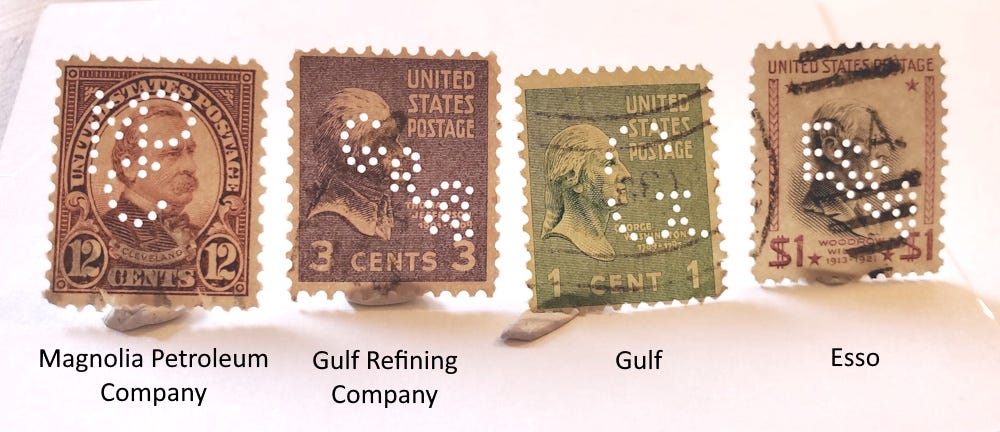
Episode #329. Perfin is a portmanteau word derived from “perforated initials,” for the patterns punched in stamps by companies and organizations to prevent their theft or use by those who did not own the stamps. They are also called spifs, an acronym for “Stamps Perforated with Initials of Firms and Societies.”
They are most valuable when used on envelopes (covers) with information about the company, but the four cheap perfins that I have serve as a vehicle for a short essay on oil companies and their names.
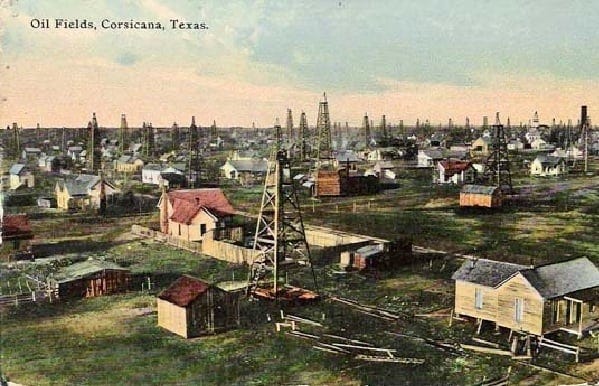
In the late 1890s three companies were established with roots in Corsicana, Texas: The Cullinan Company, which became Navarro Refining; Corsicana Petroleum; and Burts Refining, which became Security Oil. Those three companies were acquired in 1911 by the John Sealey Company, with the merged business named Magnolia Petroleum Company, whose “MPC” initials you see in the perfin at the left.
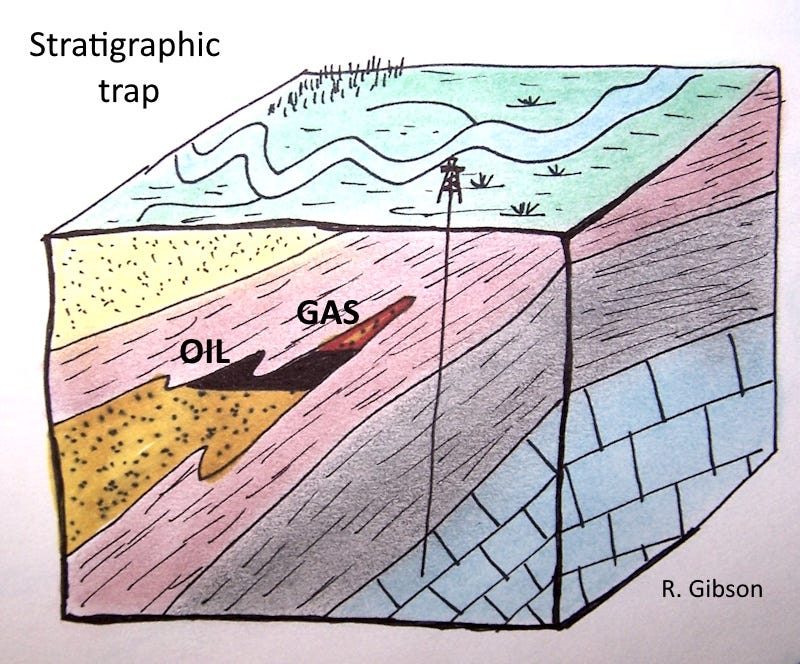
Texas’ first commercial oil was discovered at Corsicana in 1894. Oil and gas are in the Cretaceous Navarro (Corsicana) Formation, in complexly distributed sand lenses in a regional stratigraphic pinch-out, similar to the generic pinch-out in my drawing above.
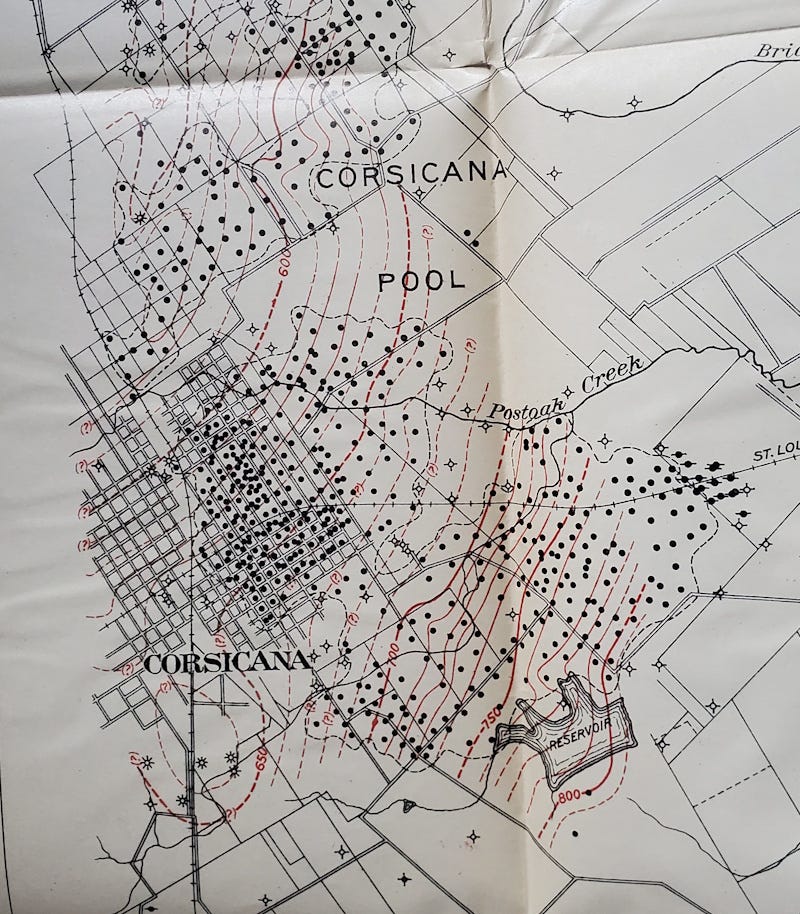
My copy of the 1917 Corsicana report (USGS Bulletin 661) belonged to Henry Carter Rea (1900-1963), a prominent oil exploration geologist who worked for Shell, Standard of California, and other companies, and as a consultant all over the world, from Baluchistan and Borneo to Italy and the western United States. He is credited with coining the word “photogeology.” (Thompson, 1964, Memorial to Henry Carter Rea: AAPG Bulletin, September 1964.)
Magnolia with its logo, Pegasus, the flying red horse, was acquired in 1925 by Standard Oil Company of New York (SOCONY), one of the companies spun off in the breakup of the Standard Oil Trust in 1911. Magnolia continued to operate as a subsidiary after SOCONY merged with Vacuum Oil (another Standard Oil spin-off) in 1931 to form SOCONY-Vacuum, which operated under that name until it was renamed Mobil Oil (one of its popular brands) in 1959, when most of the Magnolia business entities were also subsumed in the new corporation. Mobil continued to use Magnolia’s Pegasus logo.
In 1999, Mobil merged with Exxon (another Standard Oil spin off, originally named Standard Oil of New Jersey). The new company is called ExxonMobil.
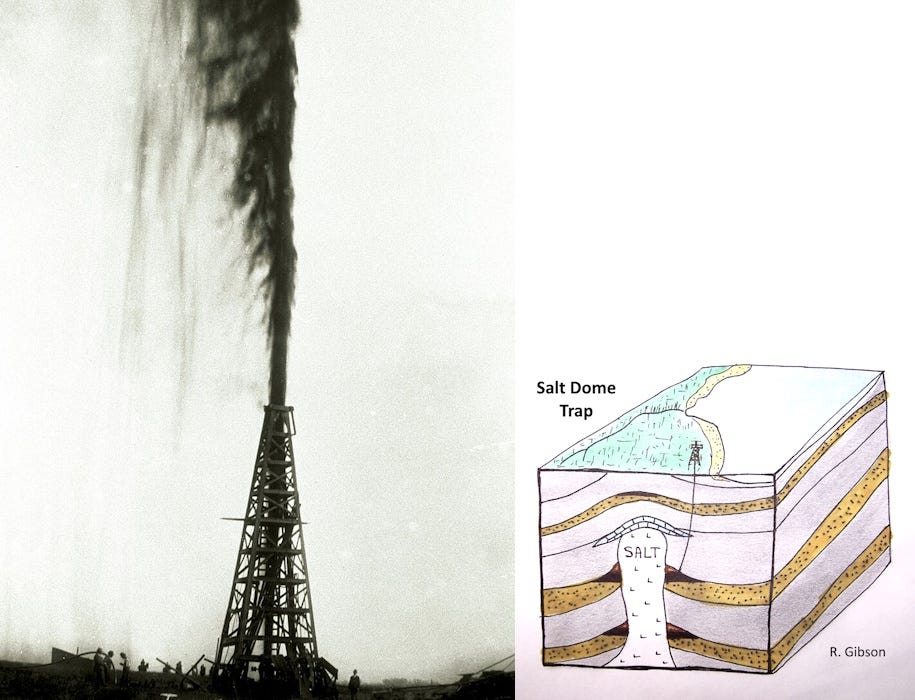
The two center stamps are from Gulf Oil, with the large “G” perfin and “GRCo” for Gulf Refining Company. Gulf started in 1901 in large part because of investments in the huge Spindletop oil field on the coast of the Gulf of Mexico by the Mellon banking family of Pittsburgh. Spindletop is in oil traps associated with a salt dome, similar to the generic drawing above.
Gulf was acquired by Chevron (formerly the Standard Oil Company of California (Socal), created by a merger of Standard Oil of Iowa and the Pacific Coast Oil Company about 1906) in 1984, the largest corporate merger in history at the time. That merger allowed me to move from Houston to Denver and become a consultant, and ultimately is an important underlying reason I’m in Butte today.
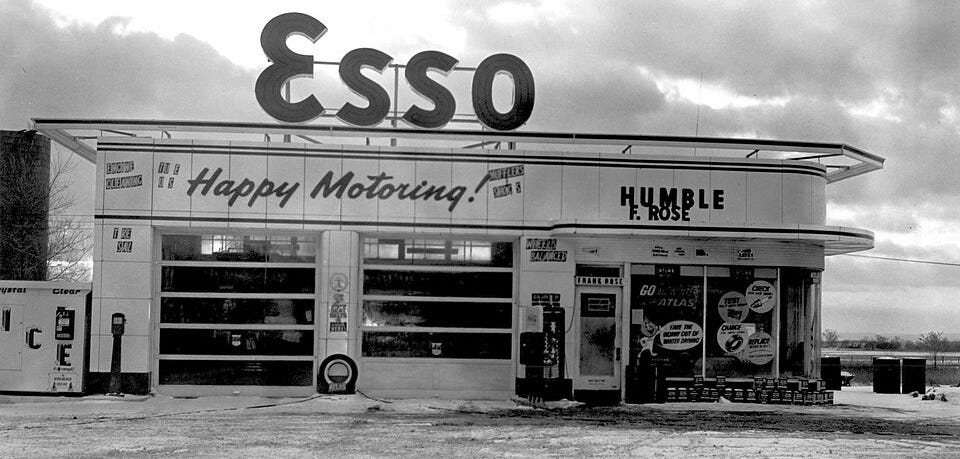
The stamp at right is perforated with “ESSO,” a well-known company name. Esso is just the phonetic spelling out of the letters “S O,” for Standard Oil, and Esso was used by the Standard Oil Trust in the early 1900s. The name was trademarked by Standard Oil of New Jersey in 1923 and continues today as a brand used by ExxonMobil, mostly in Canada and overseas.
Esso and Standard of New Jersey also used the Humble Oil brand for many years, based on their acquisition of Humble Oil & Refining, a Humble, Texas, company formed in 1911 and acquired (50%) by Standard of New Jersey in 1919.
The 12-cent stamp with the Magnolia perfin was issued in 1923 and probably used about that time. The other three stamps were issued in 1938 but were in print continuously into the 1950s, so they could have been perforated and used by Gulf and Esso (Standard of New Jersey) at any point in that time frame.
The Standard Oil Trust breakup in 1911 resulted in 34 new companies. Over time, mergers have reunited at least 13 of those spin-offs in three of the supermajor oil companies: Exxon (with at least 4 original 1911 Standard Oil companies), Chevron (4) and British Petroleum, BP (5).
Thanks, Richard. I have a fondness for Magnolia Oil. I lived in the middle of the old Luling/Stairtown oil field for about 15 years. My house had originally been the "clubhouse" built by Magnolia. The flying horse symbol was stamped in the front porch.
Thanks Richard. A new stampy thing to look out for!