
Puddingstone
So old, it’s a little stale

Life in the USA is not normal. It feels pointless and trivial to be talking about small looks at the fascinating natural world when the country is being dismantled. But these posts will continue, as a statement of resistance. I hope you continue to enjoy and learn from them. Stand Up For Science!
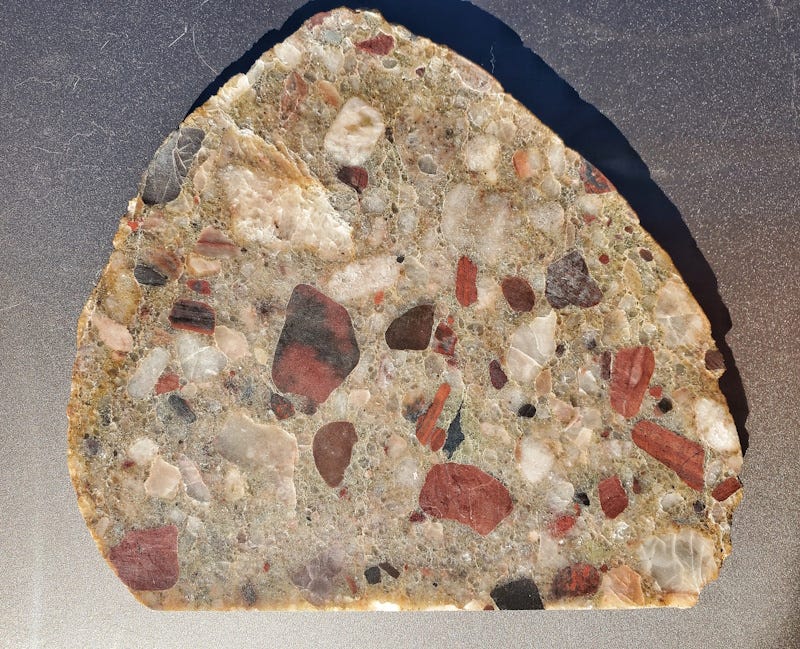
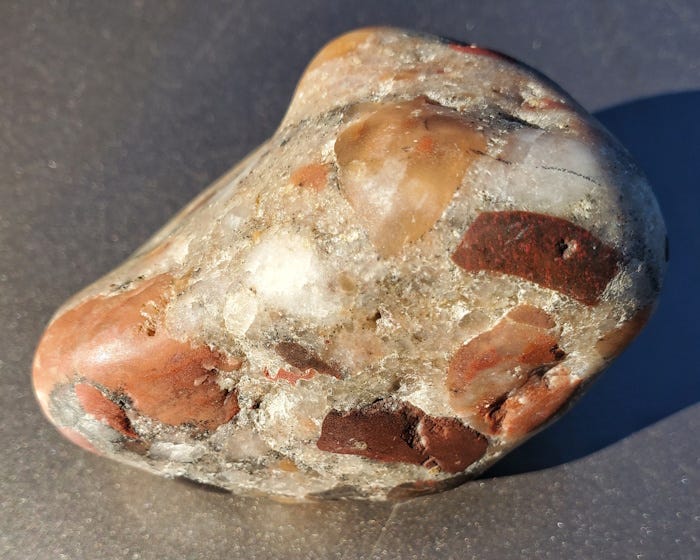
It’s called puddingstone for its rounded pebbles and distinct color contrast, something like the raisins or plums in a Christmas pudding. A bit crunchy for my taste in puddings, but to each his or her own.
More technically this is a jasper pebble metaconglomerate probably derived ultimately from outcrops near the north shore of Lake Superior and from outcrops east of Sault Ste. Marie, Ontario, specifically the Highway 638 road cut in the Rydal Bank area of the Algoma District.
I say “ultimately” from there because this rock that my father slabbed sometime in the 1970s or 1980s could have been picked up on St. Joseph Island, Ontario, or Drummond Island, Michigan, both southeast of Sault Ste. Marie and near the northern end of Lake Huron. Pieces of conglomerate like this have also been found all over Michigan and as far south as Ohio and as far west as Iowa, where they were carried by continental ice sheets during the most recent glacial period, the past two million years or so. It’s so distinctive it can be used as a tracking method for glacial ice flow paths.
The outcropping rocks in the Algoma District are part of the Lorrain Formation, Cobalt Group, Huronian Supergroup, about 2,200 million years old, or maybe as much as 2,450 million years, just after the time when we conventionally separate the older Archean (more than 2,500 million) from the younger Proterozoic Eon.
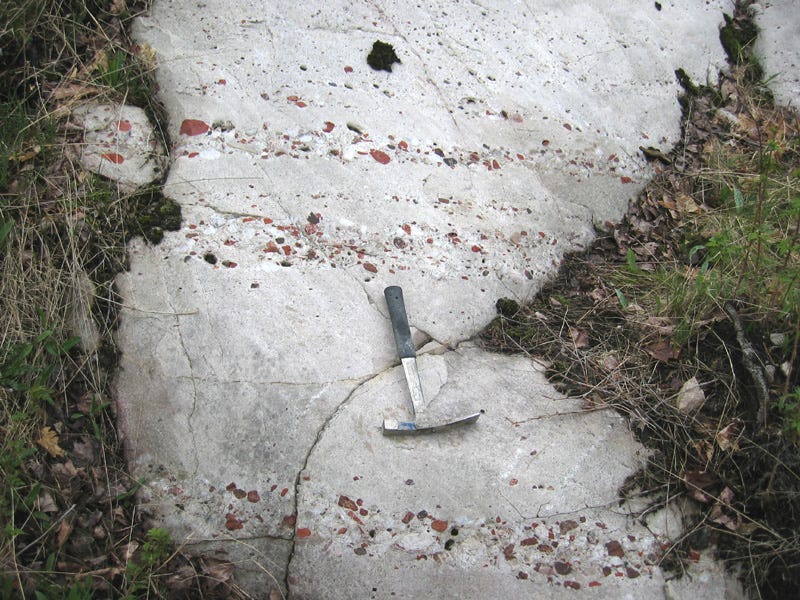
The pebbles and sand were deposited in an active stream system with multiple channels where the coarser pebbles were concentrated, alternating with sandy and silty zones. It occurs over a wide enough area that we might think of it as an extensive braided stream system with localized channels, rather than a single, narrow river, or perhaps a series of coalescing fluvial and alluvial fans on a mountain front (Lowery, 1985, Stratigraphy and sedimentology of the Lorrain Formation, Huronian Supergroup (Aphebian), between Sault Ste. Marie and Elliot Lake, Ontario, and implications for stratiform gold mineralization: Geological Survey of Canada Open File 1154). The rock is old enough that the sandstone serving as the matrix for the pebbles is slightly metamorphosed to quartzite, but it’s really only barely a metamorphic rock.
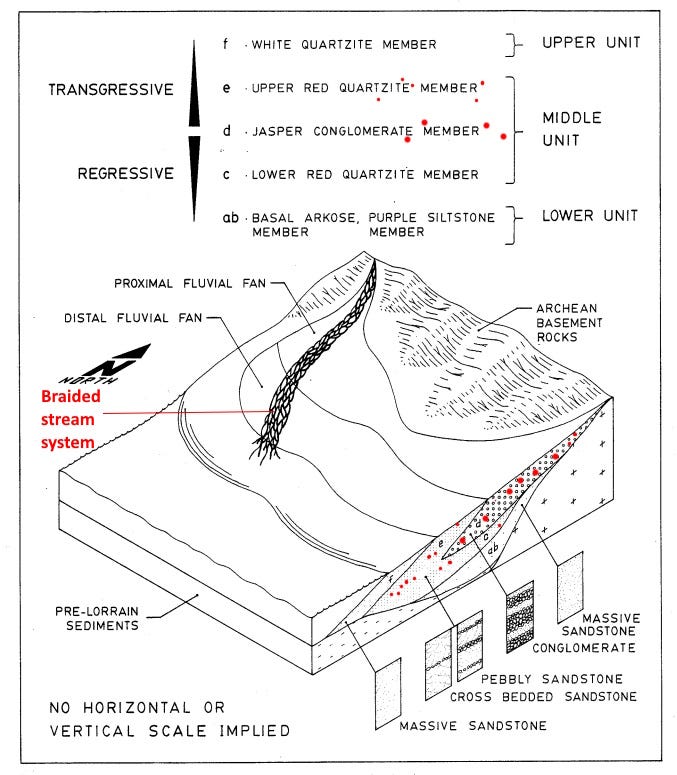
There must have been some relatively high topography to shed the coarse pebbles into the stream system, or alternatively, the stream system must have been quite powerful, or some combination of both factors. The jasper (and hematite-bearing sandstone) in the Lorrain Formation probably came from banded iron formation that crops out north of the region where the Lorrain Formation lies today. The banded iron formation is Archean, around 2,700 million years old, and represents an aspect of the Great Oxygenation Event that changed earth’s atmosphere dramatically. That process was still going on when the Lorrain Formation was deposited.
Richard, my grandmother from Great Falls had a pudding stone The clasts were rounded, just under an inch in diameter, and of red and green colors I associate with belt rocks. It was rounded itself. Could it have been from a local formation?
The Planetgeo podcast did a program on puddingstone back in March of last year, including the Lorraine Quartzite. Available on Spodify or from the PlanetGeo webpage. see PlanetGeo: The Geology Podcast
Geology of Puddingstone
Mar 13, 2025 Season 5 Episode 8
In this exciting episode of Planet Geo, Chris and Jesse dive deep into the fascinating world of pudding stones! From the picturesque Hertfordshire pudding stones in England to the Roxbury conglomerate in Massachusetts, and finally the scientifically wondrous Lorraine Quartzite pudding stone abundant in Michigan. They discuss the unique geological stories each of these beautiful rocks tells and explore their origins, formations, and scientific significance. Plus, get ready for some rock-solid fun facts about the ancient landscapes and climates these stones reveal. Don't miss this riveting geological adventure that promises to be a conglomerate of knowledge and excitement. Let's rock and roll!