
Sillimanite
Aluminum silicate

Life in the USA is not normal. It feels pointless and trivial to be talking about small looks at the fascinating natural world when the country is being dismantled. But these posts will continue, as a statement of resistance. I hope you continue to enjoy and learn from them. Stand Up For Science!
Category: things I’ve had for 50+ years but didn’t fully identify until recently.
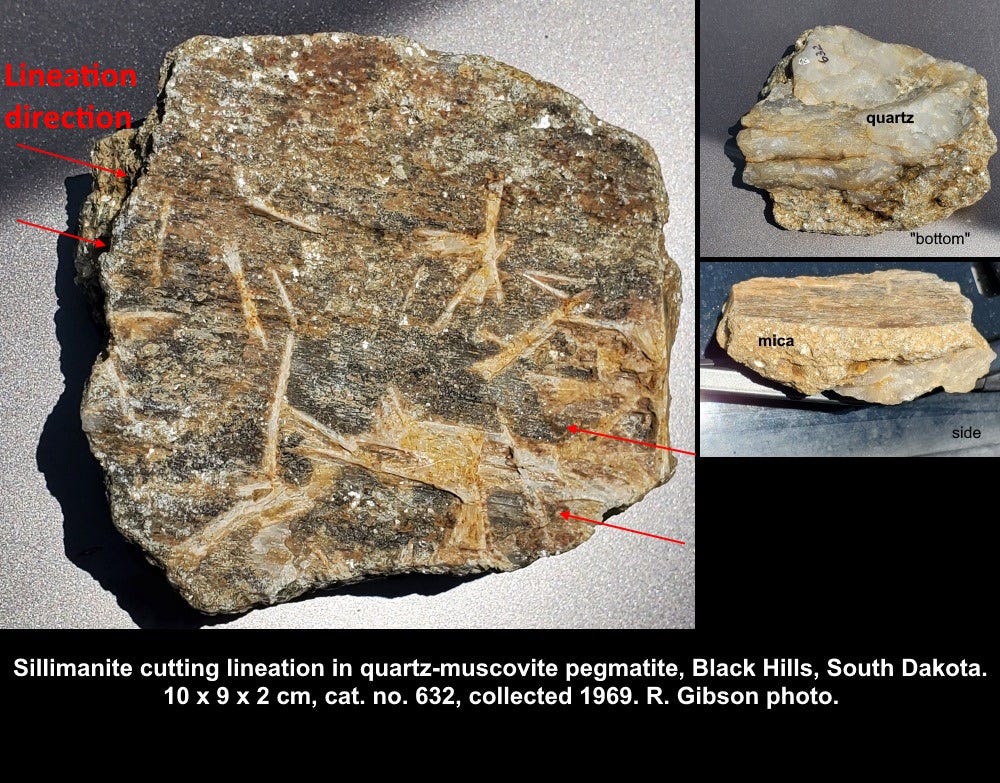
I collected this rock in the Black Mining Hills of South Dakota in 1969, from a “small pegmatite along road,” according to the original label. There’s obvious coarse quartz on one side, and a 1- to 2-cm-thick zone of coarse muscovite mica layered on that.
The interesting part is the “top” of the mica layer. It clearly has some kind of lineation (indicated by the red arrows) on that flattish surface which is superimposed on the mica and not defined by the mica, which is pretty random in and on that surface. The lineation could be a metamorphic fabric developed under directed pressure, or it might be a slickenside caused by motion (faulting, sliding) on the surface.
Whatever the origin of the lineation (and I’ve been convinced to slightly favor the structural slickenside interpretation), it wasn’t the last thing to happen to this rock. You see the obvious blades and sheafs of an elongate white mineral that cut across the lineation. I’m pretty sure that back in 1969 I naively thought they were quartz in veins or something like that, even though the long, narrow bladed habit isn’t really like quartz. They must have formed after the lineation, because they cut it and are not part of it. In the main image, the lineation is almost left-right, and yes, some of the crystals DO follow it somewhat, but more do not.
Further examination a couple years ago made me about 90% sure those white blades are sillimanite, one of the three polymorphs (same chemistry, different crystal structure) of aluminum silicate that are common in metamorphic rocks. This inference is partly because of similarity to macroscopic blades of sillimanite that I saw for the first time (other than in photos) in metamorphic rocks in my friend Joel Dietrich’s field mapping area in the northern Flint Creek Range of Montana in 2020. The elongate, sometimes sheaf-like habit, cleavage, and silky luster on broken surfaces all suggest sillimanite, and it would be totally expectable as a metamorphic mineral in rocks of the Black Hills. I’m just not used to seeing such big crystals of sillimanite.
Pegmatites in the Black Hills are typically associated with the Harney Peak Granite, which was intruded about 1,715 million years ago. Metamorphism in the Black Hills is related to both the intrusion of the granite and to regional metamorphism that spanned as much as 100 million years, so it’s no surprise that this rock may record multiple events. These sillimanite crystals probably grew sometime between 1.7 and 1.8 billion years ago, and more likely on the younger side of that time range. Because they don’t show any strong preferred orientation, it’s likely that they grew in a metamorphic setting that was more dominated by heat than by directed pressure.
The modern Black Hills uplift is far younger than the rocks in its core. The uplift came from crustal breaking about 60 to 70 million years ago, the Laramide Orogeny, the same deformation that lifted the Wind River, Big Horn, and other ranges in Wyoming and adjacent parts of Montana, Utah, and Colorado. Cat. no. 632.
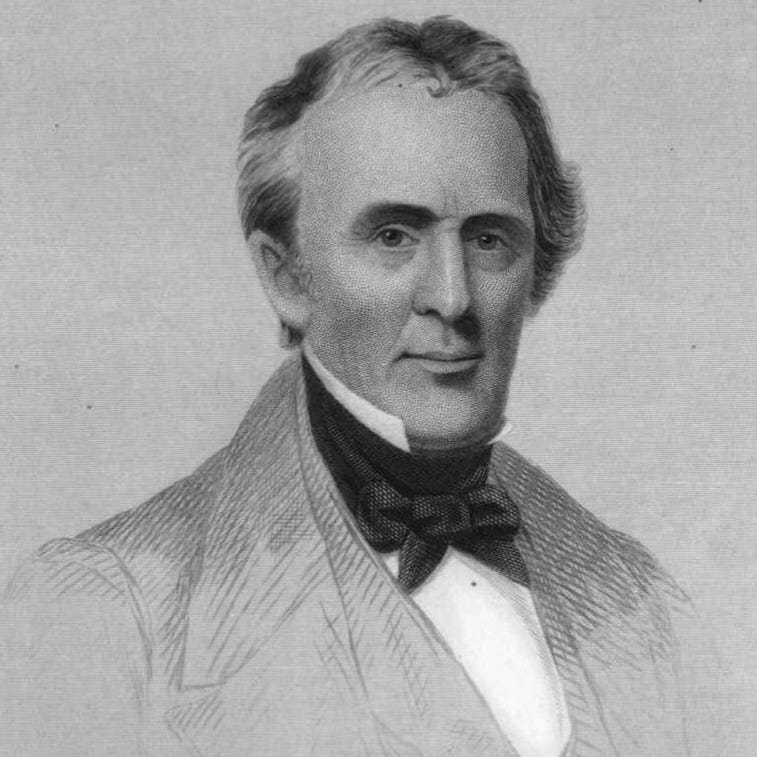
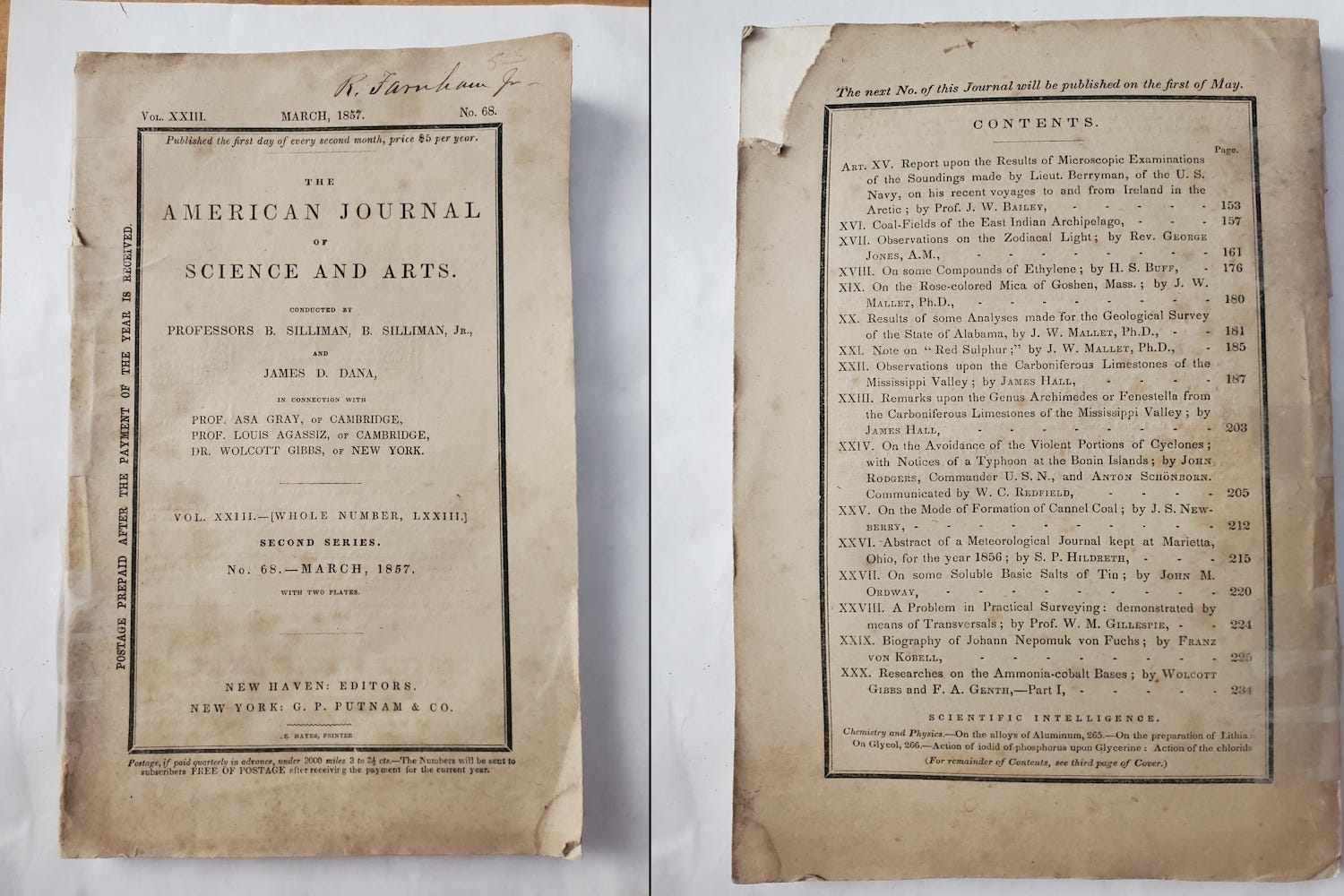
Sillimanite was named by George Thomas Bowen in 1824 to honor Benjamin Silliman, Sr. (1779-1864), Professor of Chemistry and Geology, Yale University, New Haven, Connecticut, USA, and founder in 1818 of the American Journal of Science (Silliman's Journal), the longest-running scientific journal in the United States. My copy below of one of the 1857 issues is among the oldest such items in my collections. This was at a time when both Silliman Senior and his son Benjamin Silliman, Jr. (1816-1885), were editing the journal, along with mineralogist James Dwight Dana (1813-1895), who was Silliman Senior’s student, son-in-law, and successor in 1850 as Silliman Professor of Natural History and Geology at Yale College.
Pretty sure I have collected sillimanite from a couple of locations this week. Lots of metamorphic rocks around here in Broken Hill.