
Slag
Big crystals, fast growing

Life in the USA is not normal. It feels pointless and trivial to be talking about small looks at the fascinating natural world when the country is being dismantled. But these posts will continue, as a statement of resistance. I hope you continue to enjoy and learn from them. Stand Up For Science!
Episode #250. Geologists and other collectors are basically scroungers and scavengers, picking up random stuff other people don’t want or pass over. Granted some are more discriminating than I, who picked up this item on the side of a street in Butte, Montana USA.
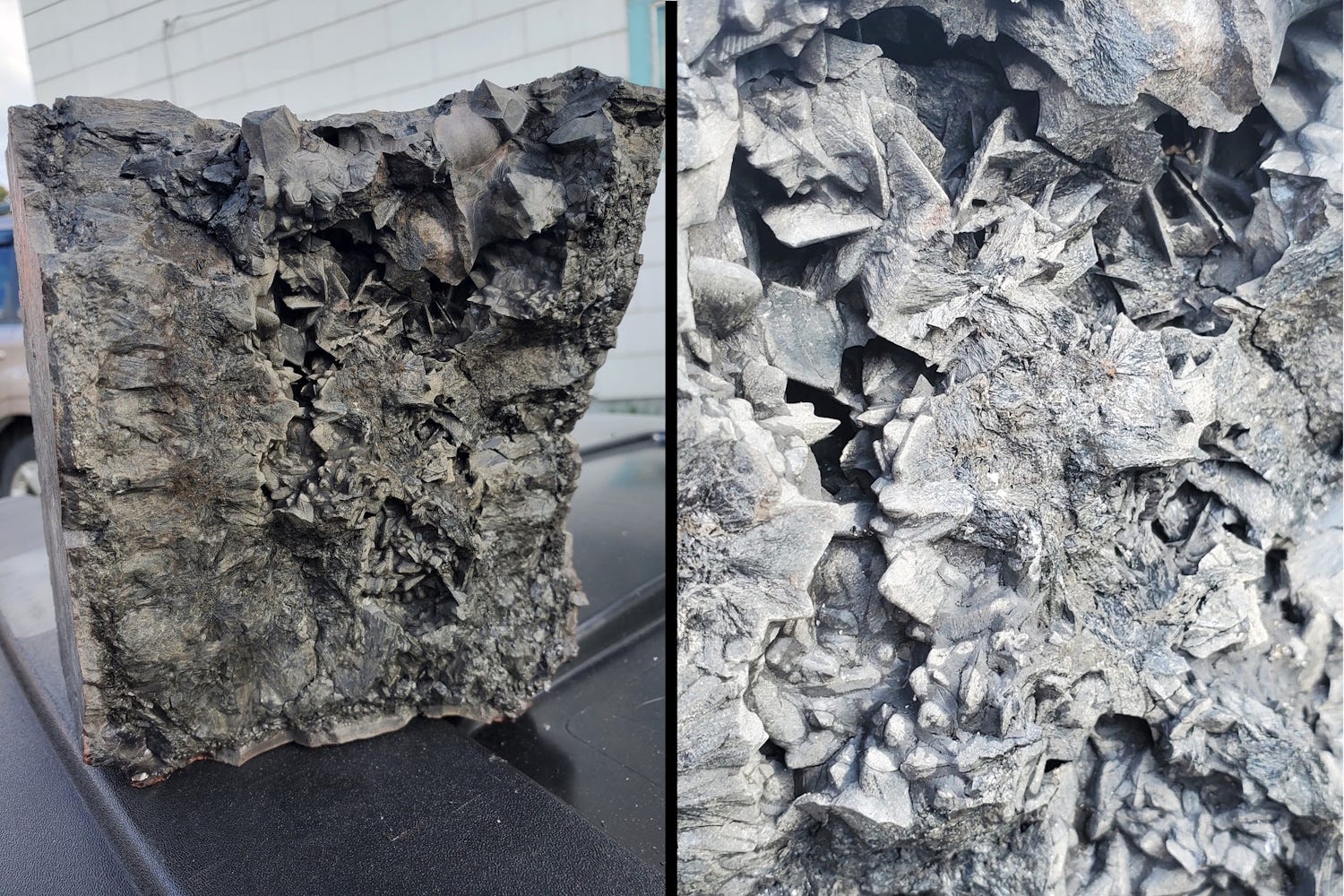
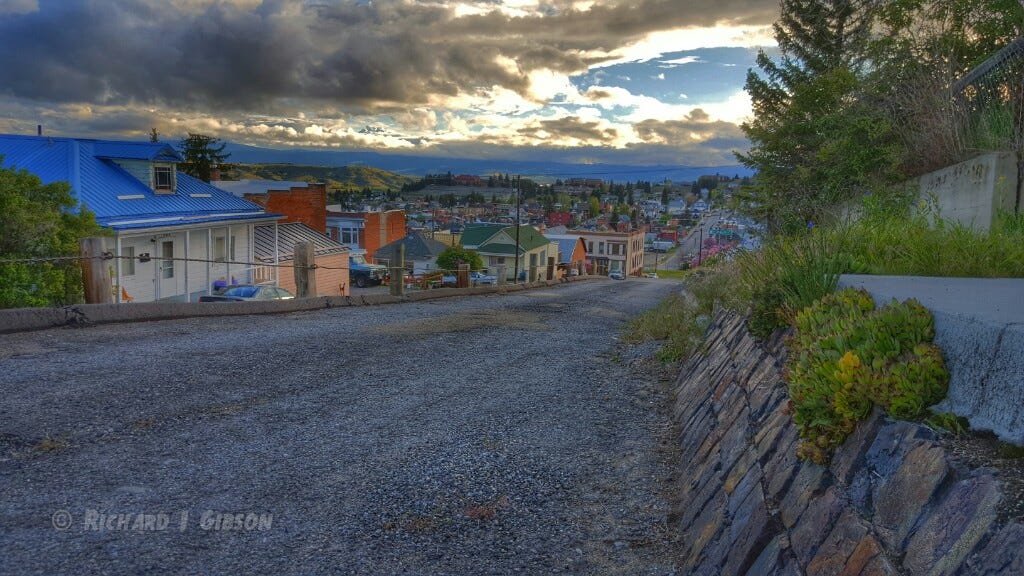
It’s a broken piece of a slag brick, weighing maybe 25 or 30 pounds, around 12 kg. Slag as most of you know is the unwanted refuse of smelting ores, and in Butte there was so much of it, they invented a way to cast it into bricks to use for various purposes, including retaining walls in residential neighborhoods and refractory linings for blast furnaces. There’s lots of slag around; you can see it in the chunky aggregate in older concrete in some of Butte’s sidewalks.
This piece got my attention because of the big crystals on the inside. You can see the thin outer rind of the brick, about 5 mm thick, where the molten slag solidified quickly (a matter of seconds to minutes, probably). The insulated interior took longer to crystallize.
Geologists are taught that large crystals indicate a long cooling time, long enough for the grains to grow. That’s why the crystals in granite, which cooled deep within the earth, are big (several millimeters to several centimeters) compared to basalt or rhyolite, which cooled quickly on or near the surface, resulting in crystals that are often microscopic.
But there are exceptions. Pegmatites are igneous rocks with really big crystals, tens of centimeters to meters in size. Does that mean they took a really long time to crystallize, longer than the thousands of years supposed for granite? No.
According to mineralogist Julian Gray, “The normal model for crystal growth is that if a magma cools slowly crystals have time to grow large. The magma is cooling and the last bit of magma has not even started to cool. Now that last remaining liquid is ready to crystallize, but it is in a relatively cooler rock. Shouldn’t it crystallize quickly and therefore grow smaller crystals? But it doesn’t. It cools quickly, yes, but the crystals are huge. That is because different processes take over. Crystal formation is inhibited, initially, and so fewer crystals begin to grow – a low nucleation rate. But the chemical nutrients needed to form the crystals are abundant so the crystals that do form are able to grow quickly – a high chemical diffusion rate. High diffusion rate plus low nucleation rate is what allows giant crystals to grow quickly.”
That must be the explanation for the large crystals on the interior of this slag brick. While they took longer than the outer rind to solidify, they still crystallized probably in a matter of hours to days, not thousands of years (this block was probably molten at most about 135 years ago, and probably as recently as 1905 or so). As Julian said, fewer crystals start, but there is a lot of chemical supply, so those few crystals grow larger.
The crystals inside the slag brick have the classic orthorhombic forms of forsterite-fayalite, the magnesium- and iron silicates, respectively, that form a group traditionally known as olivine. When pure, green, and gemmy, they can form the gemstone peridot. According to Kaplan (2016, Mineralogy and environmental geochemistry of slag in Lower Area One, Butte, Montana: Montana Tech M.S. thesis), the slag from the Butte Reduction Works that makes the slag walls west of Montana Street is largely fayalite, the iron olivine, Fe2+2SiO4, with perhaps some calcium-iron olivine (the mineral kirschsteinite, CaFe2+SiO4) and the calcium-iron pyroxene hedenbergite, CaFe2+Si2O6. Since there wasn’t a lot of calcium in the ores of Butte, I speculate that the calcium in these minerals might have come from the limestone used as a flux in the smelters.
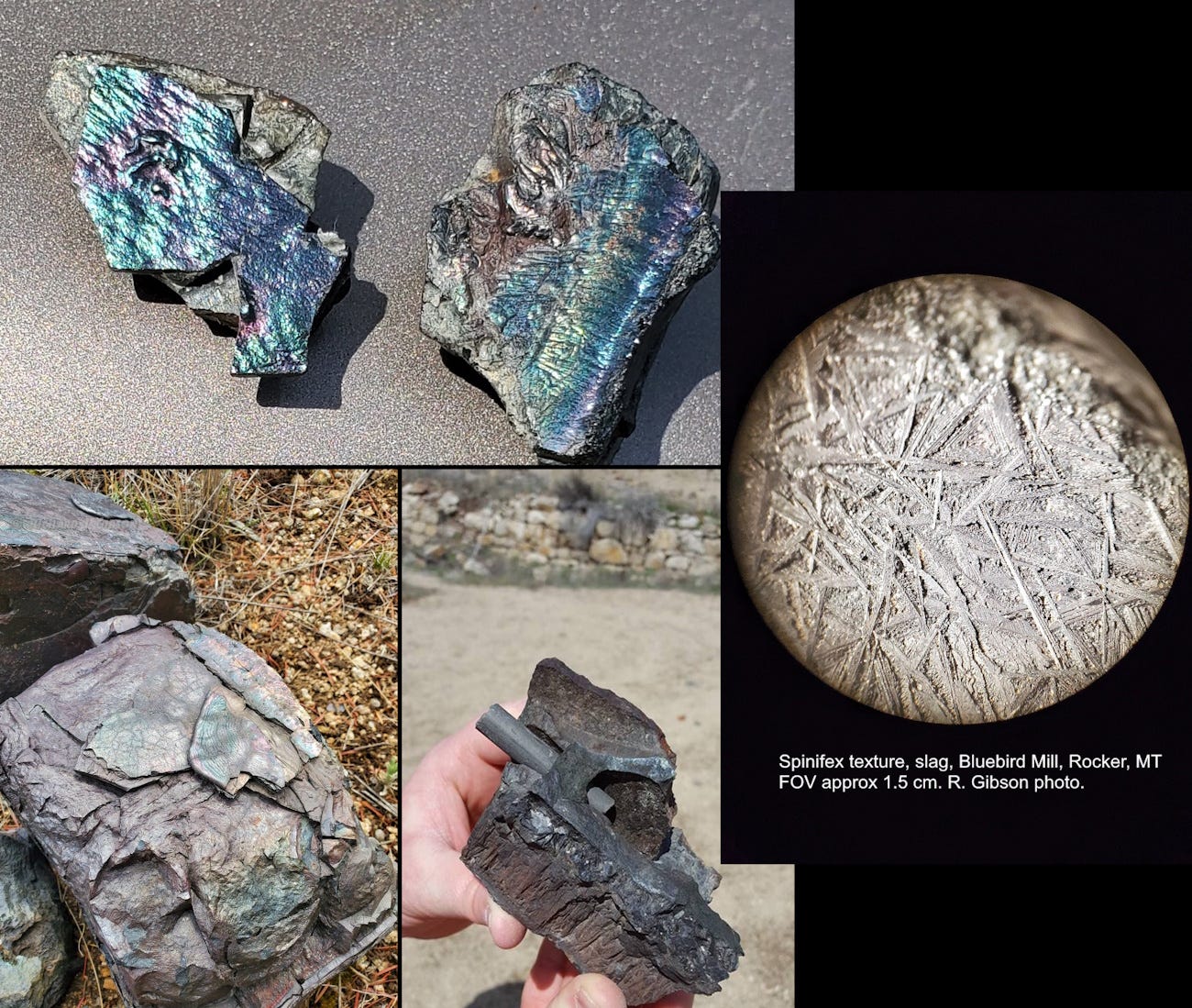
Some slag from the Butte area, such as the Bluebird Mill site, above, displays features similar to the radiating elongate crystal groups called spinifex texture (for its similarity to a spiky grass from Australia called Triodia spinifex). That texture is sometimes interpreted to mean really rapid cooling, quenching, of the slag melt, but some natural spinifex textures develop in relatively deeply buried rocks, so their origin may have more to do with the temperature gradient and/or unusual compositions. Explaining some of these textures is still problematic.
In any case the block in the top photos does not seem to me to show spinifex texture, at least not much (there might be some areas that approach it). It is dominated by the well-formed fayalite (iron-olivine) crystals; fayalite is more likely than the magnesium end member forsterite because there wasn’t that much magnesium in the Butte system, and Kaplan’s (2016) work suggested that most of the olivine is the iron-rich end member. I’m sure this is from Butte; bringing a slag brick to Butte from elsewhere would truly be like carrying coals to Newcastle.
The piece at top measures about 15 x 15 x 11 cm (6 x 6 x 4 inches) and the larger crystals on the interior are about 1.2 cm long (e.g., the lozenge shaped crystal at left center in the zoomed image). I think it is about two-thirds of the complete block. I found it at the corner of Quartz and Crystal Streets; there’s no quartz in it, but plenty of crystals.
Fayalite was named in 1830 for its type locality, Faial (Fayal) Island in the Azores. The island itself was named for the abundant faya trees, Myrica faya, from Portuguese faia, their name for the beech tree.
Second example: Glendale Smelter, Montana
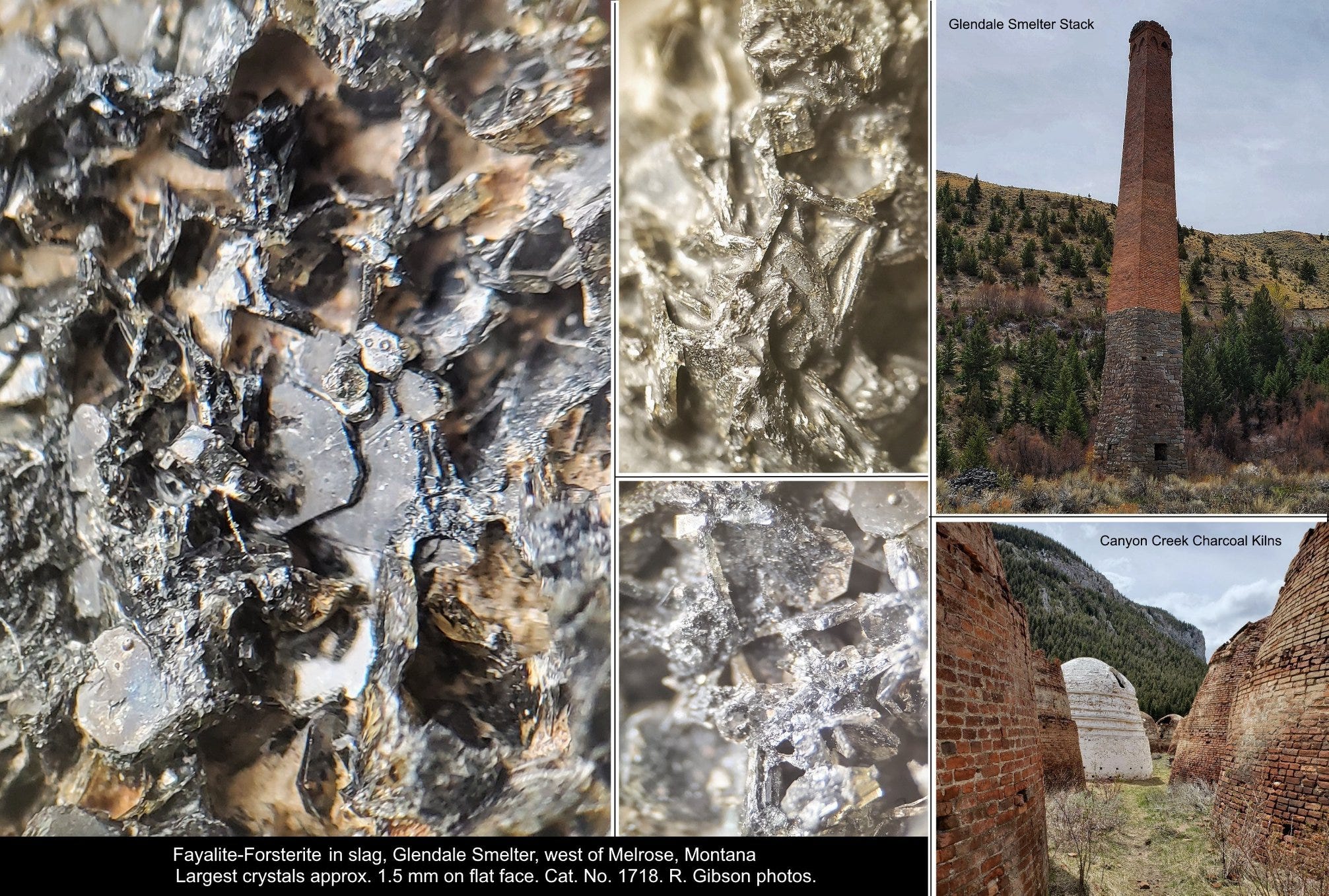
These crystals are also in the fayalite-forsterite series, iron to magnesium silicate, perhaps better known as the olivine group. The flat blades and squarish shapes are typical for fayalite, and the angles on the edges of the platy crystals are also pretty common. The alternative or additional material would be some kind of pyroxene such as enstatite, another magnesium silicate (its analogous iron end member in the series is ferrosilite). Pyroxenes tend to be a little more elongate and a little thicker (that is, more prismatic), with more pointy terminations, but they can be bladed with squarish terminations too. Both fayalite and enstatite are orthorhombic, and there are a fair number of almost transparent, not-quite cubes in the specimen that suggest that crystallography.
Geochemist Chris Gammons thinks the pyroxene is more likely hedenbergite, CaFe2+Si2O6, the calcium-iron analog of diopside, formed when workers added limestone to the ore melt as a flux. He agrees that the olivine is likely fayalite, toward the iron end member of its series.
The Glendale sample also has enough magnetite (iron oxide) in it for a magnet to stick to it.
Technically, this material isn’t mineral at all, because it’s man-made (exceptions are sometimes made for historic slags interacting naturally with sea water, such as those at Lavrion, Greece). The photos are of slag from the Glendale Smelter that processed ore from the Hecla Mine in the Pioneer Mountains, Montana, and other mines in the area. The smelter was a few miles west of Melrose and about all that remains today is the stack and some old brick buildings. Five miles further up the road in Canyon Creek you find the beehive-shaped kilns that made charcoal used in the smelter.
The Glendale Smelter operated from 1875 to 1900, but because silver was its leading product, operations were cut back a lot after the silver crisis of 1893. Over its life the smelter produced on the order of $22 million in silver and other metals. More than 1,000 people lived in Glendale, supporting 10 saloons, two churches, The Atlantis (a weekly newspaper), a brewery, a post office, and a skating rink. Now it’s a ghost town.
Pegmatites: what's the reason for the scarcity of crystal nucleation sites? As against a normal cooling batholith, say?