
Slickensides
In the Kootenai Formation

Life in the USA is not normal. It feels pointless and trivial to be talking about small looks at the fascinating natural world when the country is being dismantled. But these posts will continue, as a statement of resistance. I hope you continue to enjoy and learn from them. Stand Up For Science!
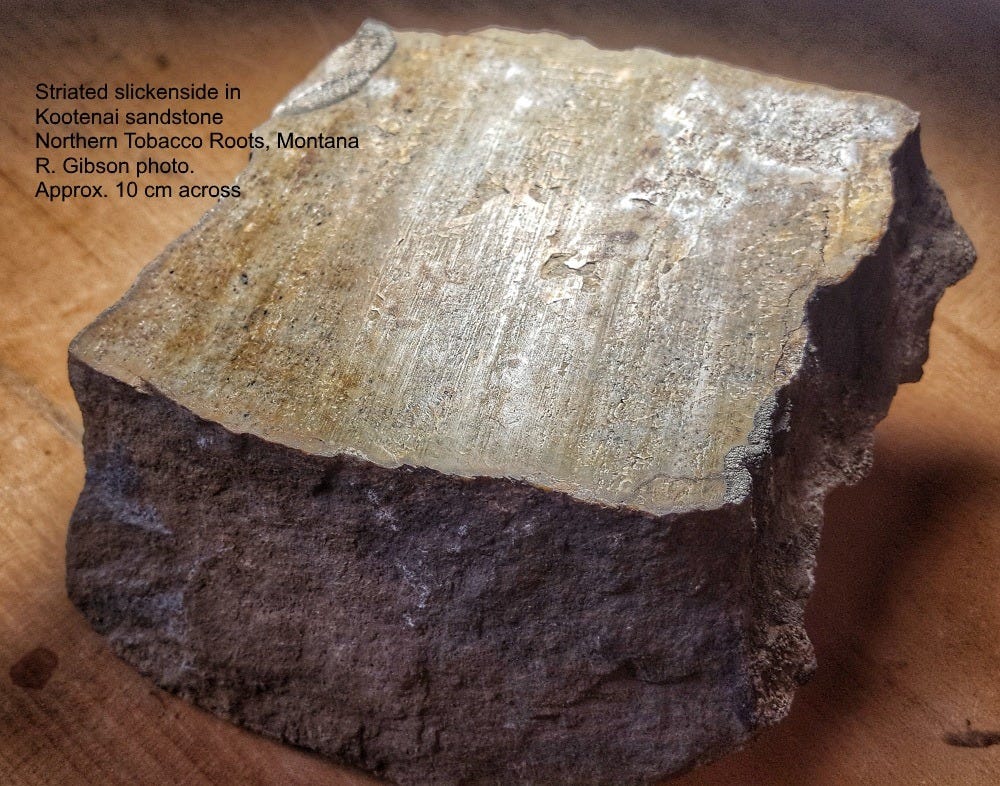
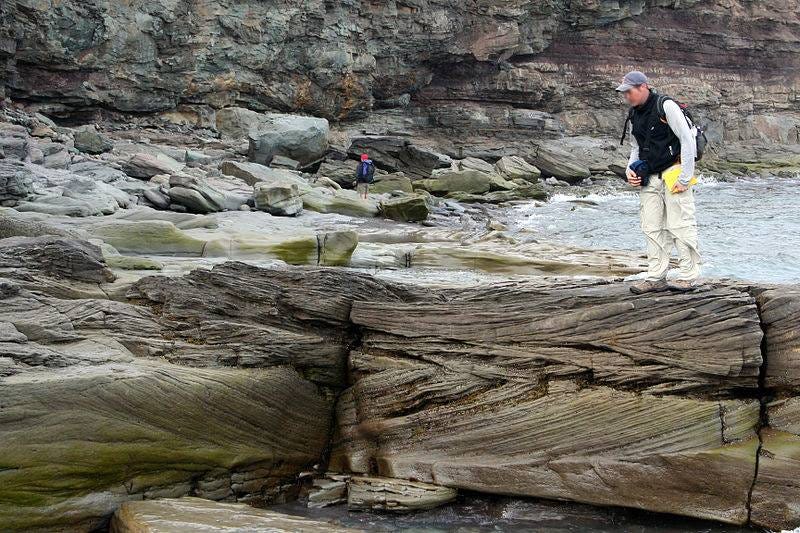
This chunk of rock is a cherty sandstone, deposited in a fairly strong river system that flowed across western Montana maybe 115 million years ago, Cretaceous time (Aptian age). The sandstone is part of what we call the Kootenai Formation, and we can tell the river system was a pretty strong one for at least two reasons: First, the sand in the rock is pretty coarse (1 to 2 mm) – it took a strong flow to move such large grains (and nearby are even coarser beds with rounded pebbles several centimeters across). And second, at a broader scale, a few tens of feet, the sand is arranged in big cross-beds, essentially petrified dunes that formed on the river bottom.
Such river bed forms reflect the volume, depth, and velocity of water flow. Some of the cross-beds in the Kootenai are a few feet high, and their orientations are not parallel to the beds, which is why they are called cross-beds: they cut across the normal flat bedding planes. (See the photo of cross-beds below.) A strong river made these large cross-beds. Often, wind-blown sand makes dunes too, and it can be challenging (but possible!) to distinguish between wind- and water-borne cross-beds.
But the rock in my photo is more informative. It’s hard to photograph, but the top surface is so smooth and shiny you’d think it had been polished. Well, it was polished, but not by humans. The smooth surface has small but more or less parallel and polished grooves. In a different place and on a different scale, such a striated smooth polished surface might be inferred to represent a glacier cutting and polishing a rock with the other rocks contained in the ice, but here there’s a different origin.
When rocks move alongside each other, say along a fault, they are often under pressure and the temperature may be fairly high, both because of the depth where it’s happening and because of the friction between the two surfaces. The two sides of the rock can polish each other, resulting in a feature called slickensides. The relative movement along a fault means that even though the sides may be quite smooth, there are tiny little steps along the surfaces that sometimes can be felt with your fingers, so you can tell which side moved which way. Update: The traditional idea that the steps may indicate a direction of movement is not really correct. Thanks to structural geologist Colleen Elliott for providing a reference (Doblas, 1998, Slickenside kinematic indicators: Tectonophysics, 295 (1–2): 187–197) that shows diverse types of slickensides and slickenlines, many of which produce step-like features whose geometry and feel can indicate motion in either direction along the slickensides or slickenlines.
Such friction altering mineral grains and smoothing rocks can develop without the material being excessively deep or hot. Some slickensides form at depths of less than 2 km and temperatures less than 270°C (Power and others, 1989, The relationship between slickenside surfaces in fine-grained quartz and the seismic cycle: J. Structural Geology, 11:7, p. 879-893).
So did I pick up this rock in the Sacry’s ranch area of the Northern Tobacco Roots of Montana at a place where the Kootenai sandstone was faulted against something that polished this surface? Nope.
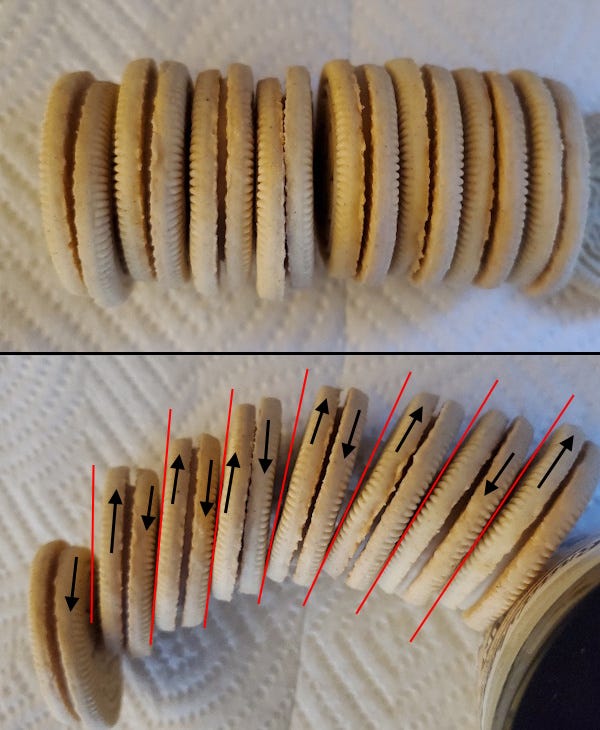
Remember those cross-beds, with packages of sandstone sitting at cross-angles to each other and to the usual bedding planes? Imagine a stack of flat cookies, nicely parallel to each other but at standing an angle in their package. Take 5 or 10 cookies in your hands and bend the group into an arch. What happens? Each cookie slides against the adjacent ones, even scraping off crumbs if you hold the group tightly enough. If the filling didn’t hold the top and bottom cookies together, they’d slide too. This is analogous to what happens to a bundle of coarse sand cross-beds in the Kootenai formation if you fold the whole system. The individual cross-beds slide against each other, and when they do they polish the surfaces of the adjacent rock. The zones that tend to slide against each other will be the weakest zones, the pre-existing surfaces that are ready to slide. That includes both normal bedding planes and cross-bed surfaces.
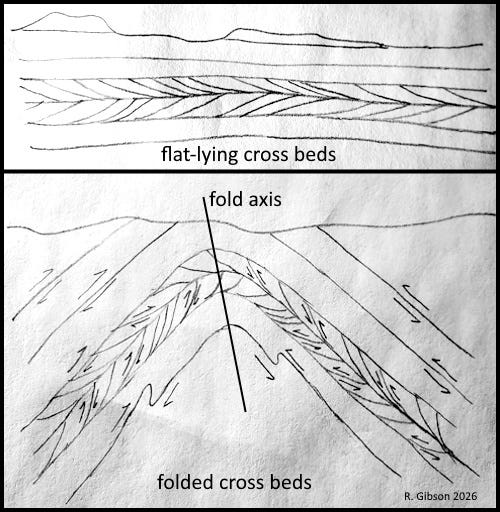
My cartoons above try to illustrate this, showing the slip (arrows) along pre-existing weak zones (bedding planes and cross-bedding planes). The slip direction depends on which flank of the fold the beds are on. Such slip need not occur everywhere (it depends on the nature of the materials) but it can and often does. I’ve seen some outcrops of the Kootenai cross-bedded sandstone where most of the cross-beds have some smoothing if not clear-cut slickensides like those in the top photo. And yes, it can get complicated in the area of the fold axis.
So this rock is probably not from a fault surface, but from a cross-bed surface that was flexed in a fold. And technically, I guess, since one piece moves relative to another, it is indeed a small fault – just not the kind you think of that breaks rocks in major ways.
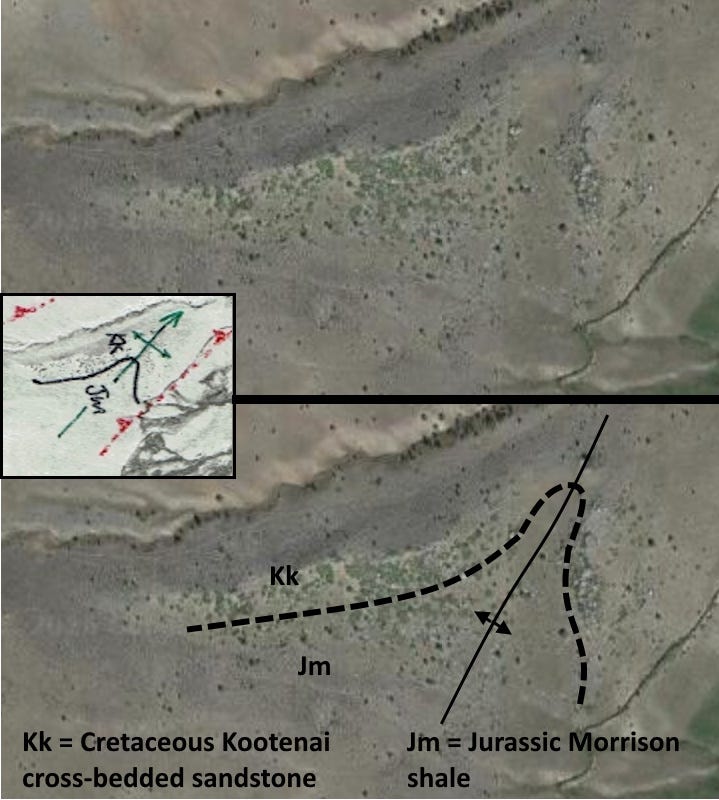
You really can’t tell all that from the rock in this photo alone – you really have to look at the broader context in which it was found, in a little anticline about five miles (8 km) south of Cardwell, Montana, seen on the Google earth image below. The inset shows my 1969 map of that anticline on a 1955 aerial photograph.
Ah Sacry's. A magical place with so many intriguing complexities! Great article. The Kootenai Fm remains one of my long time favorites!
We see quite a few slickensided serpentine rocks in western Tasmania.