
Stichtite
Connecting Tasmania and Montana

Life in the USA is not normal. It feels pointless and trivial to be talking about small looks at the fascinating natural world when the country is being dismantled. But these posts will continue, as a statement of resistance. I hope you continue to enjoy and learn from them. Stand Up For Science!
If you’ve been around The Geologic Column for a while, you know I like taking something tiny and elucidating the bigger, even global picture. If I can make some obscure connections on the way, so much the better. Here’s today’s post.
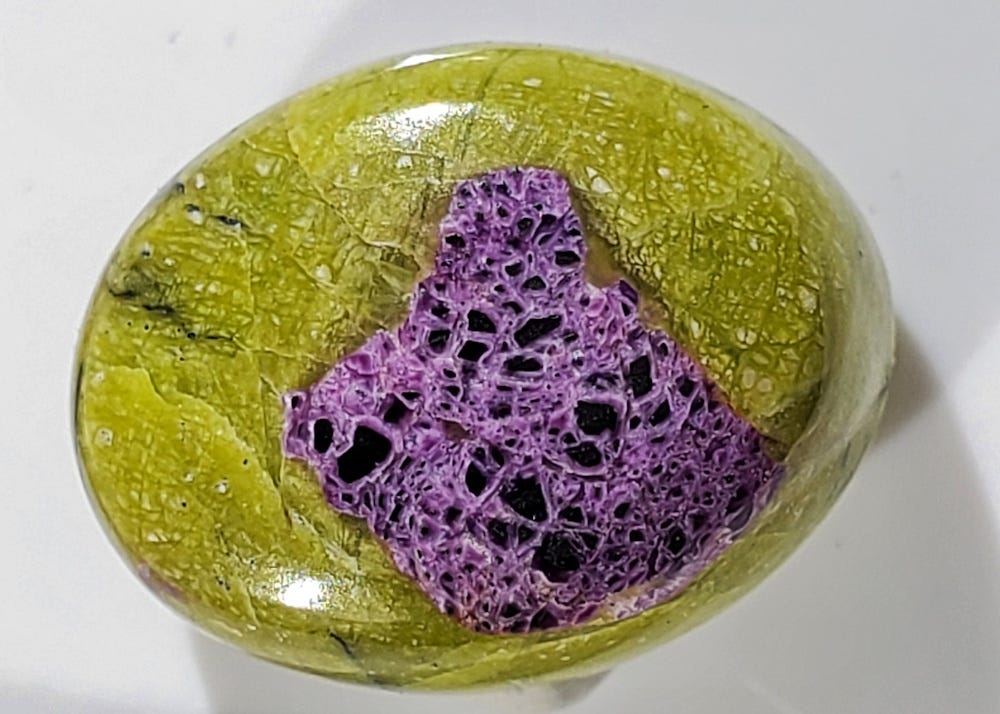
Stichtite is an unusual but pretty purple mineral, a hydrous magnesium-chromium carbonate, Mg6Cr3+2(OH)16[CO3]·4H2O. This little (13 x 9 mm) polished specimen contains black chromite fragments, suggesting that it formed as an alteration of an original chromite (FeCr2O4) grain. It’s surrounded by a yellow-green matrix of lizardite, Mg3(Si2O5)(OH)4, a magnesium silicate typical in altered magnesium-rich rocks such as ophiolites – the slices of oceanic crust we’ve visited several times in The Geologic Column. Unanalyzed, this “chromite” should more properly be referred to the chromite-magnesiochromite series, FeCr2O4 to MgCr2O4, expectable for the magnesium content.
The specimen is from western Tasmania, a gift to me from Stuart Parker. It is most likely from Stichtite Hill, the type locality in the Dundas mineral field of the Zeehan mining district, but there are other locations it might be from.
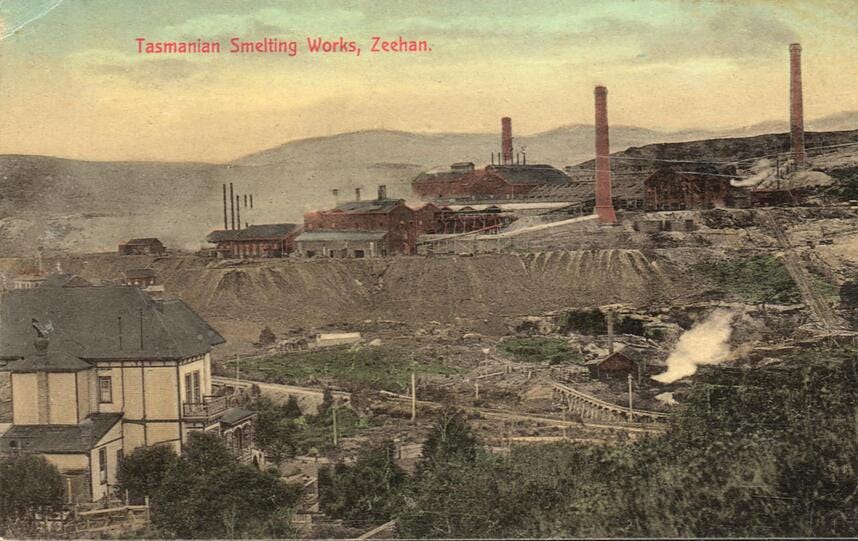
The Zeehan district was primarily lead-silver mines localized in Precambrian sedimentary and volcanic rocks intruded by the Heemskirk granite of Devonian age, about 360 million years ago (Parbhakar-Fox and others, 2019, Geometallurgical characterization of non-ferrous historical slag in western Tasmania: Identifying reprocessing options: Minerals 9(7): 415).
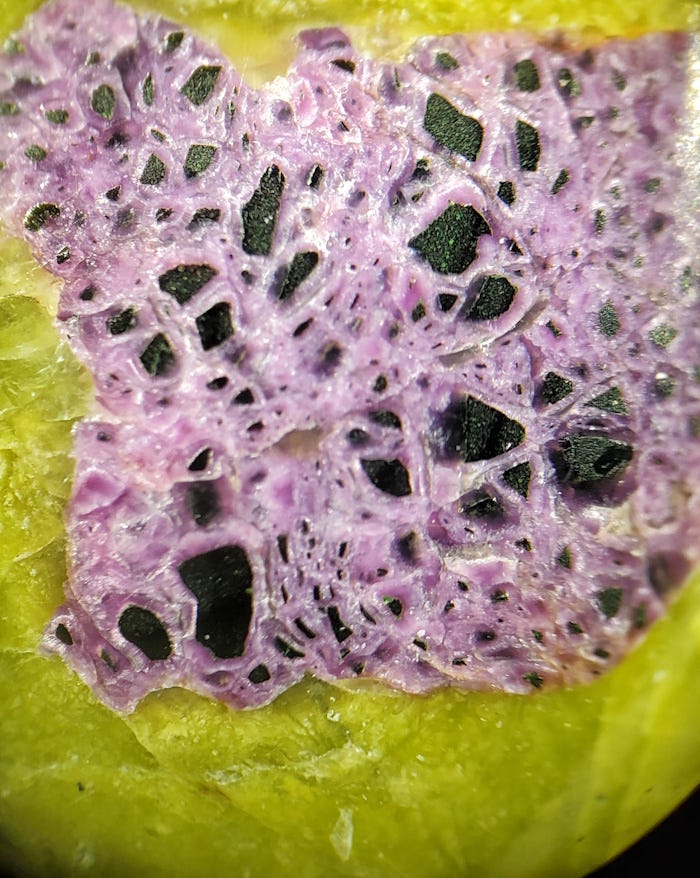
The stichtite and related chromite are from chromium-rich serpentinite in ophiolites of Cambrian age, near but not genetically part of the targets in most of the Zeehan district mines. Worldwide, all 14 known localities for stichtite are in such serpentenites (Ashwal and Cairncross, 1997, Mineralogy and origin of stichtite in chromite-bearing serpentinites: Contrib. to Mineralogy and Petrology, 127 (1): 75-86).
For more about the mineralogy of Tasmania, please see Steve Sorrell’s presentation linked at Mineral Matters.
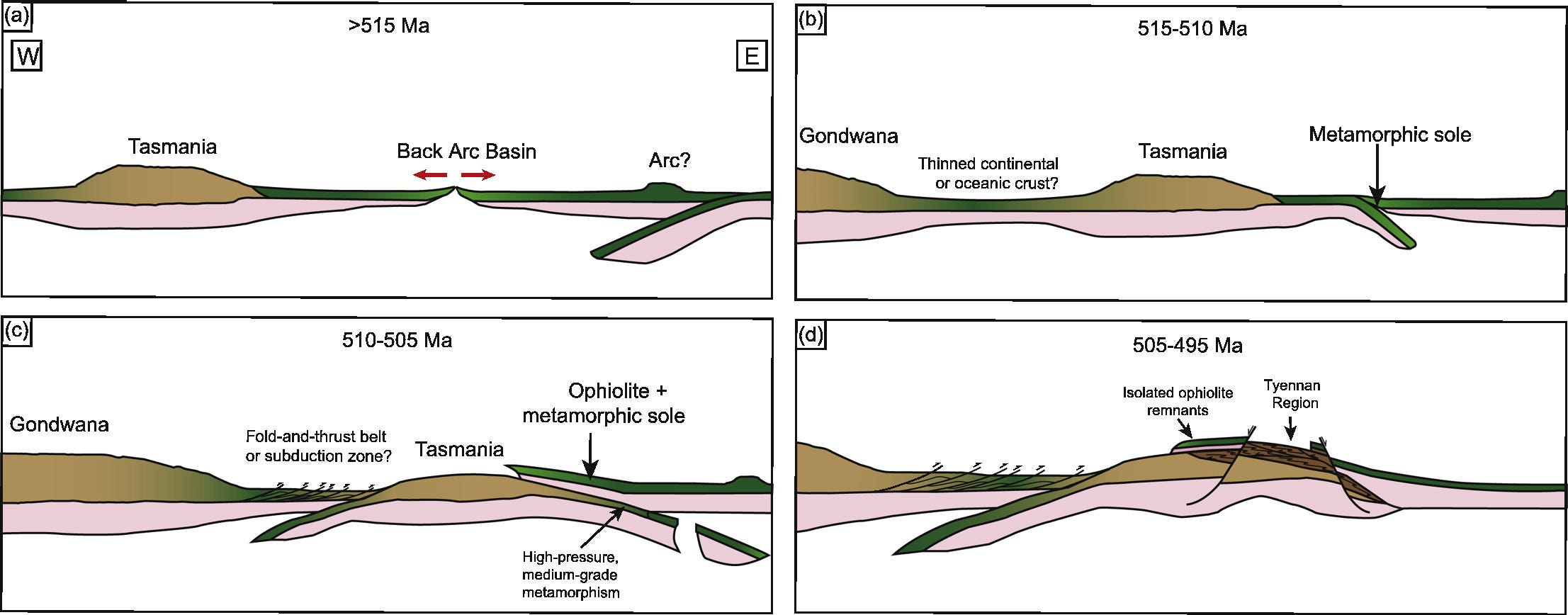
The ophiolite, oceanic crust, in the Western Tasmania Ophiolite, was probably emplaced about 510 million years ago (Cambrian time) as part of collisions and accretion following the breakup of the supercontinent of Rodinia (Mulder and others, 2016, The metamorphic sole of the western Tasmanian ophiolite: New insights into the Cambrian tectonic setting of the Gondwana Pacific margin: Gondwana Research 38, p. 351-369). Mulder and others’ cross section history is shown above.
Stichtite was named by W.F. Petterd in 1910 for Robert Carl Sticht (1856 - 1922). Sticht was the General Manager of the Mount Lyell Mining and Railway Company, Queenstown, just southeast of the Zeehan District. Sticht was born in Hoboken, New Jersey USA, and came to Tasmania in 1895 where he rose to prominence as a metallurgist, smelter designer, and manager. In addition to being the namesake of the mineral, the Sticht Range in western Tasmania was named for him. Sticht brought to Tasmania the concept of pyritic smelting, a process he pioneered in which the heat to smelt ores is primarily generated by the oxidation of pyrite and other sulfides in an exothermal process. It was cheaper than conventional roasting of ores.
Sticht’s pyritic smelting led to the Economist calling Mount Lyell “the best-managed mine in Australasia,” and for a time the company had revenue greater than the entire Tasmanian government (McShane, 1990, Robert Carl Sticht: Australian Dictionary of Biography, Volume 12), but by the 1920s pyritic smelting had been replaced by even more efficient flotation processes.
Although he opposed unions, Sticht was known for his kindness to individual miners, prospectors, and employees. He had what was considered to be the largest private library in Australia, which included Euclid’s Elementa (the Erhard Ratdolt edition of 1482), one of only three complete copies in the world.
When Sticht came to Tasmania, he had extensive experience both as a metallurgist and smelterman. His first project was in Pueblo, Colorado, and in 1888 he was in Great Falls, Montana USA, contributing his expertise to Paris Gibson’s (no relation) Montana Smelting Company smelter (Rossillon, 2011, The short life of the Montana Smelter, a custom silver-lead smelter in Great Falls, 1889-1901: IA: The Journal of the Society for Industrial Archaeology, 37:1-2, p. 43-60). That company merged in 1891 with the Helena & Livingston Smelting and Reduction Company as United Smelting and Refining, which eventually became American Smelting and Refining Company (ASARCO).
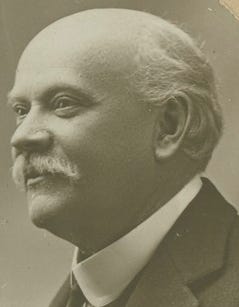
Sticht was present in Great Falls when the smelter produced its first silver bullion in January 1889, and he also worked as a consulting metallurgist on projects at Neihart and Barker in the Little Belt Mountains on behalf of United Smelting. The silver crisis of 1893 affected the Great Falls smelter badly and it closed in 1901, to be demolished in 1928.
Sticht’s next stop in Montana was as superintendent of the smelter at Boulder in 1891-1893. In 1894 he moved again, to the new Golden Sunlight gold mine near Whitehall, Montana, where he supervised the first load of ore to the concentrator in November 1894. Under his supervision, Golden Sunlight processed 125 tons of ore daily, with a yield of $75 per ton in 1890s dollars. Soon after Golden Sunlight was fully operational, Sticht went to Australia.
And the final connection: Robert Sticht’s brother Eugene was an assayer here in Butte, with his office and residence in a small one-story building at 48 East Broadway, just nine blocks from my own home. For those familiar with Butte, that East Broadway address is where the Montana Power Company offices were after the early 1900s. Eugene Sticht left Butte for Republic, Washington, about 1899 and is lost to history thereafter. Robert Sticht is buried in Tasmania.
That is definitely a Stichtite Hill specimen Richard. Also, I have a book that belonged to Sticht (with his signature inside). He received it the same year that he passed away.
Crocoite is also from Zeehan.