
The Adirondacks
And Balmat

Life in the USA is not normal. It feels pointless and trivial to be talking about small looks at the fascinating natural world when the country is being dismantled. But these posts will continue, as a statement of resistance. I hope you continue to enjoy and learn from them. Stand Up For Science!
Balmat, New York, is in the Adirondacks. The mineral deposits there were mined for mostly lead and zinc as early as 1838, and some areas were mined as recently as 2001. The original rock must have been a limestone that was metamorphosed to marble and folded during the Grenville Orogeny, about 1.1 billion years ago, when a long narrow continental fragment collided with what was then the southeastern margin of a much smaller North America.
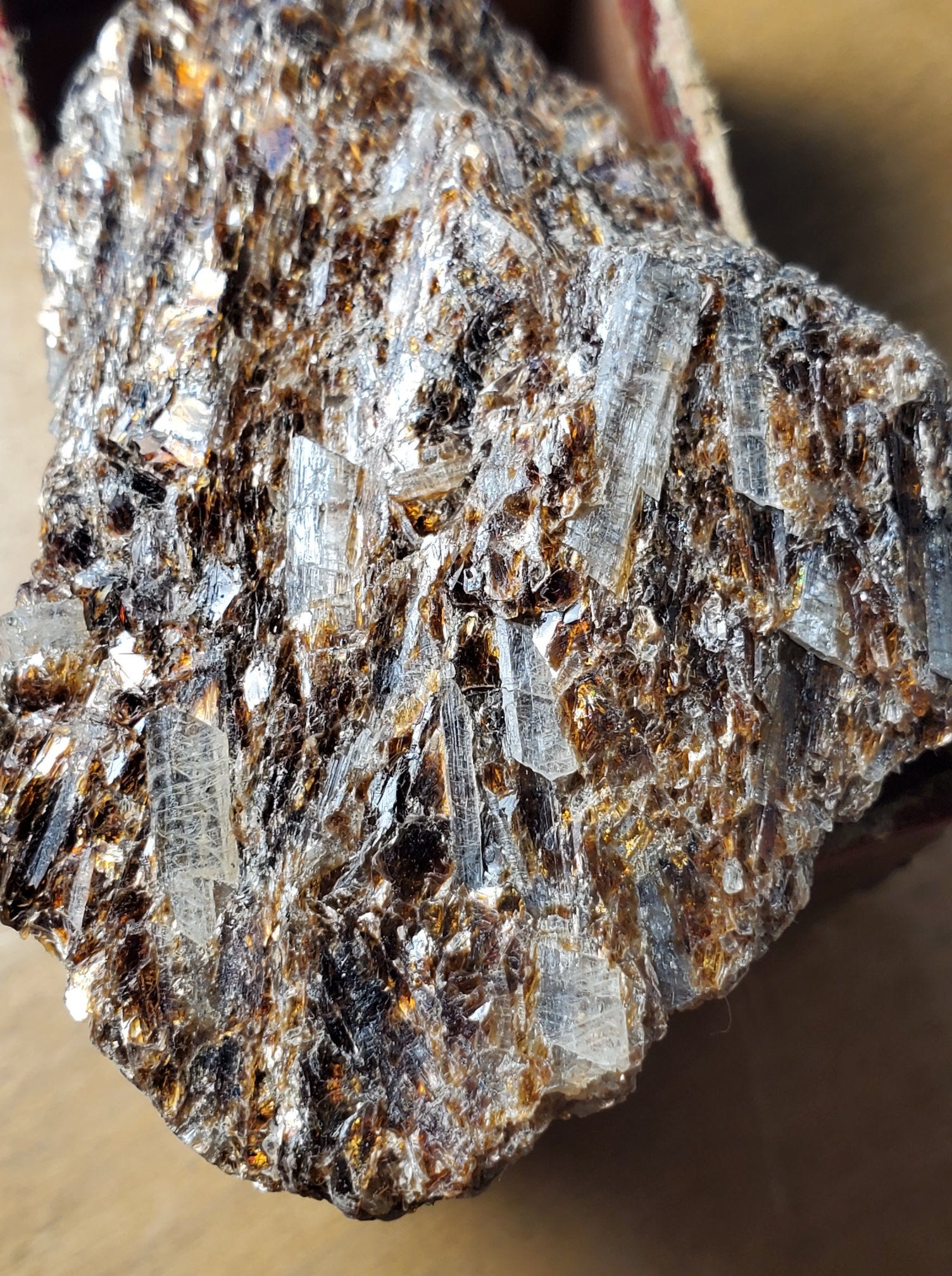
This rock in the top photo, about 5 cm long, is mostly tremolite (the bluish blades that look somewhat like kyanite, but are not), which is a calcium-magnesium aluminosilicate (one of the amphiboles), and brown mica, probably biotite, so we could call this a tremolite schist. I collected it during a Flint Junior College geology field trip in 1967. We were not in the mining district itself but in metamorphic rocks nearby.
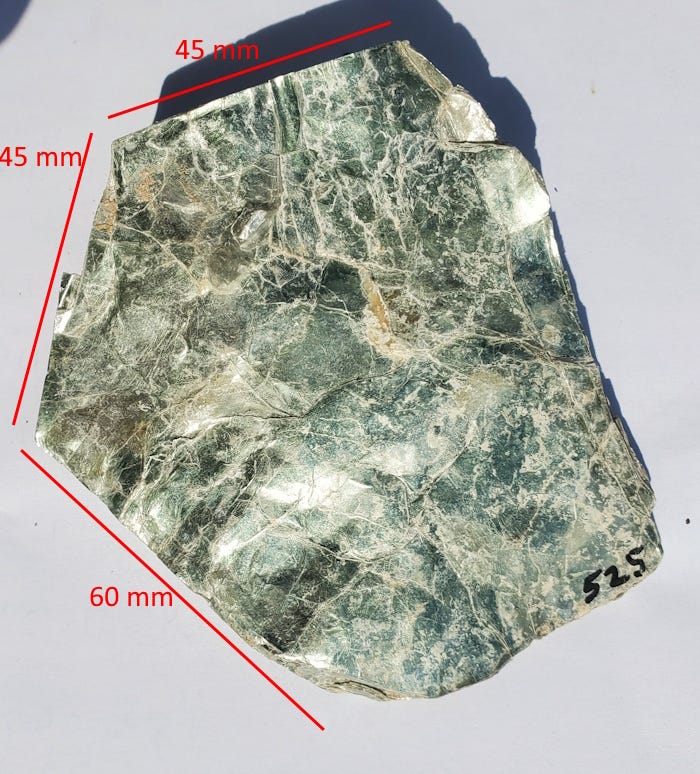
I’ve labeled the greenish mica above fuchsite, the chromium-rich variety of muscovite, but it may simply be colored by some amount of iron. It’s from the Balmat area, and it is part of quite a large crystal. The measurements of the best-formed crystal edges are labeled above. We’ve seen definite fuchsite in this previous post.
The modern Adirondacks are much younger than the old Grenville mountain-building event. The rocks were buried deeply – perhaps as much as 15 miles below the surface – during the Grenville Orogeny, when they were also intruded by various magmas. The result of the high pressures and temperatures was a wide variety of both igneous and metamorphic rocks.
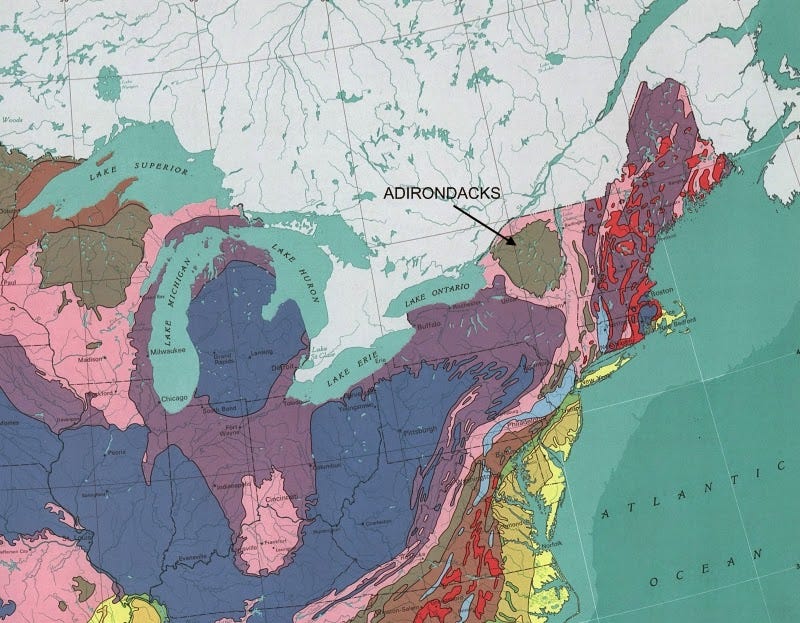
The Adirondacks of northern New York are a strange little range, almost circular in shape. It’s really a large dome, a circular geological uplift. The oldest rocks, uplifted the most, are in the center, with younger rocks draping the flanks of the dome. And this uplift is really quite young, beginning around 5 or 10 million years ago – just yesterday, geologically speaking – and continuing to the present. So the present mountains have nothing to do with the ancient Grenville mountains, and also nothing to do with the Appalachians – which today are relatively low, eroded hills, a remnant of the mountain building events of the Ordovician, Silurian, Devonian, and Carboniferous. So why are the Adirondacks there?
The circular dome shape suggests some kind of force pushing up from depth, and you get domes where things like magmatic intrusions, cylinders of molten rock, like the neck of a volcano but down within the earth, rise. They push the rocks above them up like your fist pushing up in the middle of a blanket. Salt, which is not usually molten in the earth, can flow plastically under pressure, and salt domes can do the same thing to the rocks they rise up against and through – but on very local scales compared to the Adirondacks.
The Precambrian core of the Adirondacks is exposed because those old rocks were uplifted, along with a thick pile of younger sedimentary rocks. It’s probable that sedimentary rocks, including the Cambrian Potsdam sandstone and strata from the Ordovician, Silurian, and Devonian were laid down over the region where the Adirondacks now stand. But those rocks were eroded off the rising Adirondacks, mostly in the past 5 or 10 million years or so.
It would have to be something big to rise from great depth to produce the huge dome at the Adirondacks. Not a salt dome, and not the small uplift around a rising magmatic intrusion. Those kinds of things make domes that are maybe one to 5 miles across, maybe 10 miles at most. The Adirondack Dome is 160 miles (260 km) in diameter.
To be honest, we really don’t know why the Adirondack Dome began to rise, and why it continues to rise – by some estimates, one of the fastest-rising mountain ranges on earth, perhaps as fast as 1 or 2 millimeters a year, which is actually incredibly fast; but there is controversy over uplift rate estimates.
One speculation is that there was (or is) a hotspot beneath the Adirondacks. Hotspots are regions of relatively low-density mantle, many tens of miles within the earth, that tend to rise buoyantly through denser parts of the mantle. Such a blob, pushing up, could make the broad dome that we see in the Adirondacks. Hotspots are well known, especially those that get shallow enough that reduced pressure allows the hot rocks to melt. Then you can get volcanoes. There is a hotspot beneath Hawaii, one under Iceland, and one under Yellowstone. There are a few dozen around the world.

Out in the Atlantic Ocean there is evidence for a hotspot that the oceanic portion of the North American Plate has been moving over for some time. The track is represented by seamounts, essentially flat-topped eroded volcanoes that might have once been something like today’s Hawaiian chain. The hotspot that made those volcanic seamounts is called the New England Hotspot or Great Meteor Hotspot. Don’t let that name throw you – it has nothing to do with a meteor impact. The seamount that gives its name to the hotspot, Great Meteor Seamount, was named for the German research vessel Meteor, whose scientists discovered the seamount in 1938. It is called “Great Meteor” to distinguish it from a smaller Meteor Seamount discovered earlier in the South Atlantic by the same vessel. Yes, they might have done something less confusing in their naming, but there it is.
It’s possible that the Adirondacks represent an uplift above that hotspot when it was beneath the continent. There are problems with that idea – like why is the only domal uplift at the Adirondacks? Why is it so big? Maybe the hotspot hung out there longer. Or maybe the crust was a bit weaker there. There are problems with the timing, too – the hotspot would have been under the Adirondacks well before the modern uplift, and in reality, the hotspot track is well off to the side of the Adirondacks, and it is considered to have created the intrusives in the White Mountains of New Hampshire and other parts of New England and Quebec, away from the Adirondacks. So maybe the hotspot weakened the crust, and something else made it rise adjacent to the track in the past 5 million years or so — but I think the hotspot idea leaves a lot to be desired as an explanation for the Adirondacks. Or maybe something else happened unrelated to the hotspot, or maybe it’s a different hotspot, not the one that made the Great Meteor Hotspot chain.
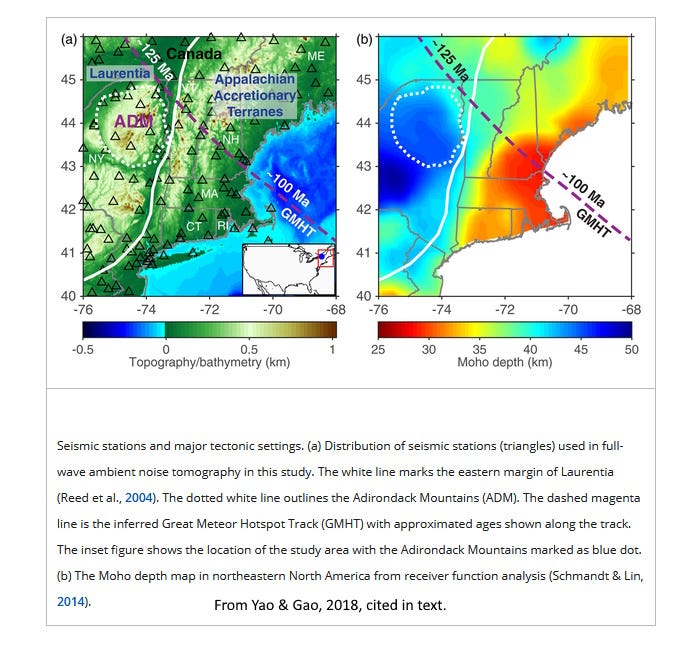
One relatively recent study using seismic imaging suggests that the timing of the passage of North America over the Great Meteor Hotspot, about 125-100 million years ago, contributed to mantle upwelling and weakening of the crust that made more recent upwelling of the asthenosphere possible. The asthenosphere is the ductile zone at the top of the mantle (below the brittle lithosphere of the crust), and a local swelling of it could account for the timing and size of the Adirondacks. (Yang, X., & Gao, H., 2018, Full-wave seismic tomography in the northeastern United States: New insights into the uplift mechanism of the Adirondack Mountains: Geophysical Research Letters, 45, 5992–6000. https://doi.org/10.1029/2018GL078438 ) Some important details, such as why the passage of the hotspot left its impact most significantly at the Adirondacks, away from the hotspot as I indicated above, remain enigmatic. On the whole, despite these interesting studies, it seems like the hot spot origin idea for the Adirondacks is largely discounted these days.
The word asthenosphere was coined by Joseph Barrel based in part on work he did in Butte and other parts of western Montana, described in one of the articles in my compilation of posts on the History of Geology.
The genesis of the Adirondacks is an interesting and challenging question, and the bottom line is we really don’t know for sure why the Adirondacks are there. Knowledgeable folks of course feel free to chime in with other, additional information.
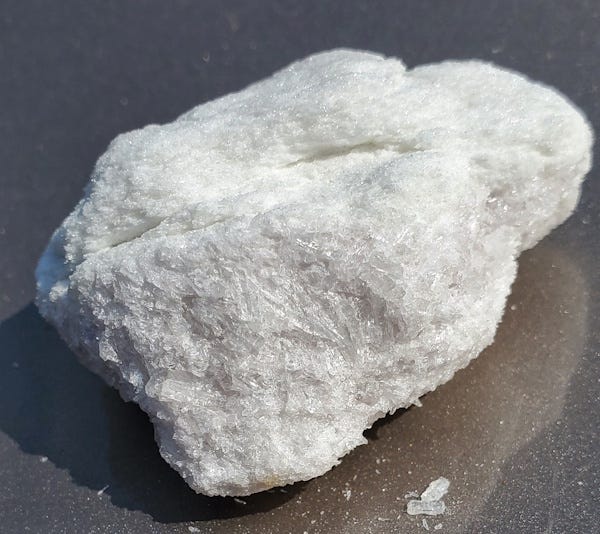
Tremolite from the metamorphic rocks of the Adirondacks is quite variable in texture and color. The crumbly, almost snow-white 60-mm specimen above fluoresces a nice yellow-orange in short-wave ultraviolet light, typical of tremolite from Balmat.
If un-knowledgeable folk are also allowed - the English Lake District is also a recently risen dome of ancient rocks. Interpretation I've read never suggests hotspots but a shrug from the distant Alpine mountain building. (Which has obvious folding on the south coast but not anywhere closer.)
This was fascinating. Love the history. I spent a summer in the Adirondacks in 1968. I love it, there. You are a veritable encyclopedia, Dick. Love these posts.