
The Amalgam War
Hg or not Hg?

Life in the USA is not normal. It feels pointless and trivial to be talking about small looks at the fascinating natural world when the country is being dismantled. But these posts will continue, as a statement of resistance. I hope you continue to enjoy and learn from them. Stand Up For Science!
Dental work in crowns, bridges, and inlays uses gold because it is so malleable and resists tarnish. The largest gold mine in the U.S. was at Homestake, South Dakota, with nearly 45 million troy ounces produced. Mining began in 1876 and continued until 2001, reaching 8000 feet, the deepest mine in the Western Hemisphere. The gold at Homestake is hosted by iron formation almost two billion years old, and the gold mineralization itself is nearly that old, at 1.8 billion years. More recently discovered – and younger – gold deposits around Carlin, Nevada, may contain as much as 80 million ounces, and in 2026 Nevada is the leading gold producer in the US with about 64% of the total; Alaska is a distant second with 22%.
The gold in your mouth may have come from one of over 1000 producing areas in the U.S., or from South Africa, the world leader until 2007, when China edged South Africa out of first place. Gold production is scattered around the world, with the leader China producing about 12% of the total, followed by Russia (9%), Australia (8%), and Canada (6%). The US at #5 produces about 5% of the world’s gold, just ahead of Ghana, Mexico, Kazakhstan, and Uzbekistan at 4% to 5% each, and Peru, South Africa, Indonesia, and Brazil at about 3% each.
Dental gold, commonly alloyed with silver, platinum, palladium, and/or copper, is harder than pure gold. The United States, ranked fifth in gold production, is a net exporter, but imports also come from Canada, Mexico, Columbia, and elsewhere.
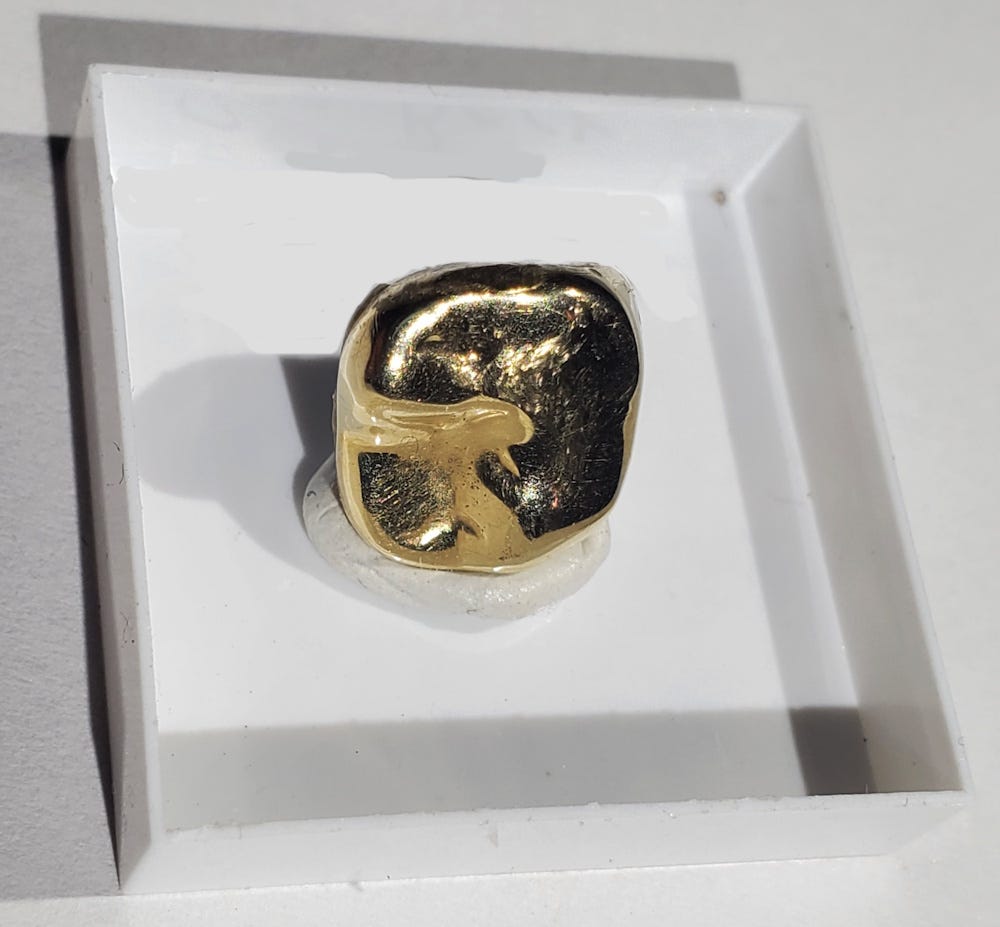
My gold crown in the top photo (yes, it is literally mine; it fell out on 27 March 2021, and of course I “collected” it) is probably about average in terms of gold content, at around 67%, but dental gold ranges from about 10 karat to 22 karat (42% to 91% gold). Even in 2021 when it fell out, this crown probably contained at least $90 in gold, and at the spot price of $4,563 on April 29, 2026, and using that 67% average gold content, this little thing, a little over a tenth of an ounce in total weight (~0.075 oz gold) has a melt value around $340.
Stone chips, lead, cork, gum, gutta percha (derived from the latex of Malaysian sapodilla trees), turpentine resin, porcelain, tin foil – all have been used to fill dental cavities or pack root canals, and some, including gutta percha, still are. Gold leaf became a common filler after Marcus Bell began to use it in Hartford, Connecticut, in 1812, but the drive to find cheaper amalgams led the French dentist August Taveau to combine shavings from silver coins with mercury.
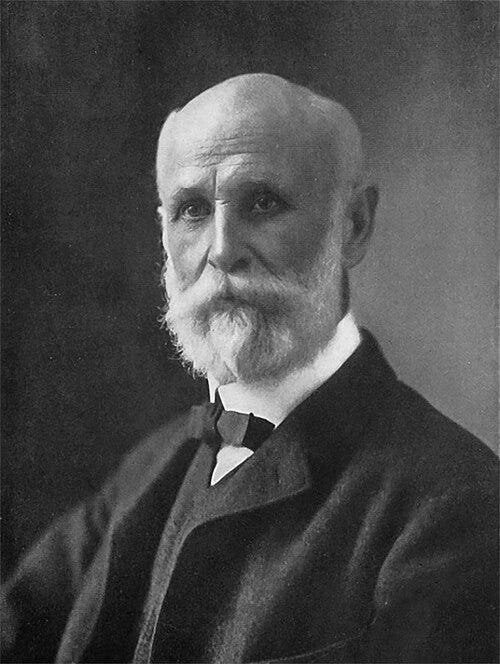
The importation of this technique to the United States in 1833 led to the bitter Amalgam War, argued largely over mercury’s deficiencies and advantages. Not until 1895 did dentist G.V. Black devise a standardized amalgam. Black is considered the father of modern dentistry, and there’s a statue of him in Lincoln Park, Chicago, Illinois.
Note: This post was scheduled about 4 weeks ago. It’s entirely coincidental that silver expert Terry Wallace, whose mineral substack I follow, recently provided a detailed look at silver amalgams and the Amalgam War, based on an experience similar to mine! For much more information than I provide here, you can click the red link.
Until World War I, dental amalgams were usually 26% cadmium and 74% mercury. Modern amalgams are about half mercury and half tin-silver-copper-zinc alloys; in 2026, the American Dental Association considers them safe, but controversy continues and some “anti-amalgamist” dentists lead an ongoing fight against mercury in dental amalgams.
Nickel and palladium strengthen both gold and silver in dental alloys, and occasionally tin, gallium, cobalt, or indium may be alloyed with silver. White composite resins, essentially plastic derived from petroleum, fill and face cavities and depressions on front teeth. To adjust strength, color, hardness, and other properties, these mixtures may contain added silica (quartz), glass, zirconium, strontium, or barium. Zirconium oxide helps make crowns and inlays fracture resistant and stronger.
As the price of gold has surged, its use in dentistry has fallen along with most other uses other than physical bars for investment. In 2026, dental gold is in the category “other” that accounts for only 1% of gold use in the US, down from around 8% 15 or so years ago, following bars, bullion, and gold for banking institutions (45% and rising), jewelry (40%), coins and medals (7%), and electronics (7%).
This post was updated and expanded from Chapter 5, “The Personal Alchemy Kit,” in my 2011 book What Things Are Made Of.
My insurance won't pay for gold fillings or gold teeth - both of which I've asked for over the years. Alas, my mouth is merely an amalgam of acrylic resin, doritos seasoning flakes, coffee stains, and at least one molar has been backfilled with friable shale (the Decorah Shale to be exact).
I have a remarkable gold filling, installed about 1994. It fills the bite area of 2 teeth and the space between. No problems ever with it, while other filled areas in my mouth have chipped and needed replacement. Too bad the art of gold fillings has fallen aside and is not supported by insurance. Seems to be a superior product.