
The Old Red Sandstone
and the Loch Ness Monster

Life in the USA is not normal. It feels pointless and trivial to be talking about small looks at the fascinating natural world when the country is being dismantled. But these posts will continue, as a statement of resistance. I hope you continue to enjoy and learn from them. Stand Up For Science!
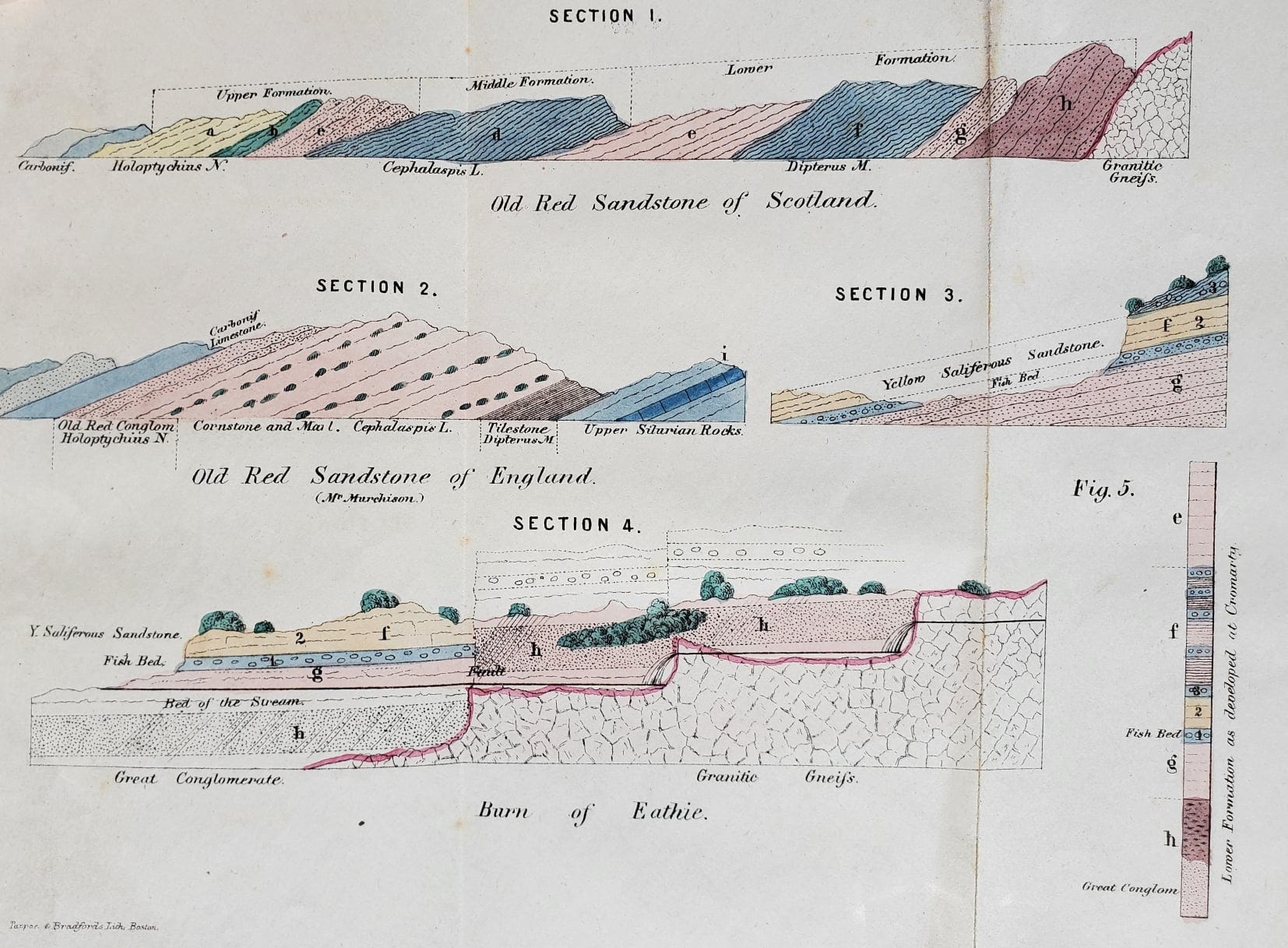
Hugh Miller’s 1841 book, The Old Red Sandstone: Or, New Walks in an Old Field, was an early scientific work on the rocks of Britain that made geology accessible to laymen. This frontispiece above, from my copy of the first American edition published in 1851 in Boston, shows cross sections that helped people understand the relationships among tilted and deformed strata.
The Devonian Old Red Sandstone was deposited in fault-bounded troughs formed late in the Caledonian Orogeny when sediments were eroded from the high Caledonian Mountains about 370 to 390 million years ago. At that time, a 300-mile-long (480 km) transform (strike-slip) fault developed in what is now Scotland (where it is called the Great Glen Fault), Newfoundland (as the Cabot Fault), and Cape Breton Island Nova Scotia (the Aspy Fault) which were attached to each other then as parts of the elongate microcontinent/island arc of Avalonia.
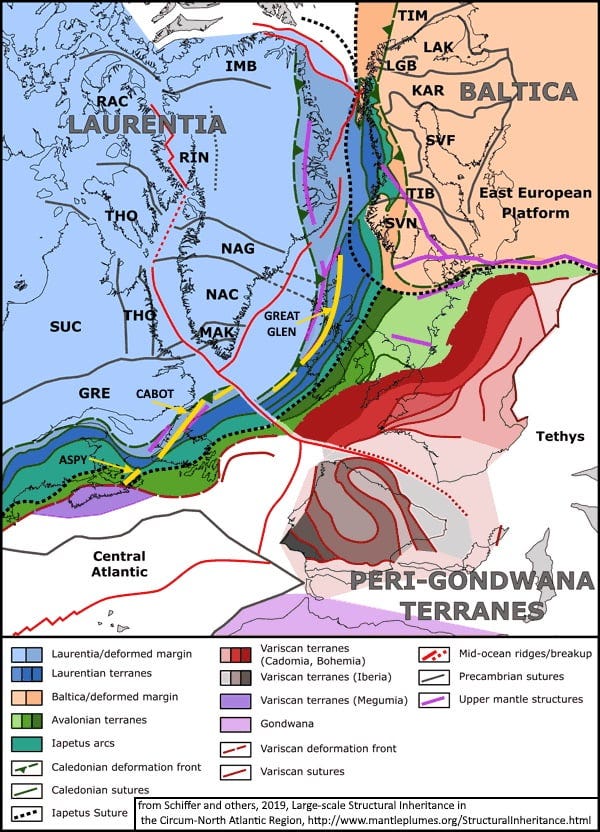
The big transform fault, similar to the San Andreas or even more so to the Alpine Fault in New Zealand, resulted from parts of the amalgamated terranes sliding past each other and also from faulting breaking into the older rocks they collided with in the ancient core of North America (Laurentia). Ongoing movement eventually tilted the Old Red Sandstone beds. That was probably mostly related to the Carboniferous collisions that formed Pangaea about 335 million years ago when the Great Glen Fault was rejuvenated. There may have been some additional movement when Pangaea broke apart and the North Atlantic Ocean formed about 180 to 160 million years ago.
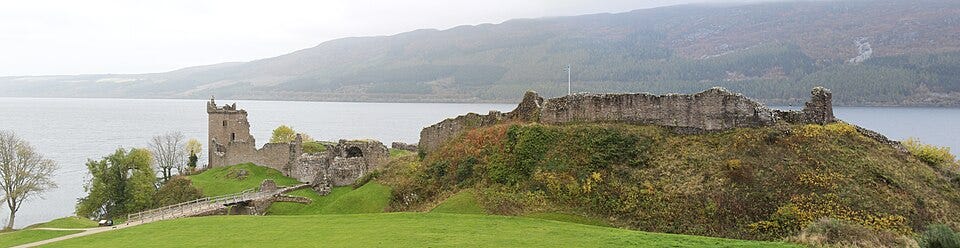
Today, the Great Glen Fault localizes Loch Ness, a long, very narrow lake. The fault continues offshore northeastern Scotland, just a few miles east of Cromarty and the Burn of Eathie where Hugh Miller made his observations, and whose rocks are shown in his cross sections in the frontispiece to his book.
According to Piccardi (2014, Post-glacial activity and earthquakes of the Great Glen Fault (Scotland): Memorie Descrittive della Carta Geologica d’Italia, XCVI, pp. 431-446) the origin of seismic activity (with rare earthquakes as large as magnitude 5) on the Great Glen Fault today is ambiguous and may be related to ongoing spreading of the North Atlantic Ocean or to glacial rebound or both.
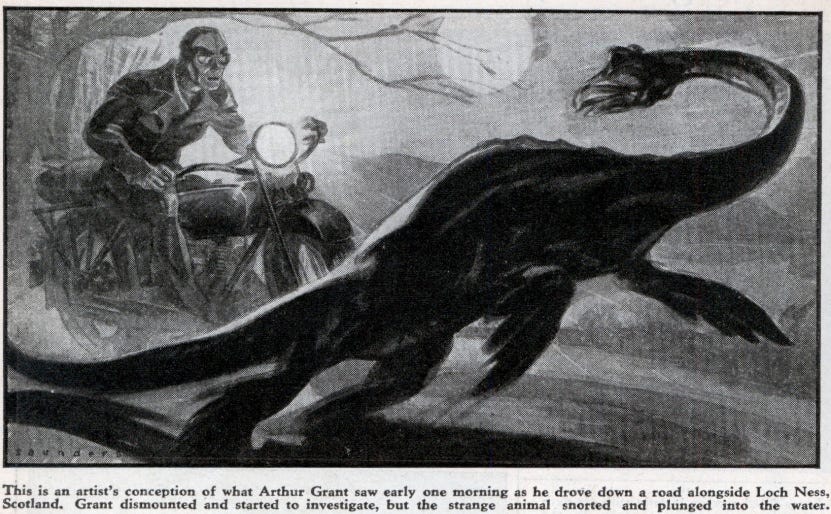
There is also good anecdotal evidence that the modern belief in the Loch Ness Monster correlates with periods of seismic activity on the Great Glen Fault that probably produced “violent commotion of the water and anomalous wave-wakes,” particularly in an earthquake swarm in 1934. Seismic sounds and other phenomena near the Great Glen Fault are also reported in the stories of St. Columba, the 6th-century Irish priest who brought Christianity to Scotland and in whose legends the Loch Ness Monster is first mentioned.
Until chromolithography became relatively cheap in the 1870s, the only effective method for producing color in mass-produced items like books was hand-painting, as you see in the drawings at top. Each instance of this color illustration would have been individually hand painted with watercolors on sheets engraved or lithographed with the outline of the drawing. The press run was probably on the order of 800 copies, and for larger runs publishers employed small armies of painters to color their illustrations.
Watercolors in the frontispiece of The Old Red Sandstone include shades of red, blue, green, and yellow, all probably derived from mineral-based pigments. Reds come from various iron oxides and the blue may be Prussian blue, a pigment made of iron cyanide, or it might be the newer (1802) cobalt blue. Chrome green was developed in 1809 and cadmium yellow became available in 1817.
Even with such varied pigments, accurate natural colors were challenging to reproduce cheaply in printing until the advent of chromolithography.
Hugh Miller’s house in Cromarty, Scotland, was built in 1800 and still stands. The Devonian rocks Miller described are called the “Old Red” to distinguish them from similar but much younger red sandstones of Permian to Triassic age – the New Red Sandstone. For a nice look at the New Red, see this post at About Mountains.
Thank you - that photo brings back memories from 2016 when I joined friends on a sailboat anchored just offshore from that castle.
What a neat history Richard. I suppose the mountain building and erosional histories of sedimentary rocks was often lost on me. I really like visualizing the moving parts of the old Paleo maps and shifting plates of our past. I like the idea of those old supercontinent mountain chains that now exist on different continents in much different places but literally the same rock. How fun would it be to have a pint with Hugh and talk about rocks! My first thought about this when I watched that Myron Cook video on much of the sandstone in southwestern US being a ancient erg and sloughing off from the Eastern pangean Appalachian mountains. Blew my mind having grown up in those mountains in Western Pennsylvania.