
Two unusual geodes
Brachiopod and stylolite

Life in the USA is not normal. It feels pointless and trivial to be talking about small looks at the fascinating natural world when the country is being dismantled. But these posts will continue, as a statement of resistance. I hope you continue to enjoy and learn from them. Stand Up For Science!
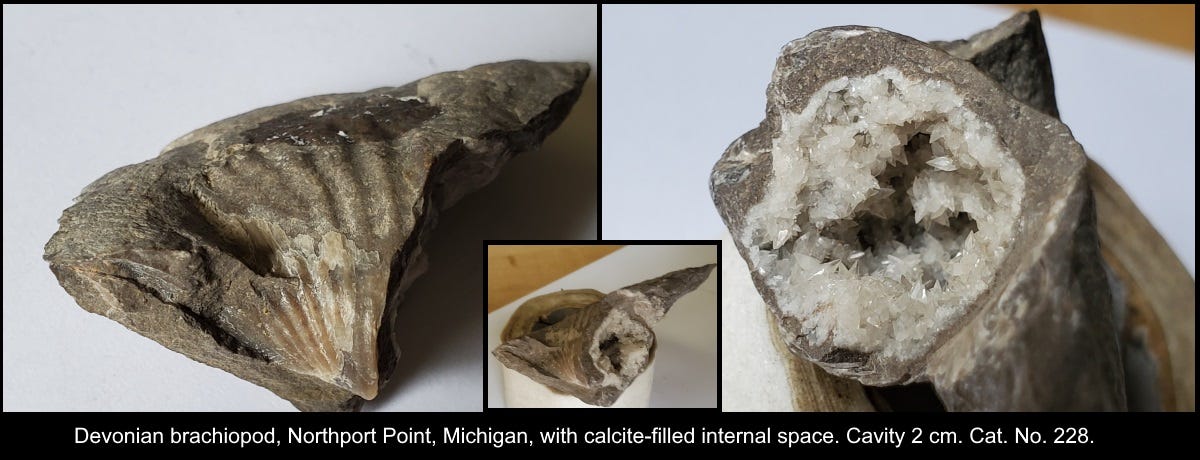
At first glance, the photo above left looks like a pretty uninteresting brachiopod fossil, one that under normal circumstances I probably wouldn’t have kept. Especially since it broke in half when I was trying to break it out of the rock. But that turned out to be the good news.
In the right-hand view you see the cavity that occupied the internal part of the brachiopod shell (where the animal used to live), filled like a geode with pointy little scalenohedrons of calcite. They precipitated in the hollow shell as calcareous water percolated through the rock that held the fossil. The cavity with the calcite crystals is about 2 cm across.
This brachiopod is probably of the genus Atrypa, which is abundant in the limestones at Northport Point, Michigan (the tip of the “little finger” of lower Michigan), where I collected this in 1967 or 1968. The rock is the Middle Devonian Traverse Group, about 380-390 million years old. This brachiopod was more or less coeval with the extinct coral Hexagonaria percarinata, better known as the Petoskey Stone, Michigan’s state stone.
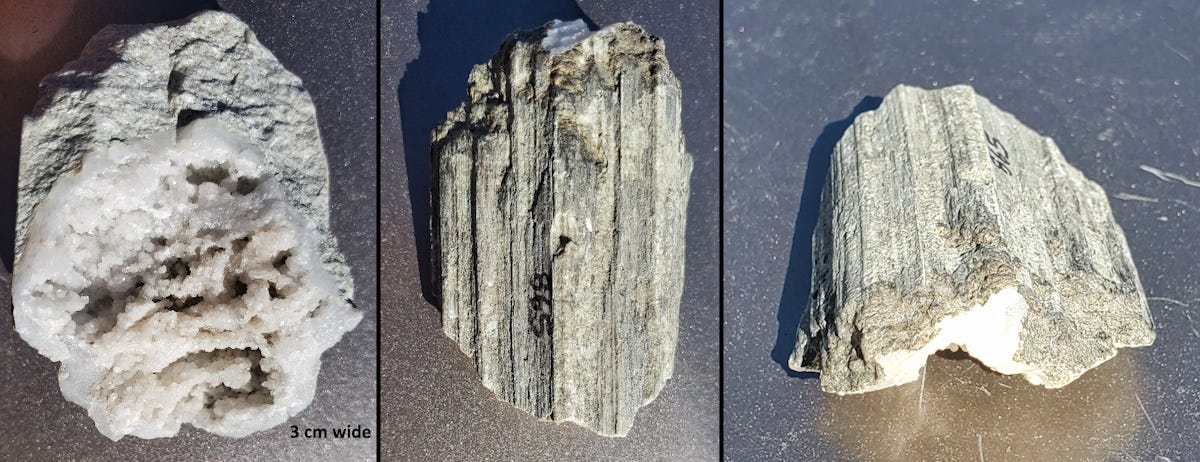
The second example (left above) looks like a normal, not very special quartz geode in gray limestone. It’s from the geode-rich Mississippian-age rocks of southern Indiana. It’s only about 3 cm across, and although it does contain a tiny bit of white dolomite, it’s the sort of thing I’d have tossed aside. But the backside got my attention.
At first glance the striations in the center photo might seem like petrified wood, but they are structures in the limestone containing the geode. The photo at right looks along the length of the specimen, so you can see how the striations form a curved arch surrounding the geode on the other side.
These striations are stylolites, pressure-solution features in sedimentary rocks, especially limestones which are mostly the mineral calcite, calcium carbonate. The simple weight of overlying strata, together with the easy cleavage (breaking) and solubility of calcite, make some of the calcite dissolve along surfaces that become quite complex because of slight variations in the limestone. While the calcite easily dissolves it often leaves behind bits of insoluble material in the limestone, including clays, iron oxide, and other things, so that the stylolite surfaces are visible as irregular dark lines. The photo below by Michael Rygel shows a classic example of stylolites.
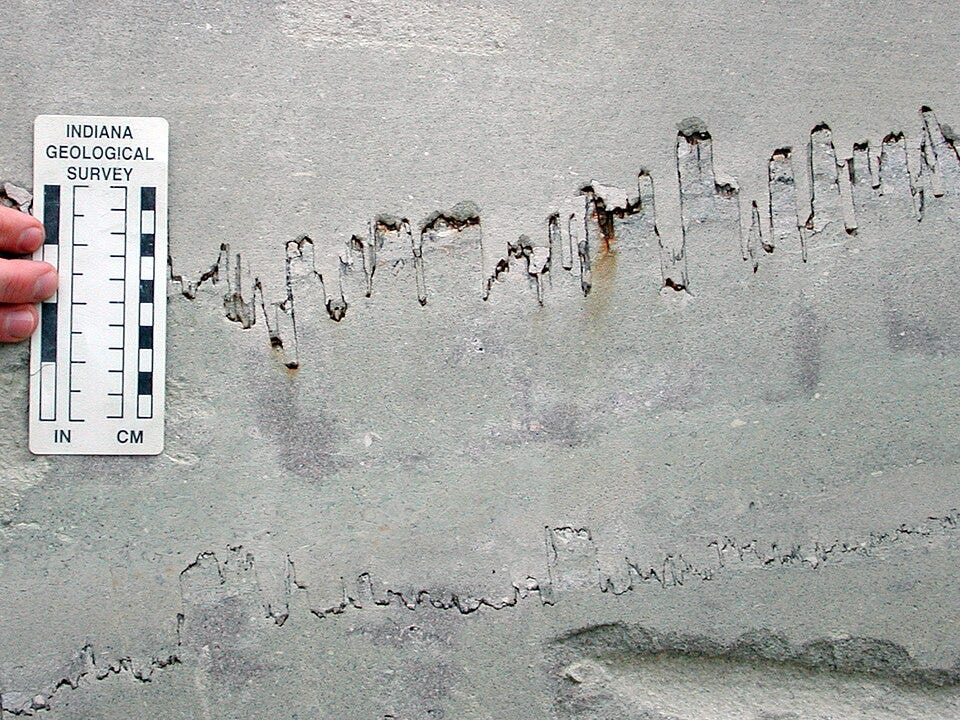
The word stylolite is from Greek stylos, pillar + lithos, stone, for the often columnar appearance as you see in the photo above.
In both the hollow brachiopod and the stylolite, a space, or at least a volume of lower confining pressure, forms to allow the geode to grow. At least that’s the case for the brachiopod. You might ask of the stylolite, which came first? Either the geode grew in a small cavity or crack in the limestone, and the stylolite came later, developing around the stronger quartz geode, or the stylolite developed in the limestone under the pressure of the overlying material, creating a space that was already stressed or broken, making a favorable position for a geode to grow. In my specimen, the geode is probably from a position analogous to one of the curved “ends” of the columnar stylolites in Mike’s photo above.
Typical limestone stylolites form parallel to bedding, zones of higher porosity, and that’s where fluids moving through the rock also typically focus on some vacancy or other nucleus to deposit the minerals that become geodes. I suspect that in my example the stylolite came first, but an earlier geode should also be possible, and it’s also quite possible that both of them developed more or less simultaneously as fluids and pressures in the rock fluctuated over time.
Hi Dick. Wow, that's amazing how much you have traveled about in the past. I have a great friend from college that lives in Traverse City. I was there about 30 years ago and someone from Anaconda saw our plates and said hello out driving one evening. Anyway, while there I ended up acquiring a famous Petosky stone. I'll bring it up and show you one of these days. Thanks for the interesting post. Kirk Waren
Wow! What a surprise inside the fossil! But embarrassed to admit that I'm still confused about the styolite / striations in the second piece, are the striations parallel or perpendicular to the overall bedding plane? I don't quite understand how they relate to the jagged but overall horizontal line of the styolite in the the "classic" example photograph (almost looks like a needle-generated seismic or EKG readout!) Wikipedia was helpful in explaining the process of formation, but I don't really understand the resulting visual line(s) of deformation.