
Vanadinite
Palomas Gap

Life in the USA is not normal. It feels pointless and trivial to be talking about small looks at the fascinating natural world when the country is being dismantled. But these posts will continue, as a statement of resistance. I hope you continue to enjoy and learn from them. Stand Up For Science!
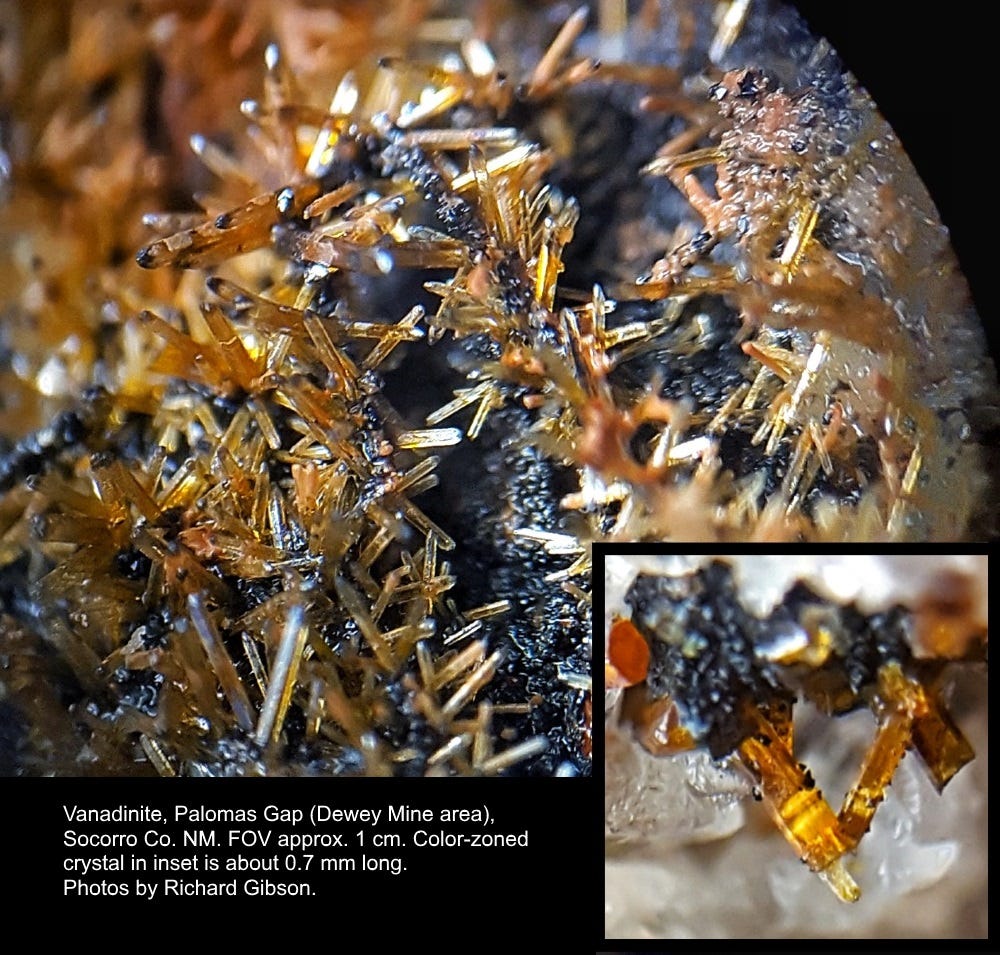
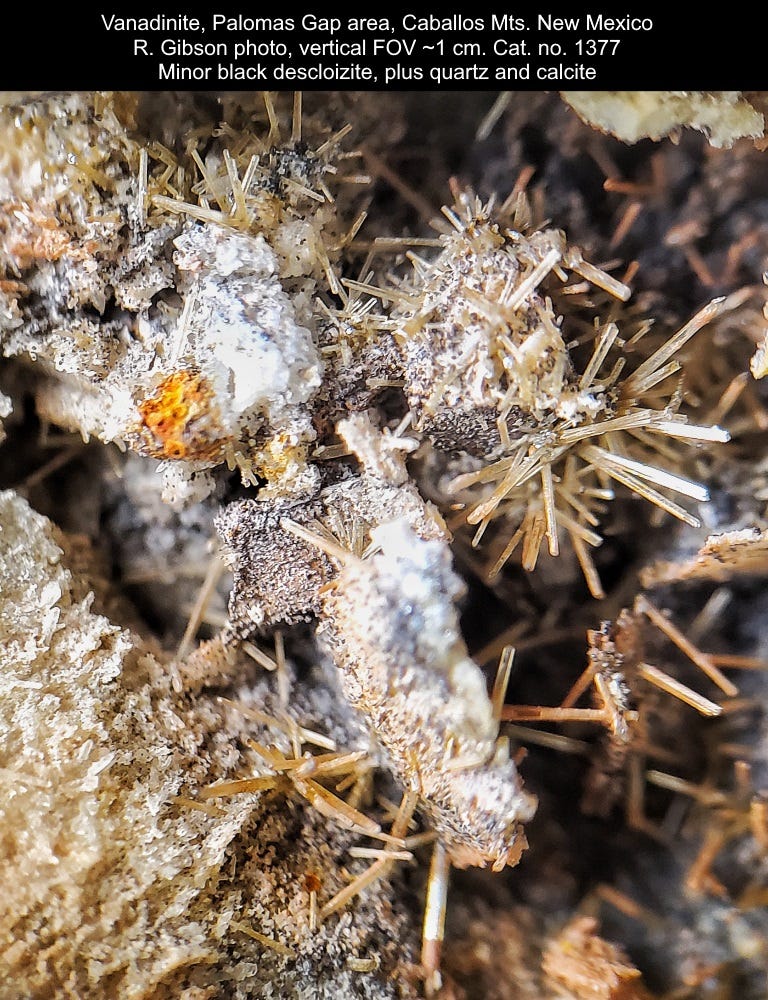
These spindles of vanadinite (a few with zoning), lead-vanadate-chloride, are from the Palomas Gap area (Dewey-White Swan Prospects), Caballo Mountain District, Sierra Co., New Mexico, USA. Vanadium prospects there are in low-temperature hydrothermal deposits in the Pennsylvanian Magdalena Formation limestone. The ore carried 0.5% vanadium pentoxide in 1944, which was non-economic (unreferenced statement on MinDat); today, the total volume is probably too small to be economic. The deposit may be related to the faulting that began about 25 or 30 million years ago and is continuing to create the Rio Grande Rift.
Vanadium is mostly used (90% of the total) in iron and steel alloys to improve corrosion resistance, improve hardness, and lower density. It also makes steels stronger over broad temperature ranges – for example, more than 650 tons of vanadium was alloyed with the steel used to make the Alaska Pipeline, to make it more stable at Arctic temperatures. Vanadium-based batteries are used for high-volume, high-energy-density storage batteries, but volumetrically the largest non-metallurgical use is in catalysts in the manufacture of sulfuric acid.
In 2025 the United States was about 41% dependent on imports for vanadium, mostly from Canada (34%), Brazil (13%), South Africa (13%), and Austria (10%). Neither Canada nor Austria had reported significant mine production of vanadium, and like the US, most of their production came from reprocessing petroleum residues, ash, and spent catalysts. Petroleum refining has historically been one of the largest sources of vanadium, and the US formerly obtained a lot by processing heavy crude from Venezuela. Vanadium is the most abundant trace metal in petroleum, where it originated from the plants that generate hydrocarbons. Many plants naturally concentrate vanadium from soils, passing the metal on to petroleum in the process of maturation (Dechaine and Gray, 2010, Chemistry and Association of Vanadium Compounds in Heavy Oil and Bitumen, and Implications for Their Selective Removal: Energy & Fuels 24:5, 2795–2808).
US reserves of vanadium in minerals are trivial, amounting to much less than 1% of the world total according to the USGS. Depending on the purity, some estimates show Australia with as much as 48% of the world’s vanadium reserves (but no reported production in 2025) with China and Russia at about 25% each.
China is the dominant miner of vanadium with 76% of the world total in 2025 (and vanadium has been a pawn in some of the tariff issues between the US and China), followed by Russia at 19% and Brazil and South Africa at a distant 4.5% each.
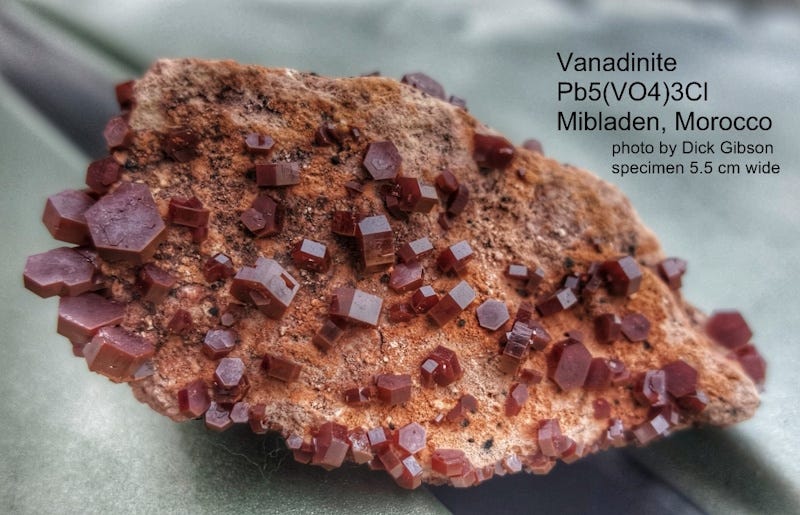
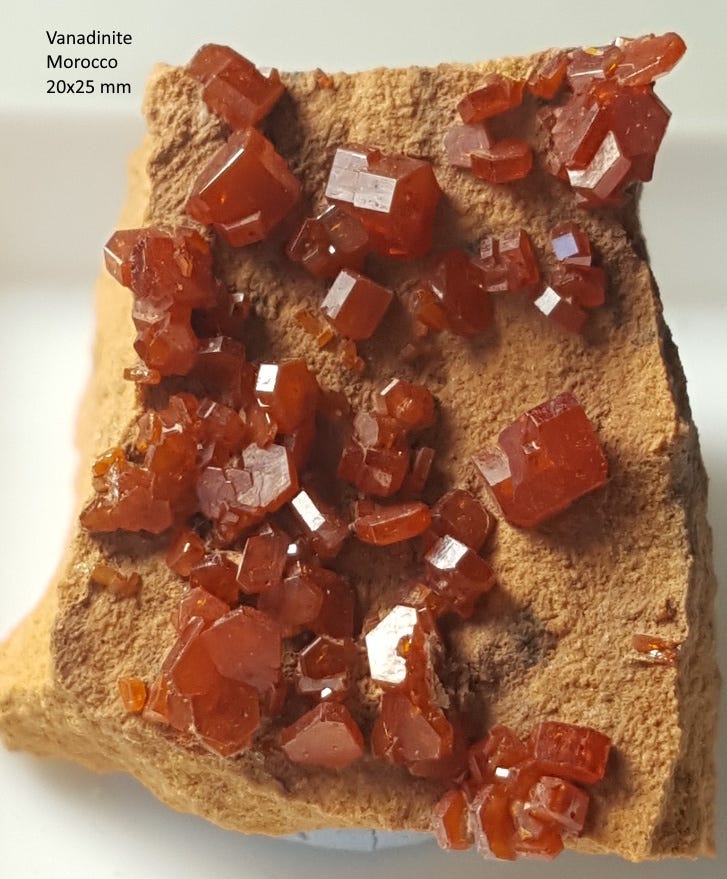
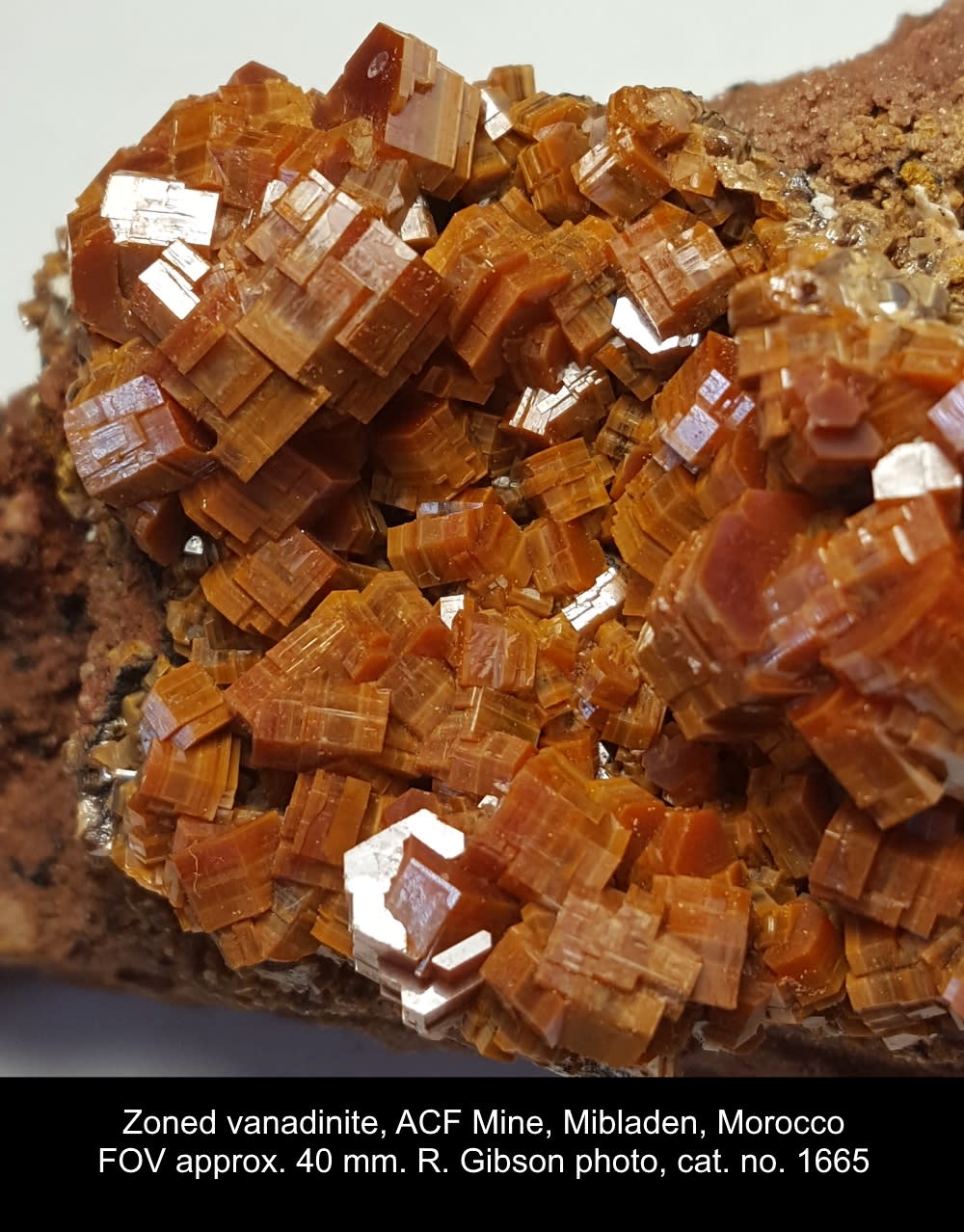
Although Morocco is not a significant player in the vanadium mining industry (although some areas are under evaluation), it is famous as a source of beautiful red vanadinite crystals prized by collectors; their abundance makes them typically quite affordable. Three examples are below.
I did not know about the Australian reserves. There's not that much in terms of mineral specimens for collectors either. Mindat shows 36 valid species with V, but the vast majority of those are really minor occurrences.