
Bastnäsite
for Cerium

Life in the USA is not normal. It feels pointless and trivial to be talking about small looks at the fascinating natural world when the country is being dismantled. But these posts will continue, as a statement of resistance. I hope you continue to enjoy and learn from them. Stand Up For Science!
Cerium is one of the rare earths, and like them all, is neither an earth nor especially rare. It’s a metal, more abundant in the earth’s crust than lead or tin, and just barely less abundant than copper. But the rare-earth elements have atomic radii that make it challenging for them to combine with other elements to make economic mineral deposits.
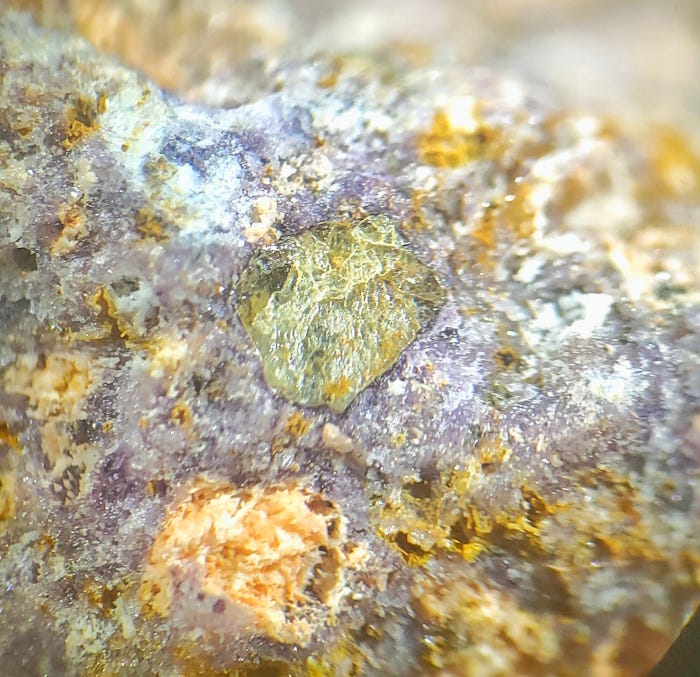
But they do make SOME minerals. Bastnäsite, cerium carbonate-fluoride, Ce(CO3)F, named for the type locality at the Bastnäs mines, Riddarhyttan, Skinnskatteberg, Västmanland, Sweden, is one of them (you also see it spelled bastnaesite by those who don’t use umlauts). Bastnäsite is really a group, where the cation can also define specific minerals with dominant lanthanum, neodymium, or yttrium, but the cerium-dominant variety is most common.
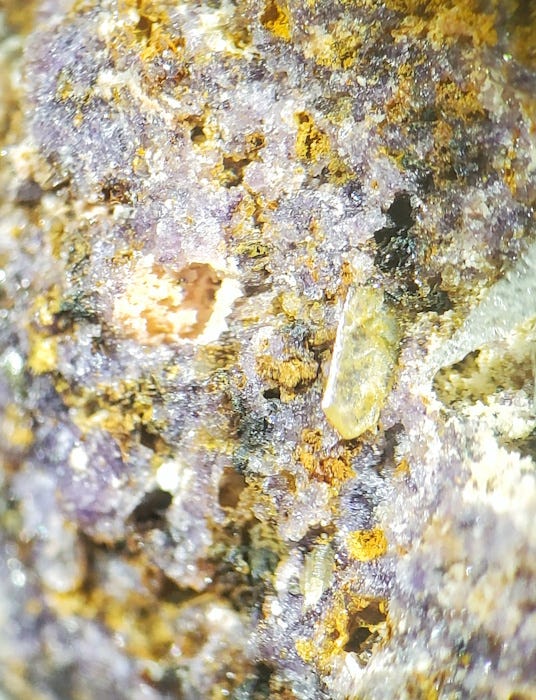
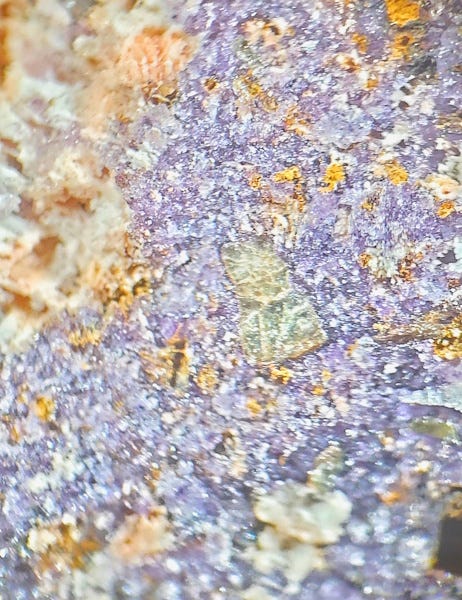
The three yellow-green examples here are from the Red Cloud Mine, New Mexico (yes, New Mexico, not the Red Cloud in Arizona famous for wulfenite), where the bastnäsite is associated with fluorite (the purplish matrix in my photos) and other minerals. Each bastnäsite crystal is about 1 or 2 mm across.
The Red Cloud Mine was established in 1881 to exploit copper, silver, and lead. The bastnäsite was discovered in 1943 and about 142,000 pounds of bastnäsite was produced there in the 1950s along with fluorite (McLemore, 2010, Geology and mineral deposits of the Gallinas Mountains, Lincoln and Torrance counties, New Mexico: New Mexico Bureau of Geology and Mineral Resources Open-File Report OF-532).
The rare-earth and fluorite deposits at Red Cloud are probably related to syenite (and possible carbonatite) intrusions and extrusions in which the mineralization developed as veins about 30 million years ago. The igneous activity was probably ultimately related to the development of the Rio Grande Rift, a major break in the North American crust that extends north from El Paso, Texas, into south-central Colorado.
Cerium was discovered in 1803, but its first use wasn’t until 1891 when Austrian chemist Carl Auer von Welsbach mixed it with thorium oxide to make mantles for incandescent lights that finally produced a good bright white color. Such mantles were used in gas lights on the streets of the major cities of Europe and North America until electric streetlights became widespread in the early 1900s. Auer von Welsbach also invented mischmetal, 50% cerium mixed with iron and other rare-earth metals. Mischmetal has historically been the main compound used in cigarette lighter flints (Gibson, What Things Are Made Of, 2011, p. 188).
Cerium is also used in catalytic converters, in CRT tubes and white-light LEDs, in pigments (cerium sulfide is a vivid red color), and as a fine abrasive for polishing telescope mirrors and many other less demanding surfaces.
In 2024, bastnäsite was mined as a primary product at the rare earth deposit at Mountain Pass, California. The resulting mineral concentrates were all exported to China because the US does not have a processing facility, but the US-China trade war has changed things dramatically, and MP Materials is aggressively working on processing plants at Mountain Pass. I think the first focus is on heavy rare earths (terbium, dysprosium, holmium, erbium, thulium, ytterbium, and lutetium) rather than cerium from bastnäsite.
Cerium comes from other minerals as well, including allanite and monazite, which we discussed in this previous post (and check the comments there too).
Brought up lots of memories of my desert rat past, have to say we kind of hated the blight of the Mountain Pass open pit mine there on the Clark mts! Red Cloud must have been a popular name in mining history, there's one in CA off Highway 10, too. Took that dirt road exit a lot, but never visited the mine.
Ive been to the Red Cloud NM mine with Jerry Cone. Lots of bastnaesites there, oodles, but all so tiny. Across the road was better hunting for other stuff.
REEs are nice to have, but wow, what do you do with the um, dross?!
But nice post, thanks