
Belemnites
Extinct cephalopods

Life in the USA is not normal. It feels pointless and trivial to be talking about small looks at the fascinating natural world when the country is being dismantled. But these posts will continue, as a statement of resistance. I hope you continue to enjoy and learn from them. Stand Up For Science!
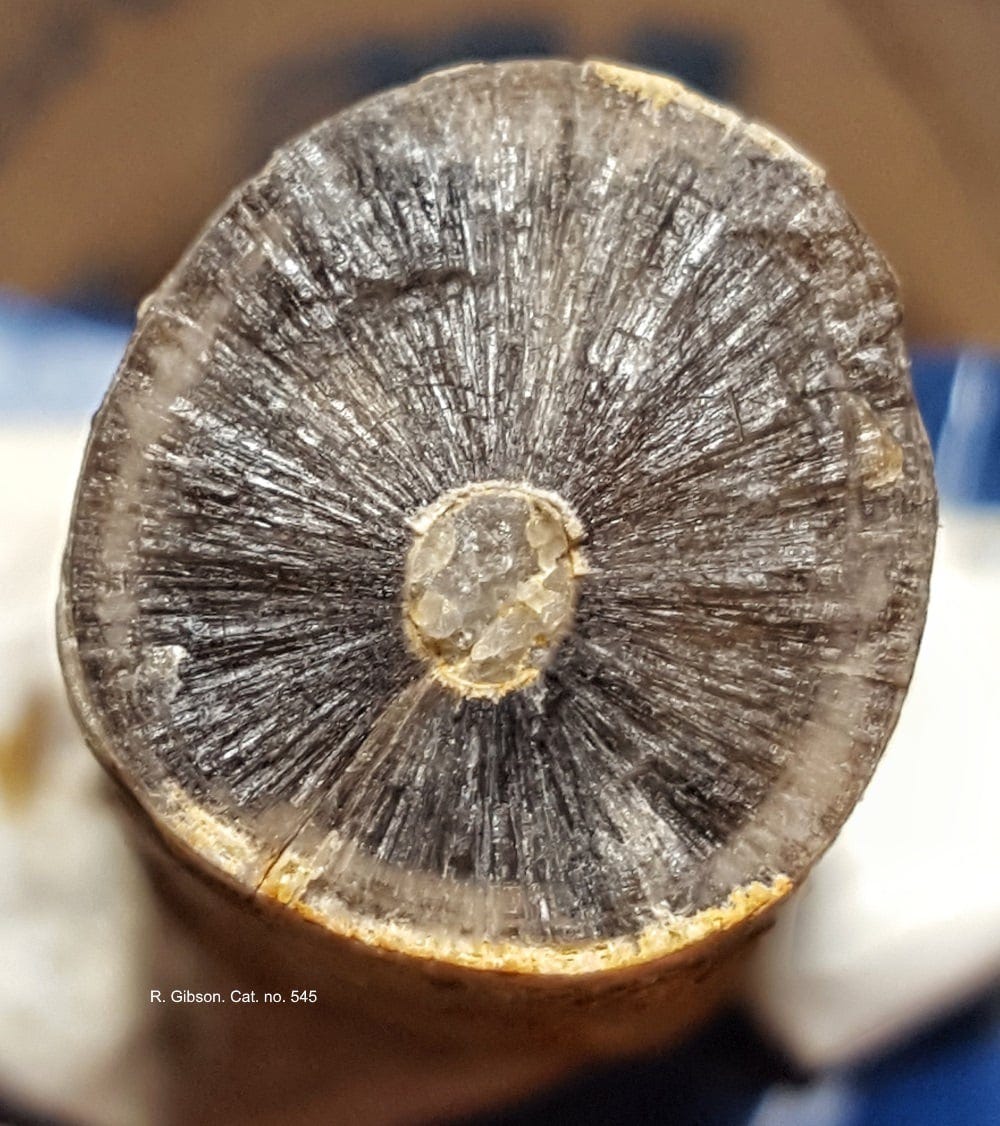
This is a cross-section view of a belemnite, an extinct squid-like cephalopod. Actually this isn’t the whole animal by any means – it’s just the most commonly preserved part, an internal structure called a guard (or rostrum, from Latin for beak) that probably served as a counterbalance for the animal and helped it swim. Fleshy external attachments on the guard likely provided lift for the animal, like the fins of a fish (Monks and others, 1996, The function of the belemnite guard: Paläontologische Zeitschrift 70, 425–431). It was probably made of calcite or aragonite (both are calcium carbonate, but with different crystallography) in life and is calcite or aragonite in fossils. The radial structure and brown color are a little unexpected for calcite, likely reflecting the original radial geometry as secreted by the animal, with the brown color from included organic stuff. Sometimes the guard shows concentric features that are interpreted to be growth rings. This one is about one centimeter across.
The circular feature at the core of the guard is also filled with coarser calcite of lighter color. That was probably part of the open chambers called the phragmocone, which were interconnected by a tube called the siphuncle. The belemnite sent gas through the siphuncle to the chambers of the phragmocone to change its buoyancy, allowing it to rise and fall in the water. Expelling water from the chambers also allowed it to jet quickly for short distances to escape predators or chase prey, like modern squids, chambered nautilus, and octopuses do.
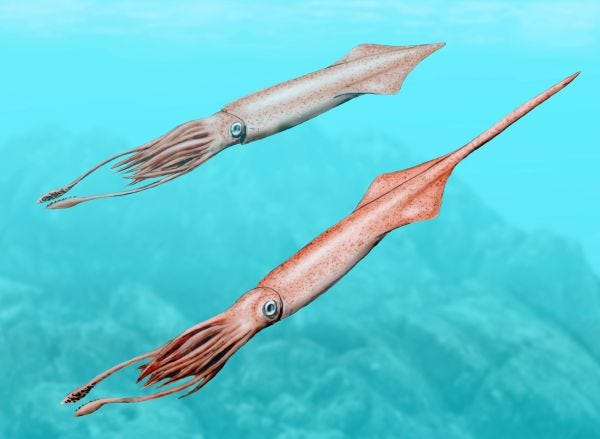
The name belemnite is from a Greek word meaning a dart or arrow, from the dart-like shape of the fossil guards.
Belemnoids had a long run, from the Triassic to the end-Cretaceous extinction, a total of about 170 million years or so, but they were exceptionally abundant during the Jurassic Period about 180 million years ago. They evolved from straight-shelled cephalopods (Bactritida) that developed by Devonian time, about 407 million years ago. Bactritida are considered to be the stem ancestor of modern octopuses and squids as well as extinct belemnites. I collected these specimens in the Jurassic of the Black Hills (South Dakota USA) in 1969.
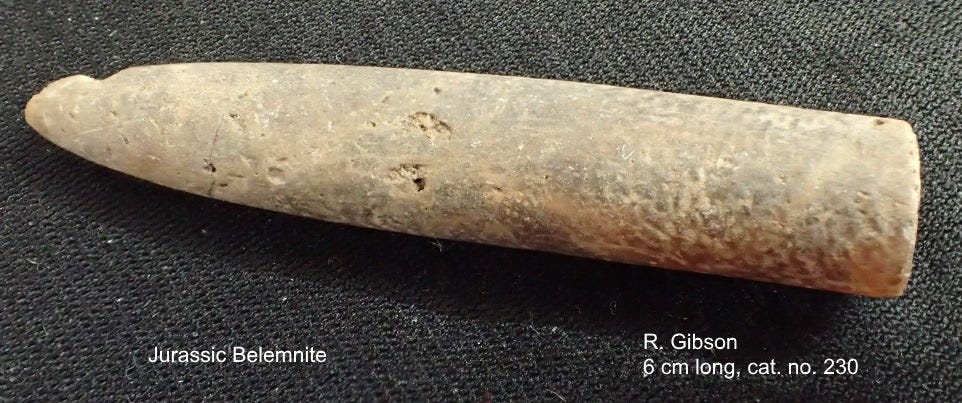
The belemnite guard above is about 6 cm long. Guards as long as 46 cm (18 inches) are known, giving an estimated length for the whole animal of 3 meters (10 feet) – a true giant.
For a bit more about belemnites, including trace fossils on the surface of one, see this previous post.