
Brookite
Distinctive habits

Life in the USA is not normal. It feels pointless and trivial to be talking about small looks at the fascinating natural world when the country is being dismantled. But these posts will continue, as a statement of resistance. I hope you continue to enjoy and learn from them. Stand Up For Science!
“Crystal habit” doesn’t necessarily mean the shape and appearance crystals habitually have. It can also describe a rare but distinctive form, or an appearance specific to a particular location.
I’m fascinated by mineral habits because they drive the question “Why?” – why does a mineral grow in one habit here and a very different habit there – sometimes in the same deposit?
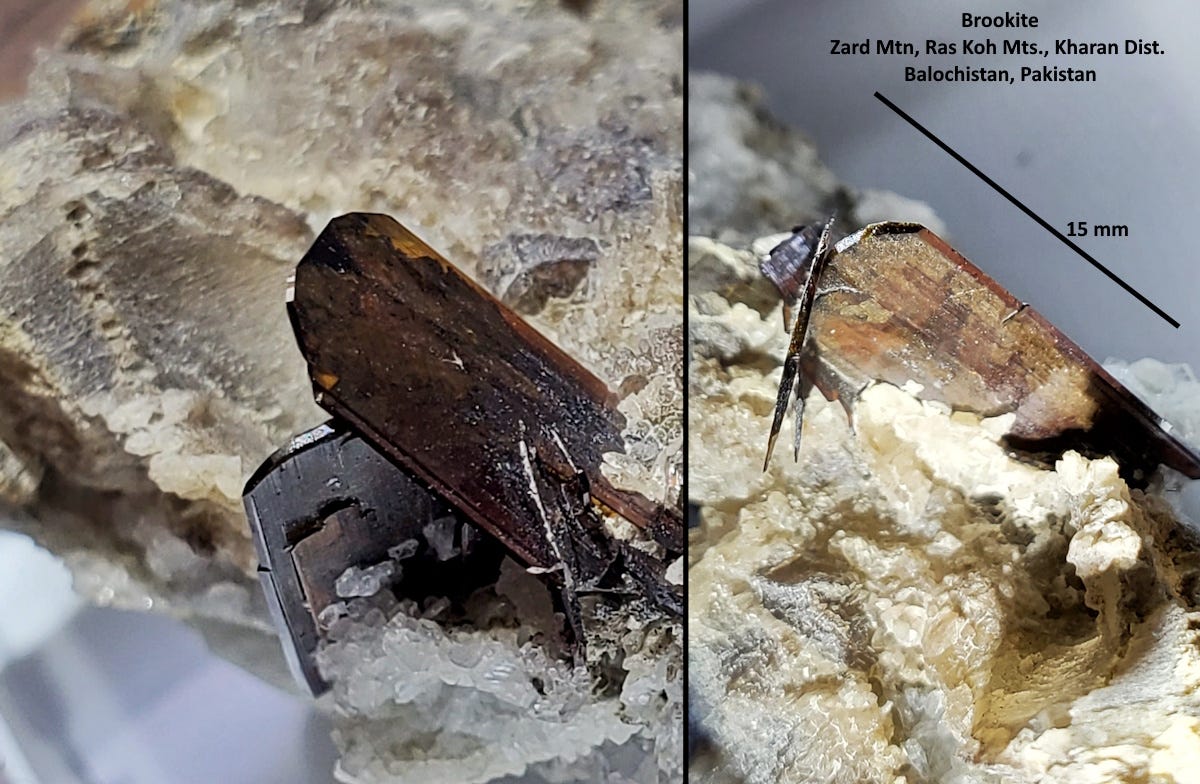
The flat lath-like crystals in the top photo are brookite, one of the polymorphs (“many forms”) of titanium dioxide. The other two common ones are rutile and anatase; there are others that are exceptionally rare. Polymorphs are minerals with the same chemistry, in this case TiO2, but different crystallography.
The crystals in the top photo are very thin – less than half a millimeter for translucent brown crystals as much as 15 mm long. This is quite a distinctive form for brookite at this locality in Pakistan.
The stubby sub-metallic black, almost square crystals below are also brookite. I think a normal person would be surprised to see such diversity in the appearance of the same mineral, but they are both definitely brookite. The examples below of brookite crystals on quartz are also distinctive for their locality, Magnet Cove, Arkansas USA. Magnet Cove has appeared in The Geologic Column several times, including this post on perovskite.
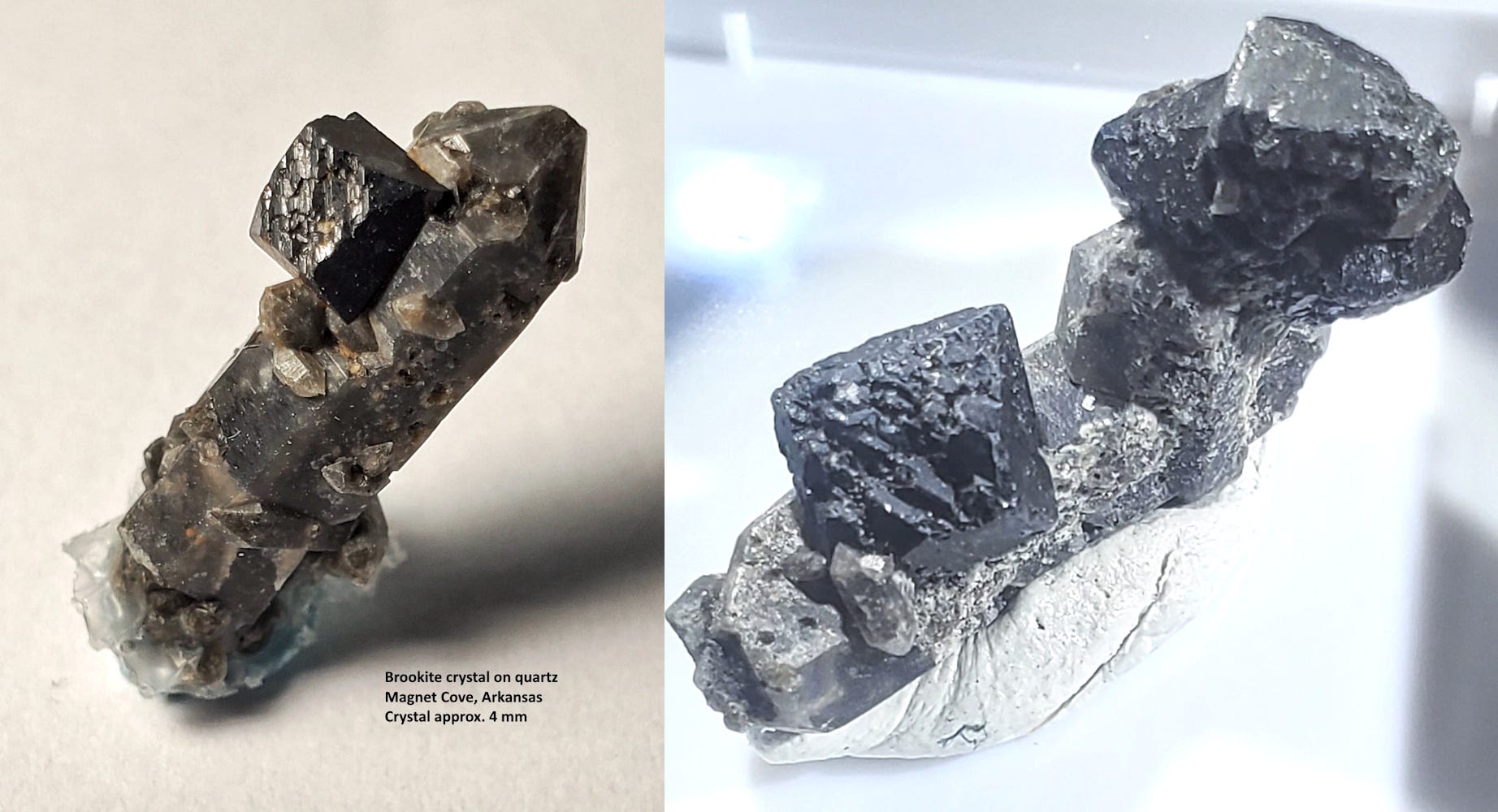
So why are the two examples so different? Crystal habit can be influenced by such things as crystal structure, including preferred growth directions and internal symmetry; unequal or preferential development of various crystal faces; temperature and pressure; space constraints; nutrient supply and crystal growth speed; and impurities. I know of no studies suggesting the origins of the habit in either the Pakistan or Arkansas brookite specimens – if my readers do know of something, please let me know!
Crystal habits include (but are not limited to) words like cubic (and others named for predominant crystal forms), prismatic, fibrous, bladed, tabular, granular, massive, radiating, sheaf-like, stubby, botryoidal, dendritic, arborescent, columnar, acicular (needlelike), equant, micaceous, blocky, stalactitic, globular, reniform, “well-formed,” and twinned, plus distinctive forms named for places where such habits were abundant or first noted, such as Muzo and Tessin.
Sometimes picking a habit name can be pretty subjective, and often enough there’s no sharp boundary between some of them. I’d probably call my crystals from Pakistan “lath-like,” but others might call them bladed. The Magnet Cove crystals might be stubby or blocky, or just something like “well-formed pseudo-cubic.” Sometimes people invent descriptions that are (we hope) self-explanatory, such as “bow-tie crystals” or something else.
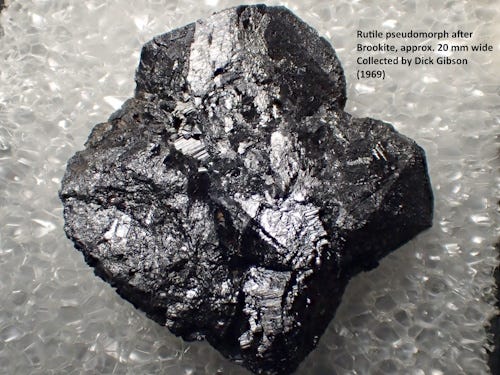
It’s even possible for things to get more complicated, as with the example below, which is rutile (tetragonal titanium dioxide) as a pseudomorph (“false form”) replacement of a group of intergrown brookite crystals (orthorhombic titanium dioxide). The rough symmetry might suggest that the original brookite crystals were twins, or maybe it was just several stubby brookite crystals growing together.
Henry James Brooke (1771-1857), brookite’s namesake, was a successful English textile manufacturer and merchant involved in the South American wool trade, but he is remembered as a prolific “amateur” mineralogist who discovered 12 minerals. He is also credited as the first to define the six primary crystal systems.
Thanks Richard. Love them laths of brookite. I got a tiny 'meh' one. It'll due for now