
Dahllite
Carbonate-rich hydroxylapatite

Life in the USA is not normal. It feels pointless and trivial to be talking about small looks at the fascinating natural world when the country is being dismantled. But these posts will continue, as a statement of resistance. I hope you continue to enjoy and learn from them. Stand Up For Science!
Dahllite isn’t a recognized mineral, but it is a synonym for carbonate-rich hydroxylapatite. Apatite (from Greek for “deceiver,” because it is easily confused with other minerals) is calcium phosphate, but it has three possible additions to its formula: fluorine (fluorapatite, by far the most common), hydroxyl (OH, hydroxylapatite), and chlorine (chlorapatite, quite rare). The general formula is Ca5(PO4)3X, where X is fluorine, hydroxyl, or chlorine.
It is also possible for carbonate, CO3, to substitute for some of the phosphate, PO4, in the structure. That usually happens in hydroxylapatite, so that makes it just a variety of hydroxylapatite. That substitution happens a lot in bones, teeth, and kidney stones, but it also occurs in some geological situations, in this case in Big Horn County, Wyoming, near the town of Lovell.
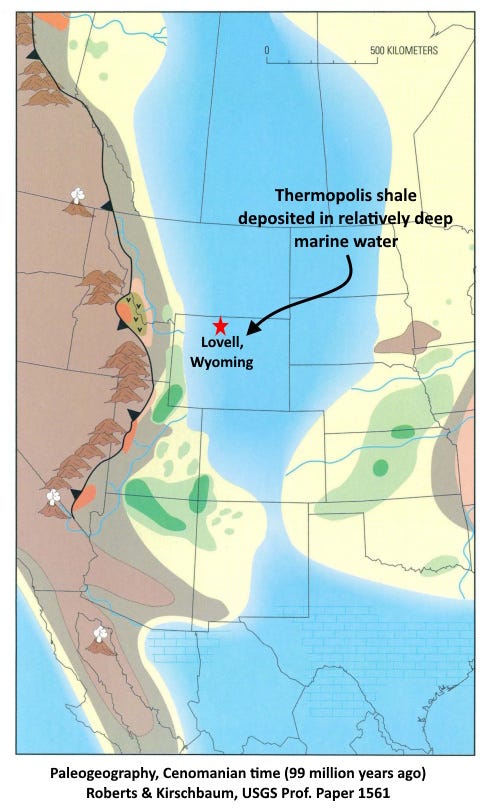
The map above is from Roberts and Kirschbaum, 1995, Paleogeography of the Late Cretaceous of the Western Interior of Middle North America – Coal distribution and sediment accumulation: USGS Prof. Paper 1561. Deposition of the Thermopolis Shale started a few million years before this time and continued a bit later than this representation.
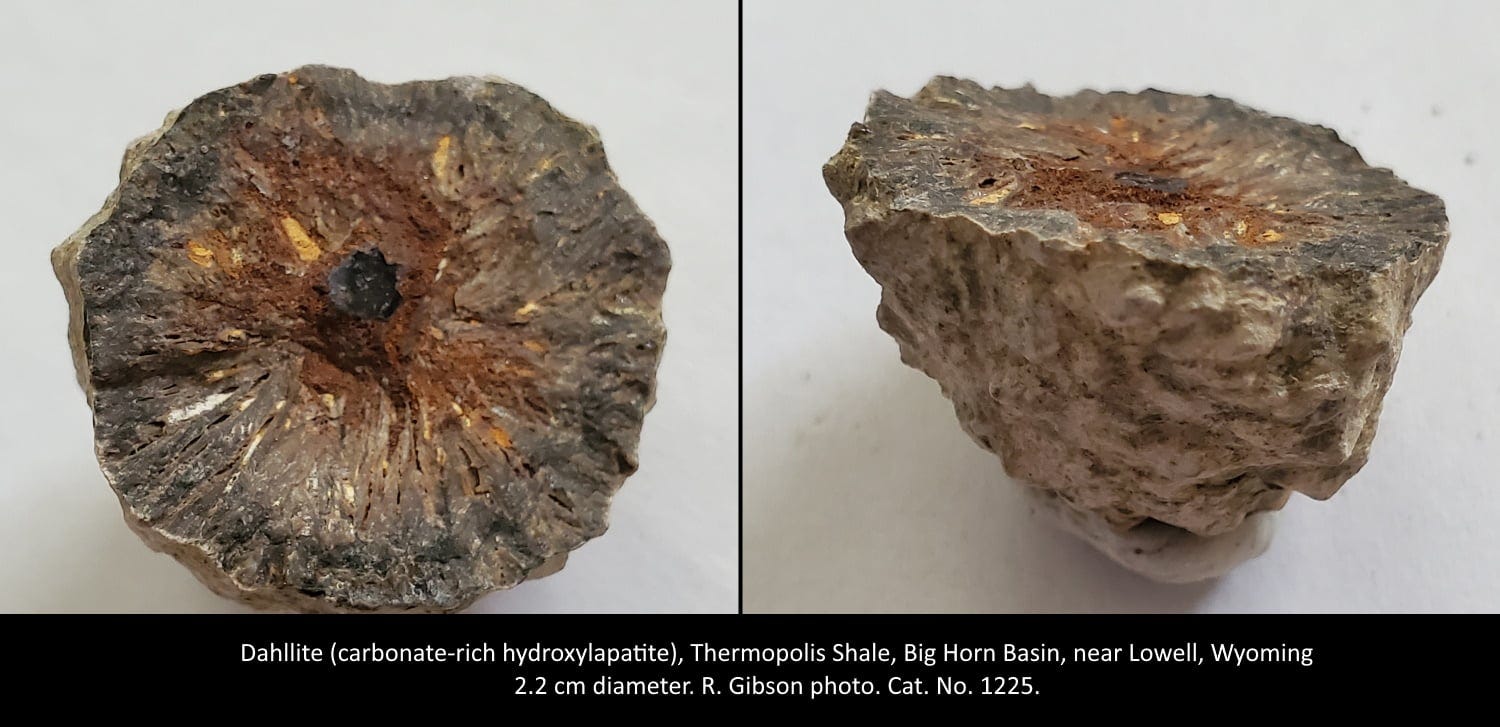
Concretions of carbonate-rich hydroxylapatite like the one in my photos form in the Cretaceous Thermopolis Shale especially near the Wyo-Ben bentonite mine, where bentonite (altered volcanic ash) is found in the shale and its silty and sandy equivalents within the Thermopolis Shale. There, Sutherland and others (2013, Rare Earth Elements in Wyoming: Wyoming Geol. Survey Report of Investigations 65) report that the dahllite concretions contain elevated amounts of rare-earth elements and yttrium, with gadolinium, terbium, and yttrium enriched to greater than five times their crustal abundance. Are the concretions abundant enough to serve as a rare-earth resource? Probably not, but the demand for rare-earth elements means people are paying attention to this deposit.
The Thermopolis Shale represents an early aspect of the Western Interior Seaway.
How these concretions form has been the subject of considerable study, but their origin is not completely clear. Trappe and Vondra (1995, Microstructure and origin of fibrous phosphate concretions from the Cretaceous Thermopolis Shale - an example of apatite replacement of a Fe-precursor?: Neues Jahrbuch für Geologie und Paläontologie - Abhandlungen, Band 198 Heft 3, p. 363 – 374) attribute them to replacement of radial marcasite (iron sulfide) by apatite in a fluorine-poor environment, and others speculate that the apatite replaces radial pyrite (also iron sulfide). You can see the dark iron sulfide/oxide core in the center of my concretion in the left photo.
Iron sulfides would be expected in the environment in which the black organic-rich Thermopolis Shale was deposited, but those ideas beg the question of the origin of the phosphate and carbonate in the first place. The bentonite (altered volcanic ash) might be one source, and eroded phosphate rocks of the older Phosphoria Formation might be another. The Thermopolis Shale, dated to about 99 to 103 million years ago, is also rich in marine vertebrate fossils including turtles, crocodiles, plesiosaurs, rays, sharks, and fish. Their bones and teeth are rich in phosphate.
Although these concretions are not particularly rare at the occurrences in the Big Horn Basin, spherulitic apatite nodules in sedimentary rocks are unusual and have been found at only a few localities worldwide.
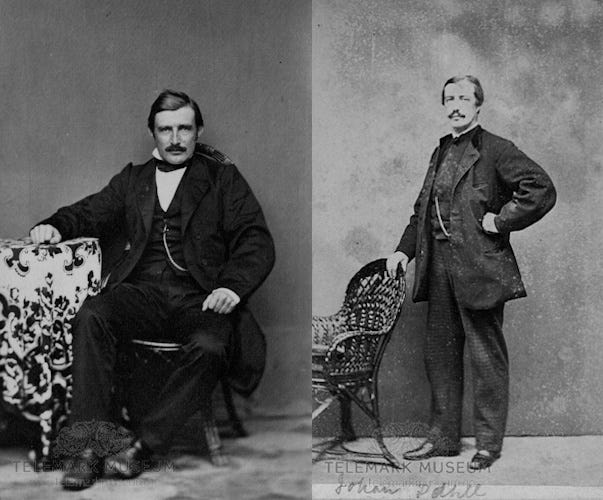
Dahllite was named as a new mineral in 1888 by Waldemar Christofer Brøgger and Helge Mattias Bäckström for the brothers Dahll, both of whom were mineralogists and geologists. Tellef (1825 – 1893) thought he had discovered the element norwegium, later discredited; it represents hafnium’s place in the periodic table (Fontani and others, 2014, The Lost Elements: The Periodic Table’s Shadow Side: Oxford University Press). Some sources say Tellef’s brother Johan Martin (1830 – 1877) named dahllite for Tellef, but I’m quite sure this is not the case; it was named in 1888 after Johan Martin was dead and explicitly honored both Dahll brothers (Brøgger and Bäckström, 1888, Ueber den »Dahllit», ein neues Mineral von Ödegärden, Bamle, Norwegen: Öfversigt af Kongl. vetenskaps-akademiens förhandlingar, Vol. 45, P. A. Norstedt & Söner, Stockholm).
Cat. No. 1225. 2.2 cm in diameter.
The bentonite clays of the thermopolis shale are also well known because that particular bentonite is the main ingredient of drilling fluids, wellbore annular seals, and other well construction and drilling material.
I had a chance to investigate a closed oil refinery in the town of Lovell a few years back, adjacent to the wyo-ben facility and the soils and outcrops of the shale were everywhere surrounding the investigation. interestingly - like the crocodiles of the thermopolis shale, the folks of Lovell suggested that someone's pet crocodiles (or maybe alligators) were thrown into the tar lagoons of the oil refinery prior to the lagoons being backfilled. We found no evidence of that. Lovell is an interesting town - I recall one evening in the Shoshone bar a british guy came in, wearing an ascot...he rolled his own cigarettes from a coffee-can sized container of tobacco. During a round of drinks, he informed us that he was an ex-pat from england that had settled outside of Lovell to raise sheep...not sure whatever happened to him.
The replacement of iron sulfide by apatite in a fluorine-poor enviroment is wild to think about from a geochemical standpoint. What gets me is the carbonate substitution for phosphate - I spent a semester lookign at similar substitution patterns in tooth enamel and never expected to see it pop up in sedimentary contexts with rare-earth enrichment on top. The spherulitic radial structure preserving the original marcasite/pyrite form really drives home how selective replacement processes can be. Makes me wonder if there are other undocumented cases hiding in black shales that just got lumped in as generic "phosphatic nodules."