
Elrathia
When trilobites ruled the earth

Life in the USA is not normal. It feels pointless and trivial to be talking about small looks at the fascinating natural world when the country is being dismantled. But these posts will continue, as a statement of resistance. I hope you continue to enjoy and learn from them. Stand Up For Science!
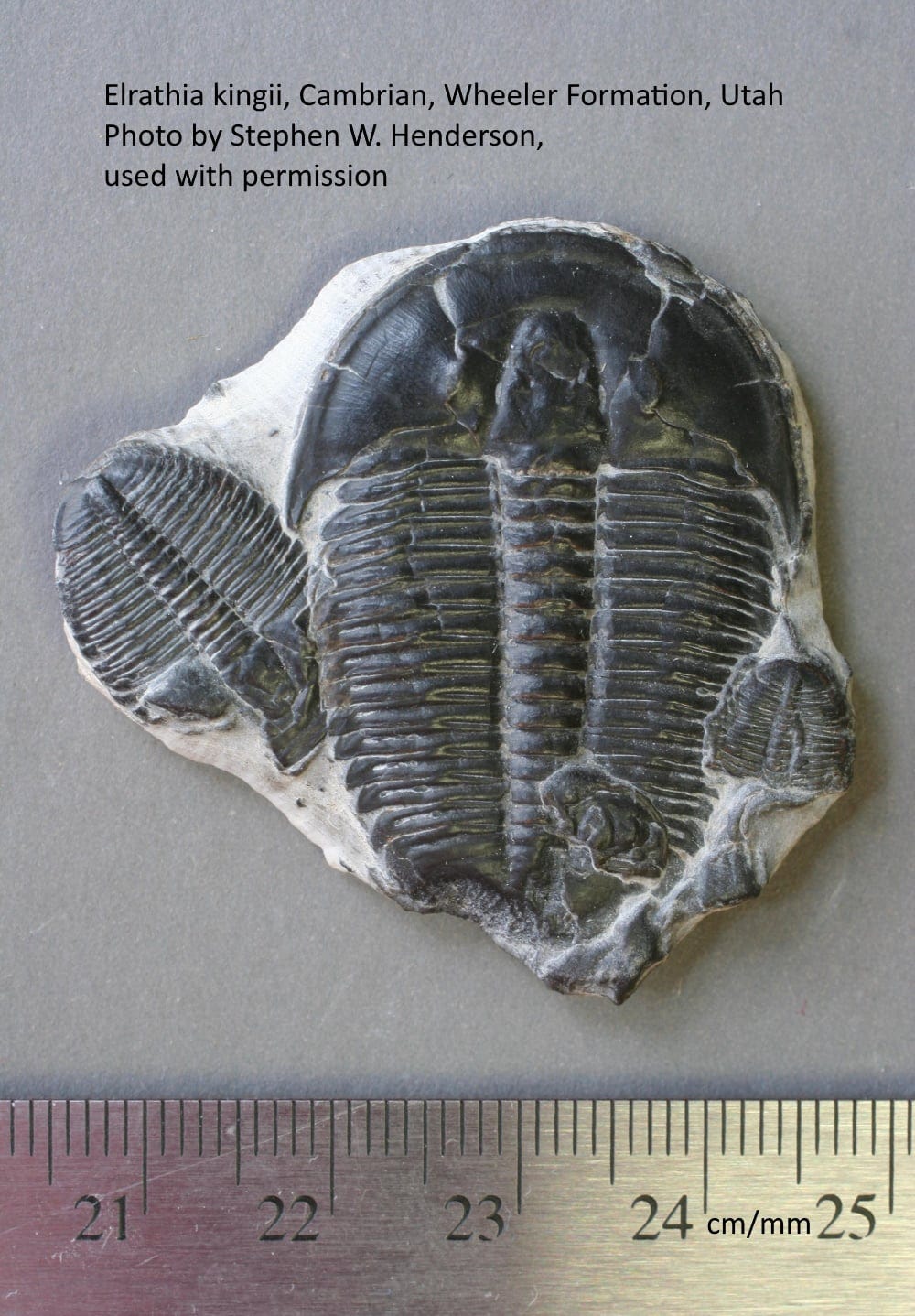
Elrathia kingii, seen in this photo by my friend Stephen Henderson, is one of the most famous trilobites. Their fossils are abundant in the Middle Cambrian Wheeler Shale, which crops out especially well in the House Range, Millard County, west-central Utah.
Gaines and Droser (2003, Paleoecology of the familiar trilobite Elrathia kingii: An early exaerobic zone inhabitant: Geology, vol. 31, p. 941) infer that E. kingii lived in the equatorial exaerobic zone of coastal North America about 507 million years ago. “Exaerobic” refers to a zone near the boundary of anoxic (no oxygen) and dysoxic (low oxygen) bottom waters. The lack of oxygen to oxidize and decompose the trilobites contributed to their preservation, but it did not seem to inhibit their proliferation.
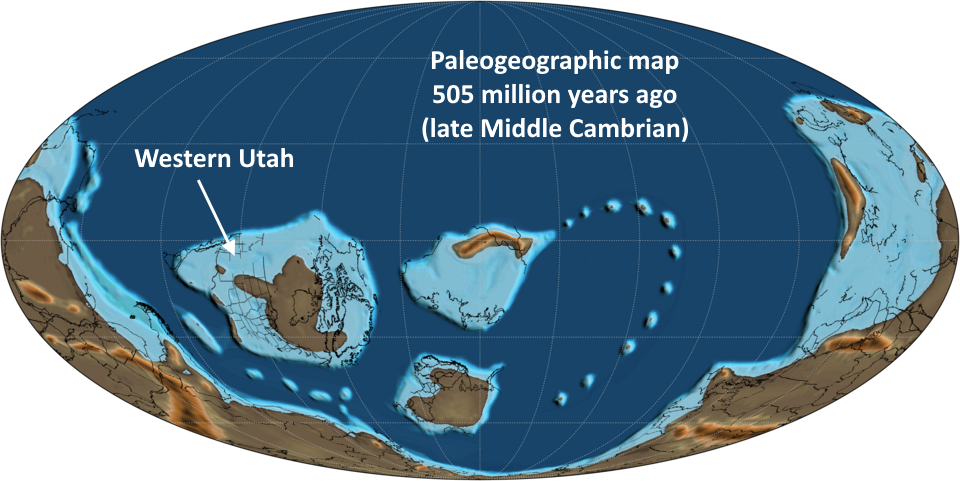
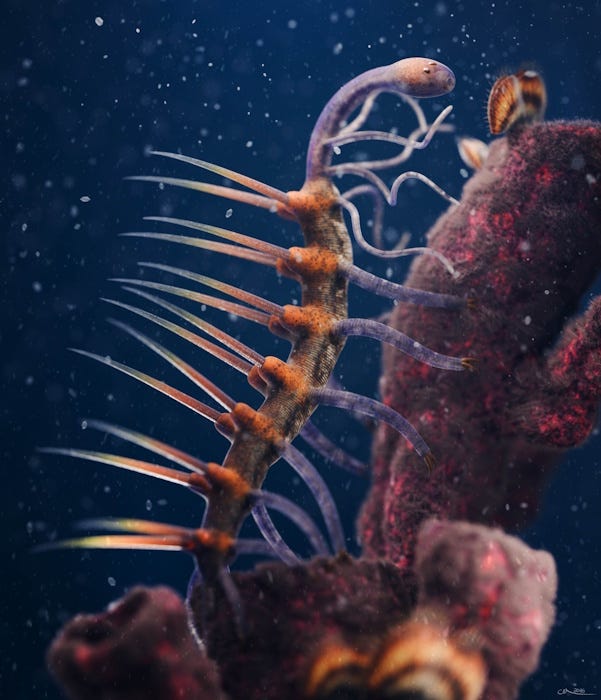
The mud rocks that preserve the best assemblages of fossils probably formed in turbidity flows and mudslides along the flank of the continental shelf. That rapid burial also contributed to the preservation. At least 48 species of trilobites are known from the Wheeler Formation, along with a wide range of additional fossil types including some that also occur in the famous Burgess Shale, which is about 505-510 million years old, pretty much contemporaneous with the Wheeler Formation. Hallucigenia, discovered in the Burgess Shale, is also known in the Wheeler Shale.
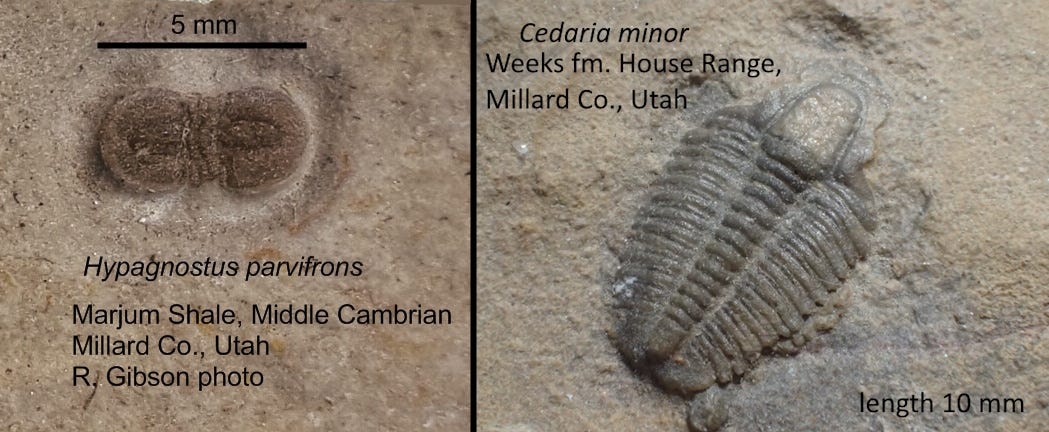
My two tiny trilobites above, Hypagnostus parvifrons and Cedaria minor, are from the Marjum Shale (uppermost Middle Cambrian) and Weeks Formation (lowermost Upper Cambrian) respectively, in the House Range, but both species also occur in the Wheeler Shale that immediately underlies the Marjum Shale.
Elrathia fossils are so abundant that one commercial collector estimates that he’s accumulated at least 1.5 million of them in his 20 years of work. I have enough of them myself that I made one into a tie tack (from back when I used to wear ties).
It’s a little unusual for the free cheeks and genal spines (the left and right segments on the side of the head or glabella) to be preserved intact on Elrathia as they are in Steve’s larger specimen; in the smaller one at left, they have fallen off.
The Wheeler Shale is a lagerstätte, a deposit with exceptional fossil preservation, sometimes including preserved soft tissues. The German word means storage place, from the same root as lager beer, traditionally stored for a time after brewing and before drinking.
Elrathia was first described from specimens in the House Range of Utah, but the name is from the town of Elrath, Cherokee County, Alabama, which was named for Samuel McElrath.
We saw one of the last trilobites, from the Pennsylvanian Period, in this previous post.
Alot of people share campfire questions like "if you could go back in time, when would you go?" and I feel like alot of times the answers range from historical ancient egypt to the 1980s or points in between, but if you really had a time machine, the times and places to go to would, in my opinion, reside in the Paleozoic - anytime from middle Cambrian to the middle Permian - the points of reference in the geologic record - the Wheeler formation, or the paleozoic sections that crop out in the midwest, or even the carbonates in Nevada all record just a completely unreal and alien world. trilobytes, erupyerids, agnathans, dunkliostious (I'm sure I spelled all of those wrong). the Paleozoic is just unreal to think about -earth when it was definitely a different planet unrecognizable to any species from the last 30 million years. its absolutely fascinating and part of me wishes some video game designer, some movie maker, or someone would make a scientifically accurate cambro-orovician vision and send a poet, a scientist, and an athelete back into that world. It would be supreme fantasy, and grounded reality that would stifle even the most cynical. like the trilobyte tie tack I have a couple pygidiums in a shoebox its still worthwhile to consider and ponder their environment and fate.
My first foray into geology was at the Community College level in CA. Our prof took a bunch of us on field trips to NV and UT for a week at a time, visiting mine dumps, touring active mines and hot springs. We went to this collecting location in the House Range. Remarkable!