
Graphite
Demand and price going up

Life in the USA is not normal. It feels pointless and trivial to be talking about small looks at the fascinating natural world when the country is being dismantled. But these posts will continue, as a statement of resistance. I hope you continue to enjoy and learn from them. Stand Up For Science!
Graphite and diamond are both nothing but carbon in elemental form, but they could hardly be more different. Graphite is earthy and black; diamond is vitreous to a fault and usually transparent. Diamond is the hardest mineral known, while graphite is at the other end of the hardness scale, soft enough to write with.
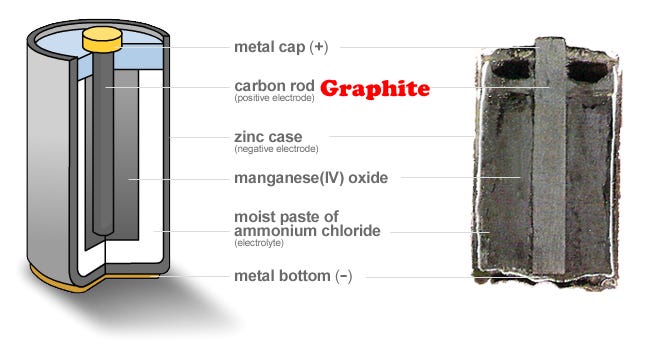
But graphite makes the list of critical minerals where diamond does not. Graphite’s traditional uses include brake linings, lubricants, refractories especially in steelmaking, pencils, and dry-cell batteries like those historically used in flashlights. The modern dry cell battery (also known as the zinc-carbon battery) was patented by German physician Carl Gassner in 1886-1887.
But it is graphite’s use in modern batteries, especially in electric vehicles, that has driven its price and demand to new highs. In the middle 1990s graphite prices were around $150 to $600 per ton, and the US consumed about 14,000 metric tons (1991). In 2025, the average price of graphite ranged from $1,000 to $2,600 per ton, depending on the grade, and US consumption was about 79,000 metric tons (down from the recent peak in 2022 at 89,000 tons). Price comparisons for graphite are challenging because different types, purity, and qualities (flake, lump and chip, and amorphous) vary significantly, as do prices of final graphite products because of variable processing.
Demand (and price) of graphite began to grow in the mid-1990s as nickel–metal hydride and lithium-ion batteries came into significant consumer use, initially mostly in portable electronics like CD players, and increasingly in cell phones and laptops. Graphite in their batteries serves as the anode, just as it does in old dry-cell batteries, but needs for relatively high-purity graphite in greater volumes drove demand.
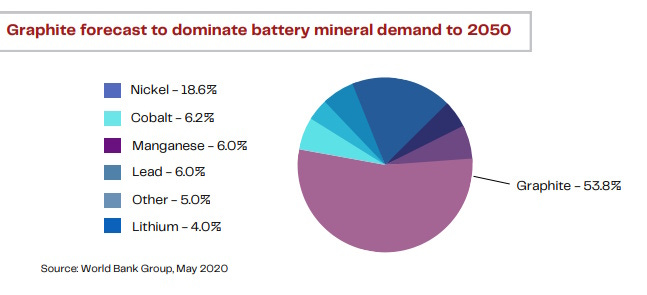
But it was the increasing popularity of electric vehicles that really pushed graphite consumption. An average EV battery typically contains 50 to 100 kg (110 to 220 pounds) of graphite, according to the Brussels-based European Carbon and Graphite Association (ECGA). By volume graphite is the most important component of modern batteries, as shown in the chart below from ECGA forecasting use to 2050.
We make synthetic diamonds for most industrial purposes, so why can’t we make synthetic graphite? We can and we do – but it is an energy-intensive process to reach battery-grade specifications. Until recently synthetic graphite cost on the order of $20,000 per ton. Prices have come down because of demand and extensive research into effective processing techniques, but for high grades, natural graphite usually remains cheaper and has better qualities. This has driven exploration and production projects for natural graphite around the world, including in Greenland, and in Norway, Sweden, Finland, and Italy in Europe alone.
China has been the 600-pound gorilla when it comes to graphite mining, with 78% of the world total. Madagascar, Tanzania, Brazil, and Mozambique are in a distant cluster producing 3-4% each (USGS data). The United States has not mined graphite domestically since 1989, and is 100% dependent on imports, at least 46% of which came from China in 2025. Tariff wars affect such imports so the figures for graphite can change dramatically and abruptly.
Graphite was also discussed loudly in early 2025 in the political games regarding Ukraine’s minerals. See this previous post for my take on that situation.
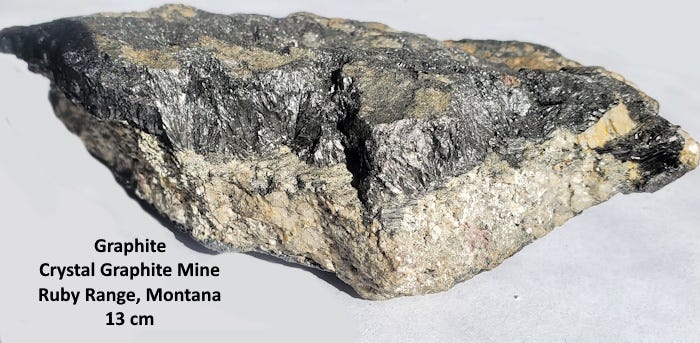
But this all means that of course, the US is also seeking to develop graphite mining, with projects in the works in Alabama, Alaska, Montana, and New York. The Montana project hopes to rejuvenate production from the Crystal Graphite Mine in the Ruby Range, the source of the specimen in my photos here.
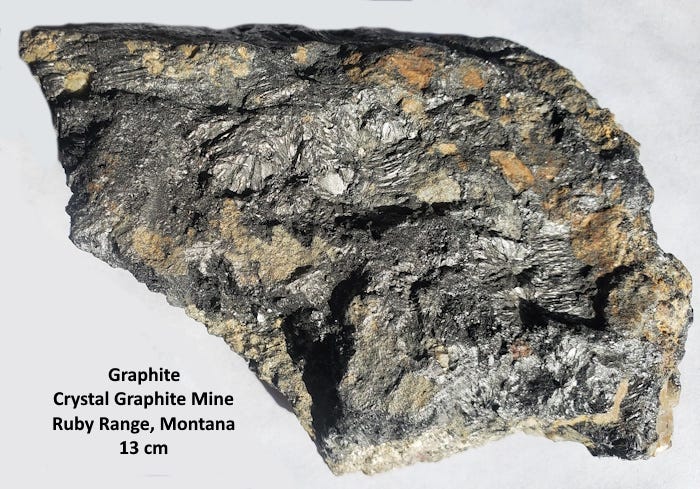
Although the only photo of graphite on MinDat from the Crystal Graphite Mine, a 13.4 cm specimen, is described as “a rare, perhaps unique large graphite from the locale,” I might argue with that. My two specimens, which were formerly one, are 13 cm and 10 cm, and while I would not contend they are equivalents to the thick graphite vein in the MinDat specimen, they are at least comparable (in my opinion!), and other photos of similar specimens are out there. The specimen on MinDat sold at auction in 2022 for $336.00, which seems incredible to me for graphite, but De gustibus non est disputandum - there’s no disputing taste. My specimen cost $3.00 in 2003.
According to Robinson and others (2017, Graphite: Chapter J in Critical Mineral Resources of the United States—Economic and Environmental Geology and Prospects for Future Supply: Professional Paper 1802–J), “The Crystal Graphite Mine near Dillon, Montana, is the largest known graphite vein deposit in the United States. At this deposit, veins up to 60 cm thick and 15 m long occur in fractures in gneiss and pegmatite.” Consequently it’s no surprise that Arizona-based Ruby Graphite Holdings is exploring that old mine.
The prospect was discovered about 1889, and mining began at the Crystal Graphite Mine in 1902. Production peaked during the world wars, when graphite from Ceylon (Sri Lanka) became unavailable for steelmaking. Underground tunnels total at least 3,500 feet (1,070 m), but Ruby Graphite considers that “the ore body has barely been touched.”
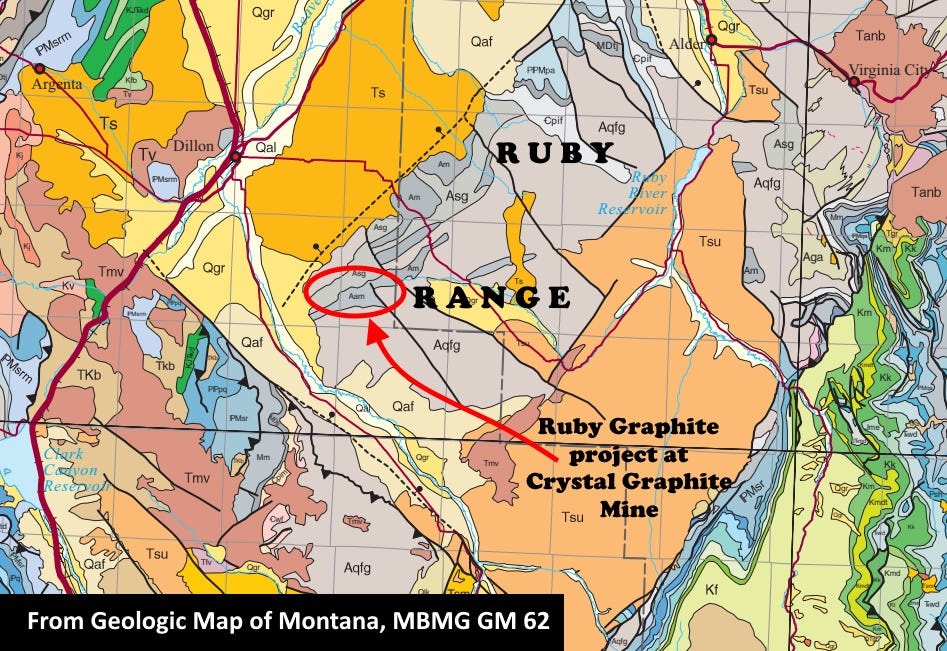
The deposit is in intensely metamorphosed Precambrian gneiss and related rocks of Archean age, probably metamorphosed at least twice including during the Big Sky Orogeny in Paleoproterozoic time. Ruby Graphite geologists suggest that the graphite came from carbon-dioxide-rich fluids ultimately derived from the mantle, deposited in a retrograde (cooling) setting in open veins in the older metamorphic rocks.
Although I had no reason to doubt this specimen is graphite, I verified it was not the sometimes similar-appearing molybdenite by its specific gravity: graphite is about 2.1 versus molybdenite’s 4.7, an easy difference to measure.
Disclaimer: I have no connection with Ruby Graphite Holdings; everything here related to the company is from their website and news releases.
Thank you…I am wondering what geological processes are behind the deposits into fracture veins…hydrological, pressure?
This might come across as a bit rant-e so apologies.
Basically what industrial compound or element isn't potentially "critical" when discussing electric vehicles and related "green" power generation and delivery. We couldn't pick a more problem laden topic than electrification of transportation (at least on the mineral supply side of the equation). Even when discussing one of the most abundant minerals, copper, that becomes a critical commodity, with occurrence and production limitations. All in the name of "green" pipe dreams.
On a more geological note, I tend to be in the camp that graphite in metamorphic rocks seem more likely be from carbonate protoliths, but the mantle-derived source is interesting.