
Nevada
The Northern Nevada Rift

Life in the USA is not normal. It feels pointless and trivial to be talking about small looks at the fascinating natural world when the country is being dismantled. But these posts will continue, as a statement of resistance. I hope you continue to enjoy and learn from them. Stand Up For Science!
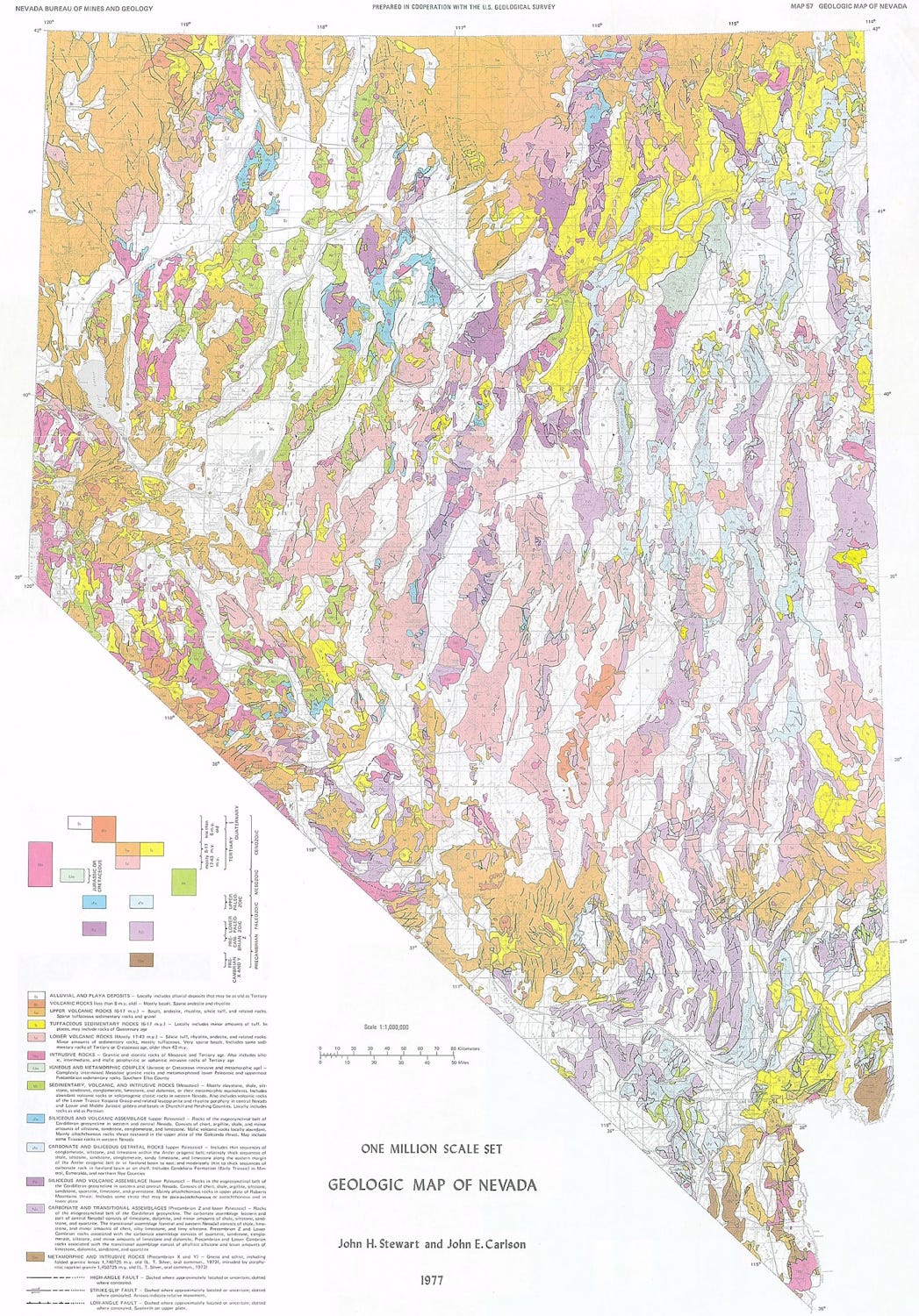
Nevada is dominated geologically by more-or-less north-south (or you may discern a somewhat north-northeast to south-southwest grain in the map above) elongate alternating basins (valleys) and ranges (mountains). Early explorer and geologist Clarence Dutton has often been quoted (and misquoted) as calling this pattern “like an army of caterpillars crawling northward.” For the full story of that, visit Looking for Detachment.
The alternating basins and ranges are the consequence of extension pulling the region apart, pulling it in an east-west sense. On the geologic map above, most of the basins containing young sediments shed off the mountains are gray-white, and the ranges are all the other colors, ranging from things like Paleozoic carbonates 400 million years old to Tertiary volcanics as young as 15 million years or younger.
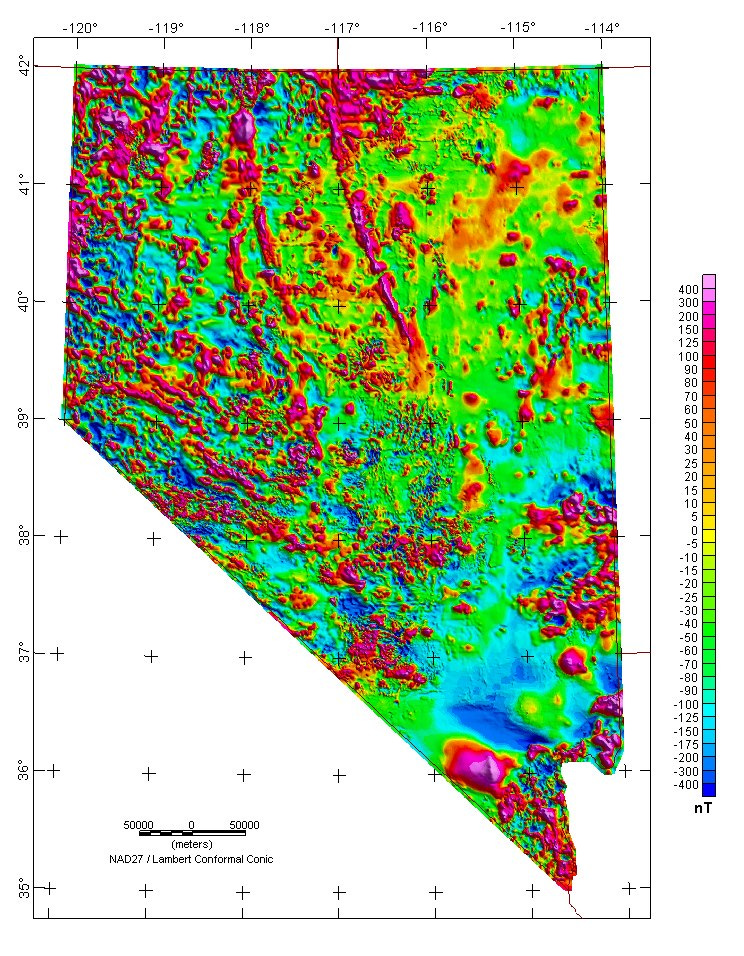
But the magnetic map of Nevada (above) shows a very different character. Probably the first thing your eye is drawn to is the long linear north-northwest trending feature in the north-central part of the state. This is the Northern Nevada Rift, a complex tectonic feature that appears to relate to such diverse things as the start of the Yellowstone caldera system and gold and oil deposits in Nevada. It is oblique to, and cuts across most of the basin and range structures. Once you know where to look, you can probably see it in subtle offsets in the geologic map at top.
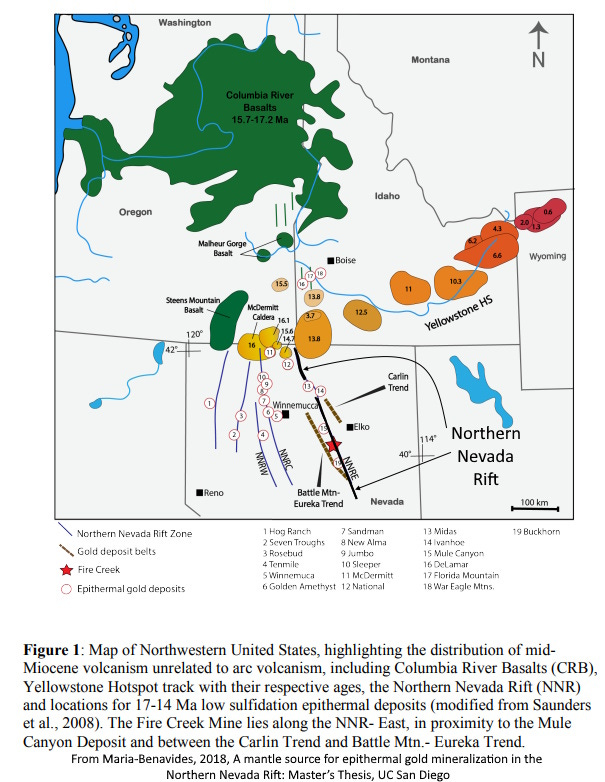
What it is: As a magnetic high, it indicates the presence of magnetic rocks. LOTS of study (for example, Ponce and Glen, 2008, A prominent geophysical feature along the northern Nevada rift and its geologic implications, north-central Nevada: Geosphere 4(1), p. 207) shows that geologically it is a set of dike swarms and related volcanic rocks of middle Miocene age, about 17 million years – nearly coincident in both time and space with the initial outbreak of the eruptions associated with the Yellowstone Hot Spot, which began in southeastern Oregon pretty much just beyond the northern terminus of the rift anomaly on the magnetic map of Nevada.
More broadly, it might relate to an old Paleozoic margin of the North American continent, or it might be a crack within the continental crust. There isn’t much doubt that the continental crust under the basin and range is different, thinner, than “standard” continental crust beneath, say, the Colorado Plateau or the midcontinent (Kansas, Illinois, etc.). As a structural feature, the Northern Nevada Rift correlates with some of the cross-cutting breaks in basin-and-range faulting, with the Carlin and other gold deposits, and in its far southeastern extension, with two significant oil pools in Railroad Valley where reservoirs are related to faulting and natural fracturing. One of those fields, Grant Canyon, included the oil well that was the most prolific onshore US producer for 10 years or more in the 1980s, at more than 4,000 barrels a day.
The source of the magnetic anomaly (as well as the parallel feature west of it) extends to mid-crustal depths, which probably reflects the deep origin of the intrusive dikes in the rift. It’s an intriguing feature whose secrets are by no means all unraveled.
It’s hard to add it all up, but I’ve probably put in more time and effort studying Nevada professionally than any other place, probably something like 3 or 3.5 years of regular working weeks on three major and several smaller projects from 1979 to 2015. When I first encountered it in 1979, during an oil exploration project for Gulf Oil, the nature of the Northern Nevada Rift was quite enigmatic, and together with other unexpected aspects to both the magnetic and gravity data I was charged with interpreting, it made for a lot of learning. Nevada is a fascinating place, geologically, tectonically, and for its complex gold, oil, and other economic resources. I’ve posted various things about Nevada previously, including this one about Huntington Valley.
A 2025 seismic swarm was located on faults that cross the Northern Nevada Rift at a high angle.
Very interesting. We drove from Vancouver, WA to Las Vegas in 2011. We made a side trip to Winnemucca to honor an uncle's grave. He was killed in in 1940 in a car crash while working at a remote mercury mine, I believe west of town in the Jackson Mountains. I had to dig into old Bureau of Mines Bulletins from 1940 to pinpoint where I think the mine was. (Mercury was being shipped to California for use in munitions. Lead up to war. The cinnabar deposit was pretty much exhausted around the time of Pearl Harbor according to an oral history transcript found in the local library). The 2011 drive was epic, glad we did it but never again! Around one range, jog in the highway, around another range. There are so many abandoned and active mines in Nevada. Yes, plenty for geologists to study.
Despite being from Montana and appreciative of its beautiful geology, I have to say Nevada geology pleases me most with its diversity and complexity. I chuckled at your comment about the motel in Laramie and your conversation with your boss; I worked (during grad school) a couple of seasons for Exxon minerals division. The first month I turned in my expense report, the office manager called me and asked if I was eating OK. Being used to the finances of a grad student, I was trying to be frugal and careful of the company's money. She told me to start eating more and better, I was making the other geologists look bad ;)