
Okenite
Associated with zeolites

Life in the USA is not normal. It feels pointless and trivial to be talking about small looks at the fascinating natural world when the country is being dismantled. But these posts will continue, as a statement of resistance. I hope you continue to enjoy and learn from them. Stand Up For Science!
This post is a follow-up to a recent one on thomsonite. 1,034 million years after that thomsonite was deposited in Michigan and on the other side of the world, another huge basaltic eruption created cavities in which spectacular zeolites and other minerals were deposited. The Deccan Traps erupted for about 700,000 years in what is now India from about 66.3 to 65.6 million years ago. Trap here is from a Swedish word for stairs, reflecting the step-like topography produced by many basalt flows piling on top of each other, and later eroding back to produce a jagged landscape.
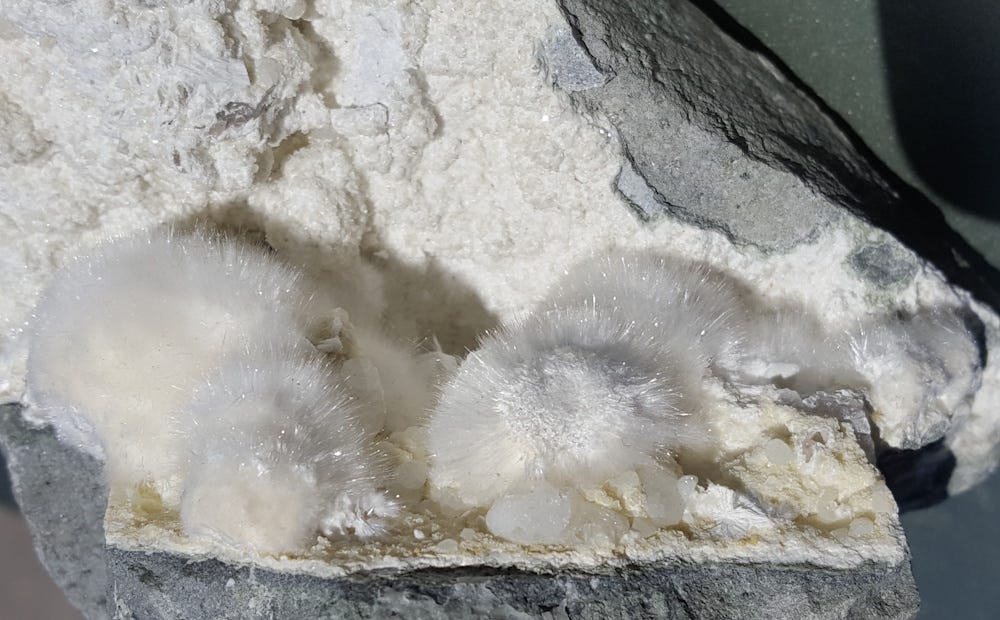
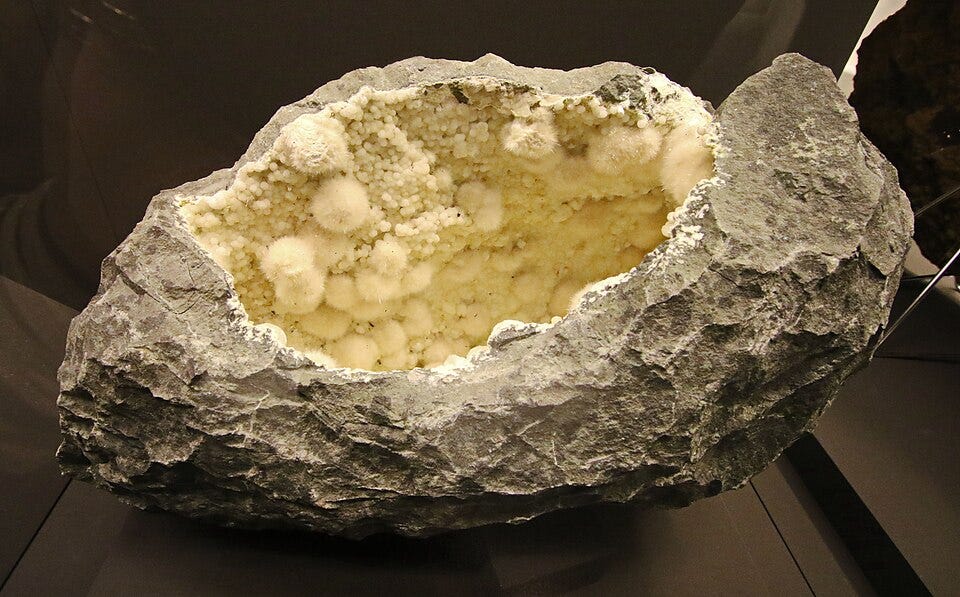
Okenite is commonly associated with zeolites, but it isn’t one. It typically forms radial white “cotton-ball” crystal groups that can be quite fragile. Nonetheless many have made their way from India into collections around the world.
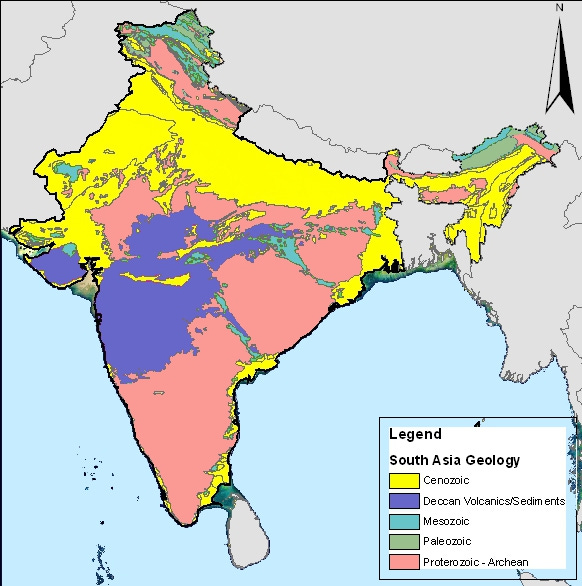
The Deccan volcanics cover an area today of about 500,000 square kilometers (200,000 sq mi), but they may have originally covered three times that area. In many places the flows total more than 2 kilometers (1.2 miles) thick. I think the most common explanation of their origin is a large, deep-seated, persistent mantle plume (hot spot), possibly the one still active under Réunion Island in the Indian Ocean.
The Deccan volcanics may or may not have contributed to the mass extinction at the end of the Cretaceous period. I think most workers believe that event was most directly related to the impact at Chicxulub in what is now Yucatan, and the role of the volcanics is controversial, ranging from a significant factor to one that actually mitigated the effects of the impact, but others say flat-out that the Deccan eruptions caused the extinction over an extremely short (1000 years) period, yielding a fossil record comparable to the “instantaneous” impact event (e.g., Keller and others, 2020, Mercury linked to Deccan Traps volcanism, climate change and the end-Cretaceous mass extinction: Global and Planetary Change 194:103312).
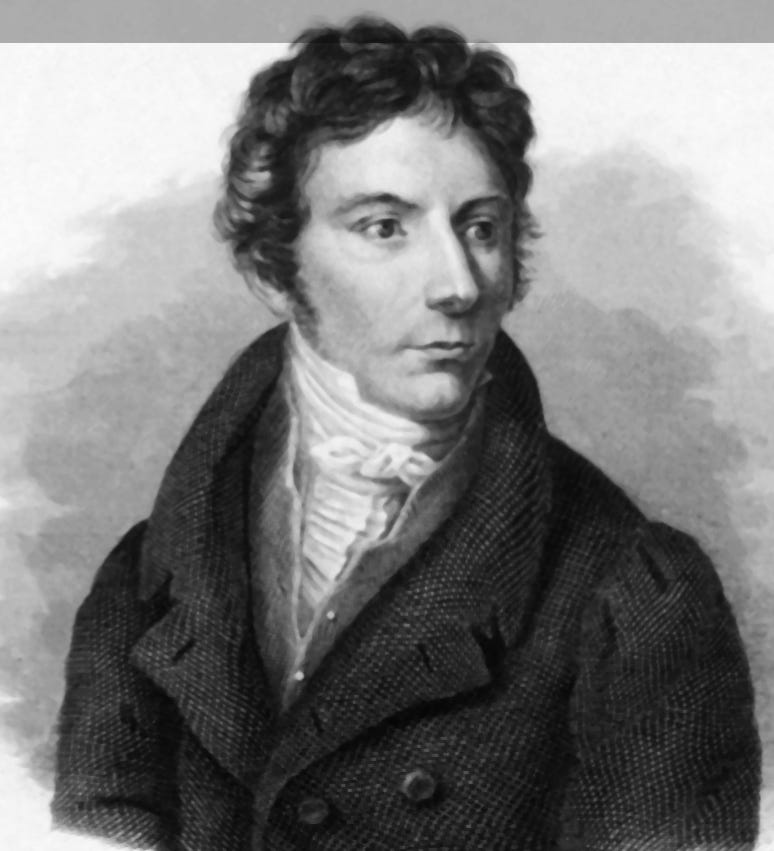
Okenite, Ca10Si18O46 · 18H2O, honors German biologist Lorenz Oken (1779-1851). His birth name was Okenfuss, shortened by him to Oken while he was at the University of Göttingen; it is sometimes given as Ocken, and the mineral was originally spelled ockenite. Oken established an early recognition of biological cell structures.
Housekeeping note: It seems that 300 or 400 of some things is, if not a limit, at least a constraint for me. 397 podcast episodes in the History of the Earth series, 400 newspaper articles on Butte history, 300 in the Butte, America’s Story podcast. Although with this post we’re at #400 in The Geologic Column, I have no plans to cease, but for the summer, I may miss one here and there. Creating one of these posts completely from scratch takes 2 to 6 hours or sometimes more, and I sometimes seem to spend as much time deciding “what’s next,” to try to maintain a nice mixture of topics, as I do writing or looking for motivation for writing. I hope and expect to “play” a fair amount this summer, so just don’t be surprised if there’s an occasional gap. Apologies in advance!
Thanks as always for your interest, and also as always, a special shout-out to those of you who have chosen to donate. I appreciate it all very much!
Gaps are ok! But please don't stop! I'm up to episode 1076. I'm glad it doesn't take me 2-6 hours for each. It can take from 15 minutes to an hour or more though!
Re the Deccan traps (btw "12 miles" is missing a decimal point!) and the timing of the Chicxulub (sp?) impact, I read (I think in When Life Nearly Died by Benton) that while the Deccan eruptions started before the meteor impact and so hadn't been thought to have been triggered by the impact, a more recent study showed that the output of lava had been relatively minor before the impact event, but right after it, the output of lava increased hugely maybe even by an order of magnitude, so it's highly possible after all that the impact triggered most of the Deccan outpouring. UC Berkeley study reported in Smithsonian here: https://www.smithsonianmag.com/science-nature/meteorite-killed-dinosaurs-also-triggered-underwater-volcanoes-180968106/