
Thomsonite
A zeolite

Life in the USA is not normal. It feels pointless and trivial to be talking about small looks at the fascinating natural world when the country is being dismantled. But these posts will continue, as a statement of resistance. I hope you continue to enjoy and learn from them. Stand Up For Science!
“I do not know what I may appear to the world; but to myself, I seem to have been only like a boy playing on the seashore, and diverting myself now and then in finding a smoother pebble or prettier shell than ordinary, while the great ocean of truth lay all undiscovered before me.” —Attributed to Isaac Newton.
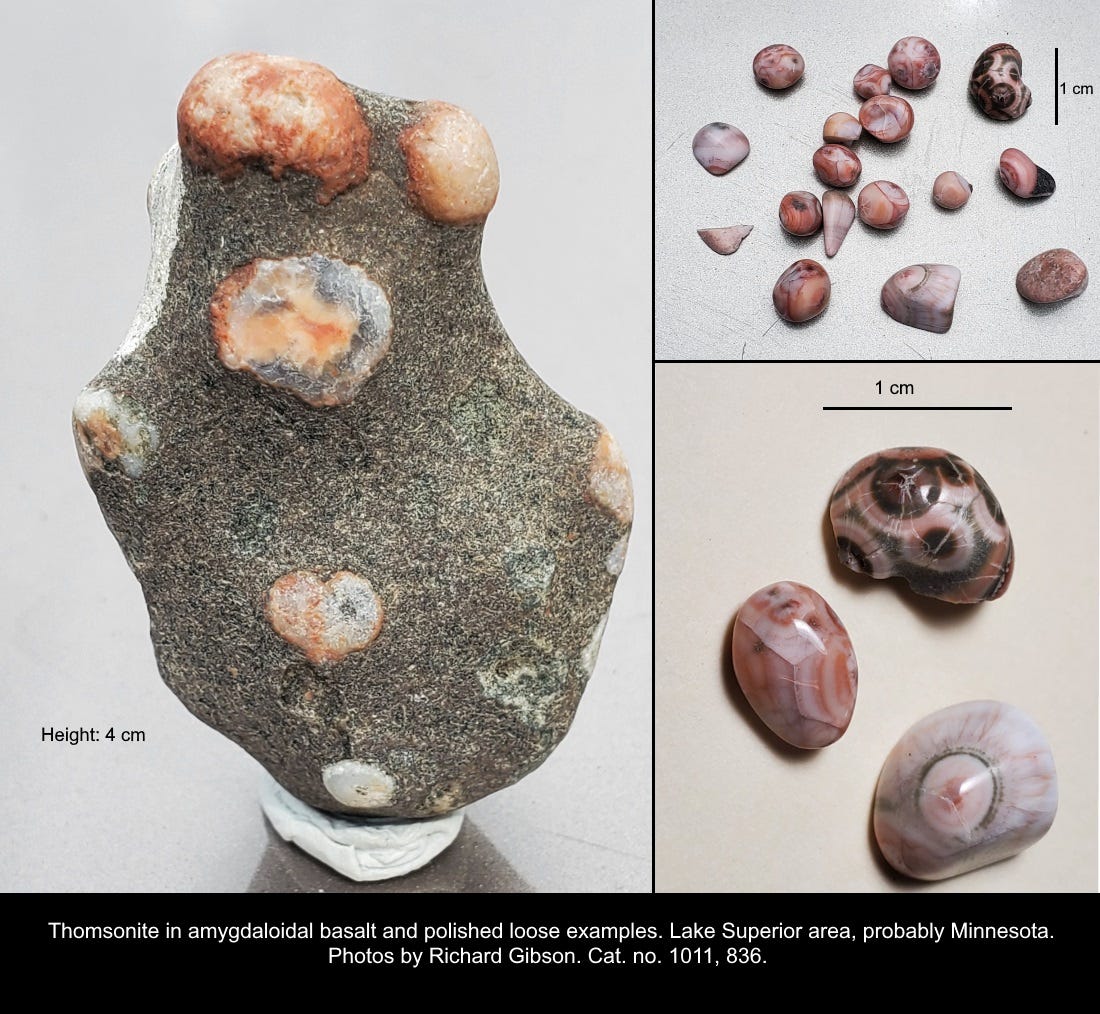
Today’s pebbles are most likely from the Grand Marais area on the north shore of Lake Superior in Minnesota, where the Duluth Gabbro Complex crops out. The rock is a fine-grained basalt, iron- and magnesium-rich silicates, which probably formed as either a flow or a shallow intrusion. As is usual in such magmas, there were gas bubbles present. After the rock solidified, the gas bubbles became open spaces in the solid rock, and at some later time water percolating through cracks in the rock precipitated minerals in the open voids.
Such void fillings in rocks like basalt often consist of zeolites – a large group of minerals, mostly hydrous calcium and sodium aluminosilicates. In this case, the voids were filled with the zeolite mineral thomsonite in multicolored concentrically and radially banded arrays. They often have patterns resembling eyes.
The filled void spaces in things like basalt are called amygdules, and the rock is called amygdaloidal basalt. That word is from Greek and Latin for “almond,” because the filled voids are often elongate, somewhat elliptical shapes like almonds. The gas bubbles often take that shape rather than spheres because of flow in the molten material, or because of strain in the solidifying or solid rock. This is not to say they are never spherical; they sometimes are.
I say the Minnesota shore is “most likely” as the source for these rocks because pieces like this are abundant there, but they might be from anywhere on the shore of Lake Superior.
The Duluth Gabbro Complex is an element of the Mid-Continent Rift, a long extensional system that runs from Oklahoma through Kansas and Iowa to the northeastern tip of Minnesota, then under Lake Superior, to turn south beneath the Lower Peninsula of Michigan (where is it often called the Mid-Michigan Rift). It represents crustal rifting and consequent intrusion and eruption of basaltic lavas – a rift that began to tear North America apart about 1,100 million years ago but failed. It may have ceased in part because of a nearly contemporaneous collision just to the east, the Grenville Orogeny, that added a long strip of continent to North America in and beneath what are now Ontario, Ohio, Kentucky, Tennessee, Texas, and other locations.
As with many minerals, thomsonite is now a subgroup within the zeolites, consisting of just two minerals: thomsonite-Ca and thomsonite-Sr. The calcium member, NaCa2[Al5Si5O20] · 6H2O, is by far the more common.
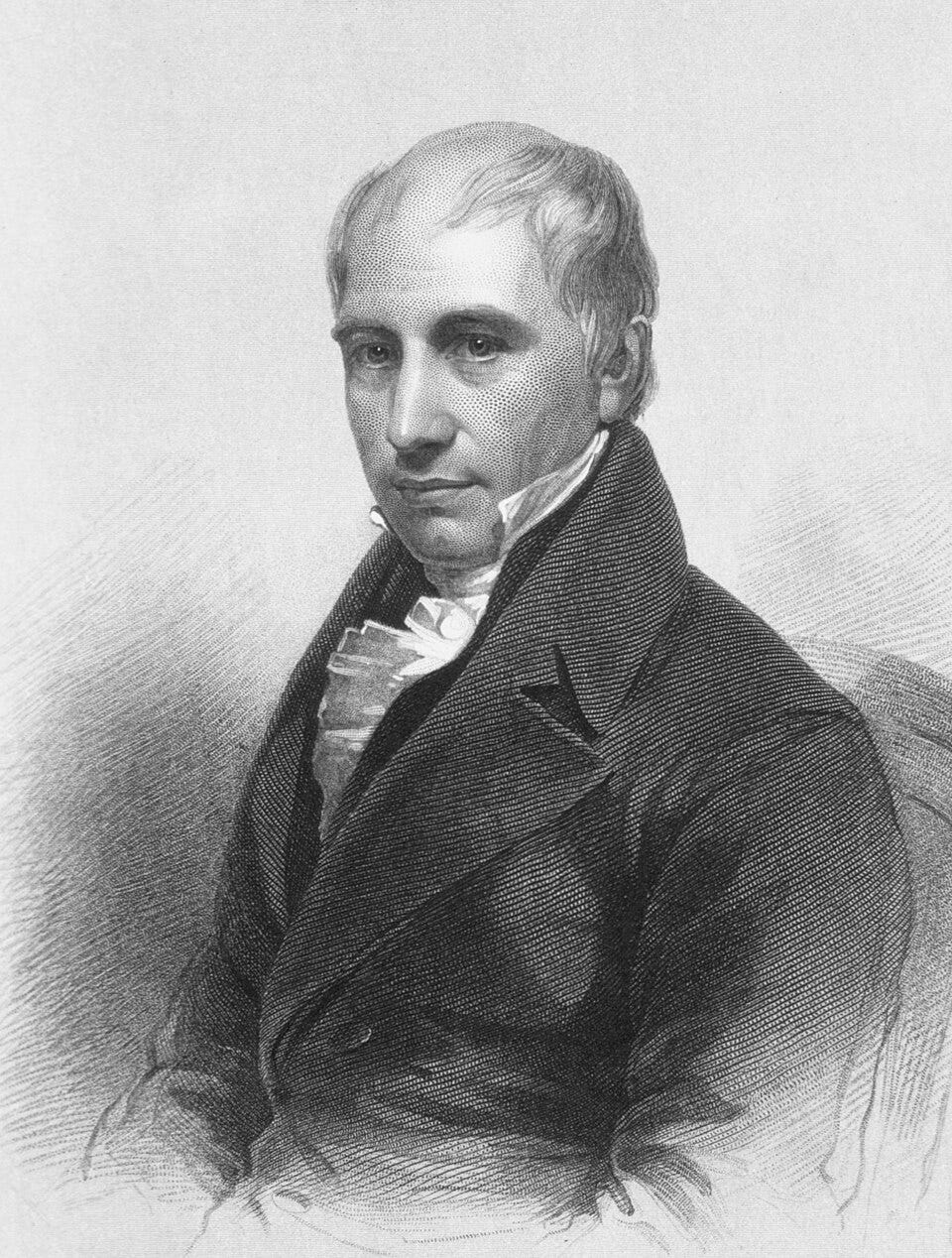
English crystallographer Henry James Brooke named thomsonite in 1820 for Thomas Thomson (1773-1852). Scottish chemist Thomson was the first to analyze the initial material, from Scotland, which Brook defined as a new mineral. There was some early confusion about the mineral; zeolites in general can be difficult to differentiate. David Brewster determined in 1821 that blocky crystals in cavities of lavas from Mt. Vesuvius were not apophyllite, and thought they were a new species, giving them the name comptonite, but they were later shown to be thomsonite. Botryoidal forms have been called faröelite for their occurrence in the Faröe Islands, but now both comptonite and faröelite are used (if at all) as varietal names for thomsonite.
We’ve seen thomsonite in tiny crystals from Montana in this previous post.
Henry James Brook (1771-1857, the namesake of brookite) introduced the concept of six primary crystal systems.
We now return to playing on the seashore.
Thanks for witing this 💚🩷💚