
Pitticite
Is it a mineral?

Life in the USA is not normal. It feels pointless and trivial to be talking about small looks at the fascinating natural world when the country is being dismantled. But these posts will continue, as a statement of resistance. I hope you continue to enjoy and learn from them. Stand Up For Science!
It seems a pity to question a mineral’s legitimacy, kind of like degrading Pluto simply because of some committee’s definition. But questions do arise.
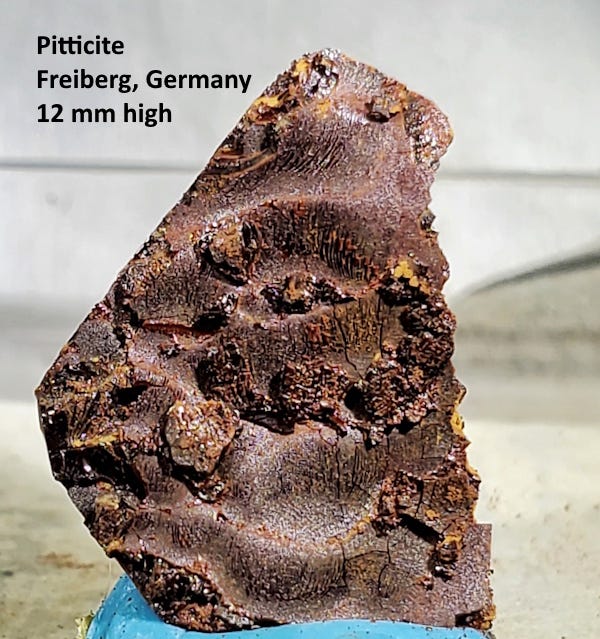
This is a tiny piece of pitticite from Freiberg, Saxony, Germany. It’s one of the things I had never heard of until I acquired a 1000-piece micromineral collection in 2018.
Recall the definition of a mineral: A naturally occurring inorganic element or compound having an orderly internal structure and characteristic chemical composition, crystal form, and physical properties. You may find slight variations on this definition (which is from MinDat), but it’s a standard format, typically widely accepted.
The IMA (International Mineralogical Association) which defines and approves mineral species gives the official formula of pitticite as [Fe,AsO4,SO4,H2O] (?). Apparently the question mark is part of the official characterization, but the chemistry does seem to indicate that pitticite is inorganic, meeting the second part of the mineral definition. But is it a characteristic chemical composition, one that is, if not specific, like quartz, SiO2, then perhaps a clearly defined series, like olivine, the series between forsterite and fayalite, Fe2(SiO4) to Mg2(SiO4), with a chemical composition varying from the 100% iron silicate end member to 100% magnesium silicate?
Apparently not.
Its description says “Chemical composition appears to be variable.” And according to Dunn (1982, New data for pitticite and a second occurrence of yukonite at Sterling Hill, New Jersey: Mineralogical Magazine, 46 (339) 261-264), “Microprobe analyses of 7 pitticites from various localities indicate that it is a gel-like mineral of widely varying composition with no apparent stoichiometry. Previously reported minor amounts of Si, Ca, P and Al are constituents of pitticites but are non-essential. Pitticite is retained as a generic name for amorphous, gel-like, ferric iron arsenate minerals of varying chemical composition.” Widely varying composition does not sound to me like characteristic chemical composition. And no apparent stoichiometry suggests that there isn’t even any balanced chemical equation or formula that would define pitticite.
What about orderly internal structure and crystal form?
Pitticite is listed as amorphous, which is the antithesis of orderly crystal structure. Nonetheless, in some reports, it is called an “amorphous mineral,” which strikes me as a contradiction in terms (Frost and others, 2011, Molecular structural studies of the amorphous mineral pitticite Fe,AsO4,SO4,H2O: J. Molecular Structure, 1006: 185-191).
In another paper, Frost and others (2012, Vibrational spectroscopic study of the mineral pitticite Fe, AsO4, SO4, H2O: Spectrochimica Acta Part A: Molecular and Biomolecular Spectroscopy, 85:173-178) say “Some minerals are colloidal and show no X-ray diffraction patterns.” Well, OK, but to my mind that still would put such colloidal “minerals” in a special category, distinct from those that fit the usual definition.
How about characteristic physical properties?
Pitticite is indicated to be “transparent to opaque.” That’s pretty much the total range for that property. Its color is given as “yellowish, reddish-brown, brownish red to brownish black, grey, nearly white.” Lots of minerals have a comparable, or even greater range of color, and color famously is one of the least reliable criteria for recognizing a specific mineral, so we’ll let that one pass. Luster, for pitticite “vitreous, greasy, dull,” is likewise quite a range, but that’s also not exceptional for some minerals.
Pitticite’s hardness, specific gravity, and streak show some variability, not too extreme, as many minerals with a chemical range do. Its habit is given as “massive; reniform to botryoidal or stalactitic; opaline crusts; earthy; also as slimy coatings.” That’s also quite a range, but again I think plenty of minerals show similar variation in habit.
Ultimately, the IMA says it is “A valid IMA mineral species - grandfathered – questionable.” I guess both valid and questionable cover most of the bases. And ultimately, officially, a mineral is whatever the IMA says is a mineral. And there are plenty of official exceptions to the formal definition.
So don’t pity pitticite (or Pluto for that matter). It is what it is, no matter what any committee or any person says, or wherever some human construct pigeonholes it.
And the name has been around a good while, defined in 1808. It’s derived from Greek πίττǎ pitta (sometimes, for no reason I can discern, transliterated as pissa), meaning “pitch,” for the typical greasy or resinous appearance.
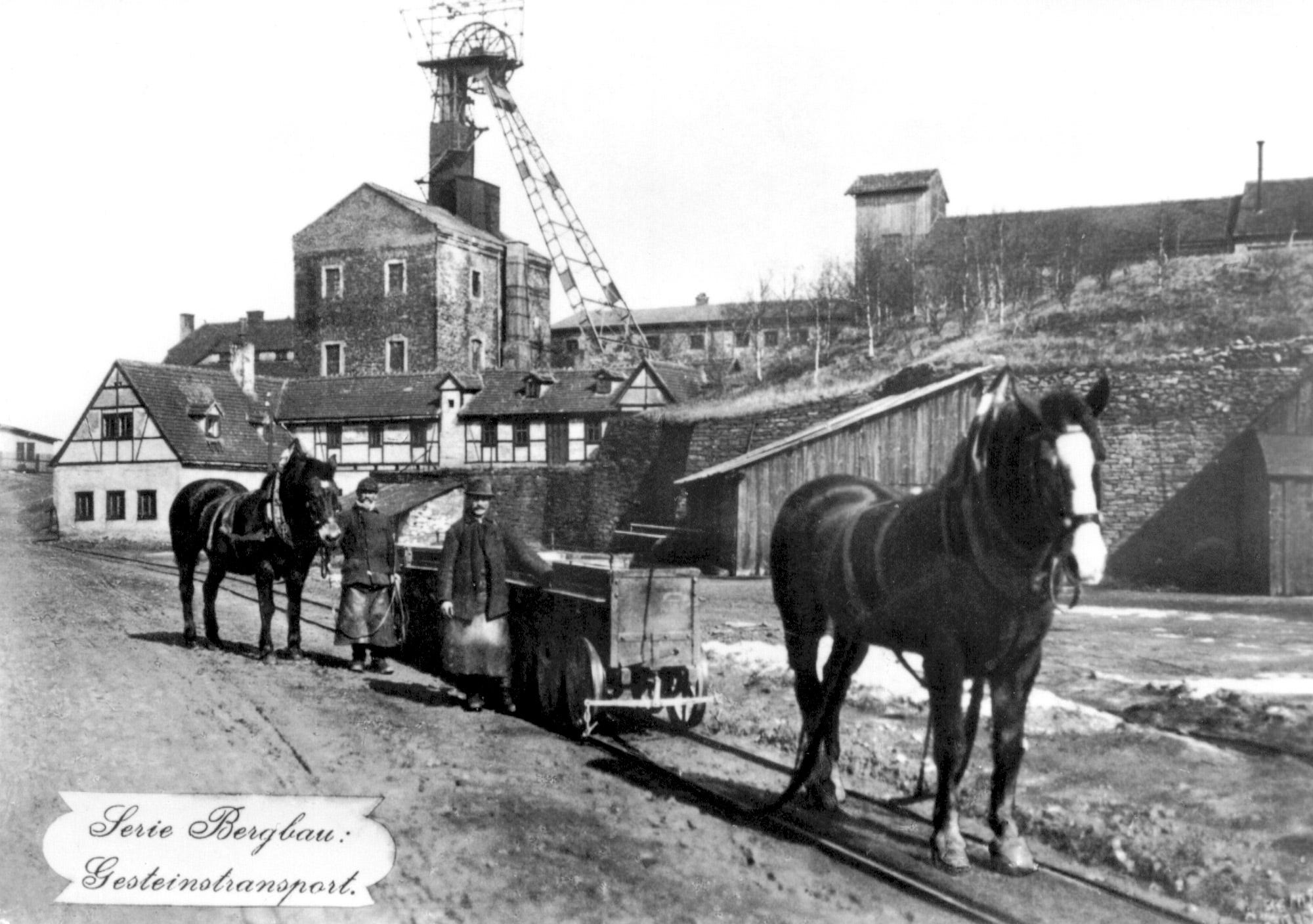
Pitticite forms as a secondary deposit related to arsenic-bearing ores, sometimes as a post-mining product, which for some might fly in the face of the naturally occurring part of the mineral definition, but not really for me; it formed naturally even if humans created the circumstances (the mine) that allowed it to grow. You can find plenty of mineral people on both sides of that argument. (I’m also in the camp that calls kidney stones minerals, even though they are “man-made” and a few are organic compounds.)
Freiberg, the town in Saxony, has the world’s oldest college of mining, founded in 1765. Freiberg the mining district where my specimen is from has been mined since at least the 12th century, especially for lead, zinc, and silver. The district, specifically the Christbescherung Mine, is the type locality for pitticite. The mine’s name means “Christmas gift-giving,” presumably for the rich gift of minerals from the earth.
"amorphous minerals" is one that the IMA definitely struggles with! A recent example is angastonite. See "Redefinition of angastonite, CaMgAl2(PO4)2(OH)4 ⋅ 7H2O, as an amorphous mineral", Grey et al, 2022. Check out "4.1 Status of amorphous minerals" in particular. An interesting read. Link https://ejm.copernicus.org/articles/34/215/2022/
Grandfathered, questionable?
Then obviously its a B------