
Urchin teeth
Mineral Monday. Or is it?

Life in the USA is not normal. It feels pointless and trivial to be talking about small looks at the fascinating natural world when the country is being dismantled. But these posts will continue, as a statement of resistance. I hope you continue to enjoy and learn from them. Stand Up For Science!
There are arguments, in my opinion mostly semantic, about the definition of a mineral. Most mineralogists would include “naturally occurring” as part of the definition, thereby excluding materials that form as a result of intervention by humans, whether deliberate or inadvertent. Things sometimes get murky with materials like kidney stones, which are certainly not formed purposefully, and even the calcite or aragonite secreted by clams to make shells and other biogenic materials that would be minerals for sure but for the fact that they are made naturally but by living things.
I’m with those who would include within the definition minerals that form as a result of the natural metabolic activity of organisms, including kidney stones, mollusk shells, and weddellite crystals in pores in leaves and cacti, and excluding only things created deliberately by the minds of humans (lots of compounds) or inadvertently but entirely because of deliberate human activity, like smelter slag or the crystals that form on corks in wine bottles, even though such things can be beautiful and interesting and are minerals in many ways except for that human connection. And I don’t think it would take much to talk me into accepting inadvertent things as minerals by definition, too. It’s all technicalities in my view, but plenty of mineralogists adhere to a stricter definition than I do. Probably the only “real” definition of a mineral is anything the International Mineralogical Association says is a mineral — and they are not always consistent with “rules.”
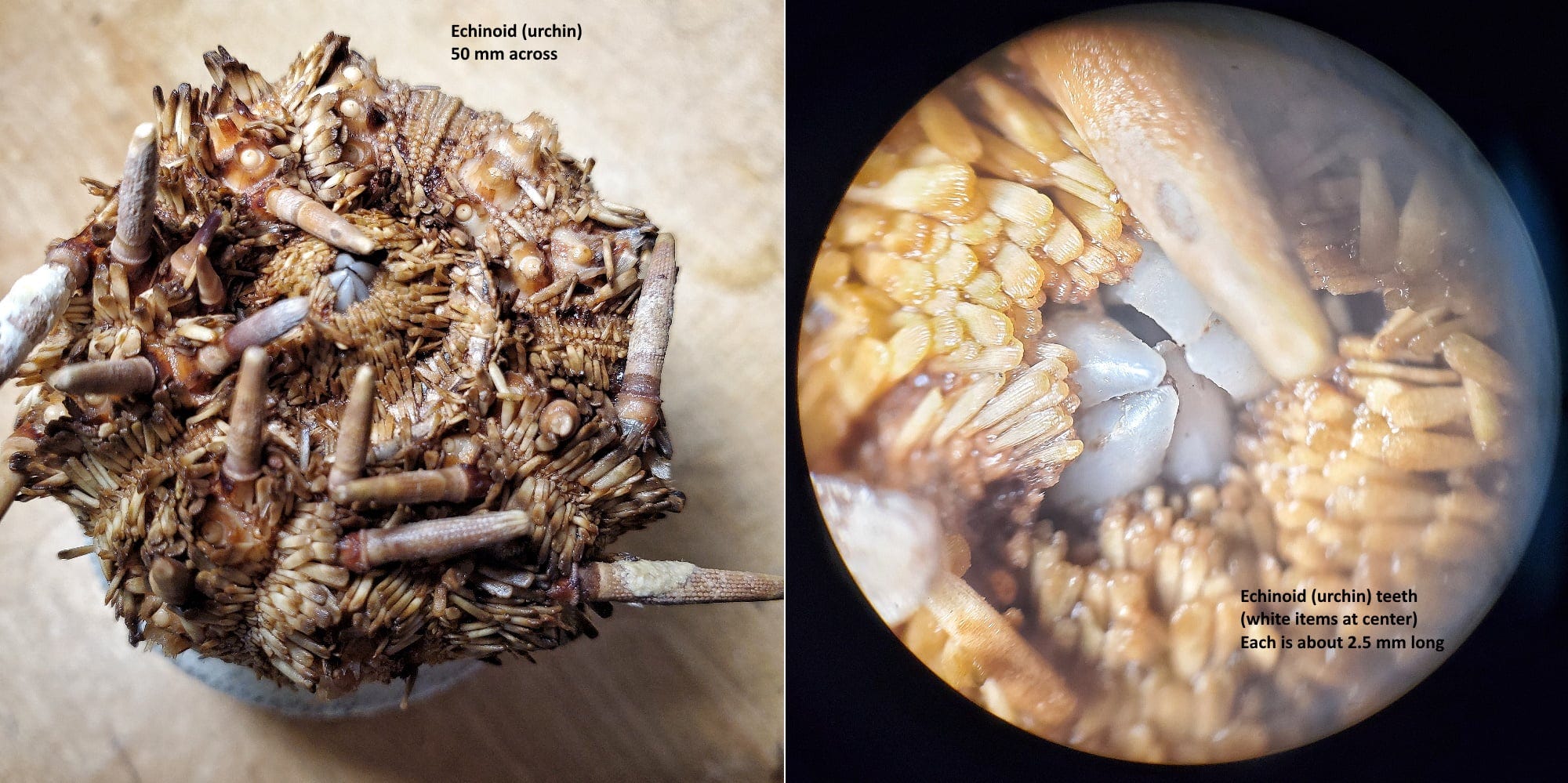
That said, in the photo at top you see some calcite (calcium carbonate). The five white things at the center of the photomicrograph at top are echinoid (sea urchin) teeth. This is not a fossil, because by convention a fossil is supposed to be at least 10,000 years old (or some other arbitrary number). This critter died in 1969 and I picked up its remains on New Year’s Day 1970 at Crawl Key, Florida. The teeth are about 2.5 mm long, and the overall body of the urchin is about 50 mm across. Everything in the urchin skeleton is calcite, but the white calcite in the teeth is purer than that in the body, spines, and scales, in which calcite is amalgamated with various amounts of organic matter such as chitin.
Urchins use their teeth to carve out cavities in limestone, which is also calcite. Calcite vs calcite should not be a winning formula for cutting, but urchins do several things to make this possible. Each of the five teeth consists of two blocks of intergrown calcite crystals, oriented to make the calcite cleave (break) in a way that amounts to self-sharpening of each tooth’s surfaces. The interleaving of those crystals also creates a microscopic, corrugated surface that aids cutting, and urchins also preferentially add magnesium to the calcite near the tips of the teeth, making those points harder and stronger (Ma and others, 2009, The grinding tip of the sea urchin tooth exhibits exquisite control over calcite crystal orientation and Mg distribution: Proc. Nat. Acad. of Sciences, March 30, 2009).
There’s not enough magnesium in urchin teeth to call the compound dolomite; more properly it is slightly magnesian calcite, but it’s still harder than pure calcium carbonate especially when the intergrowth of crystals is considered as well.
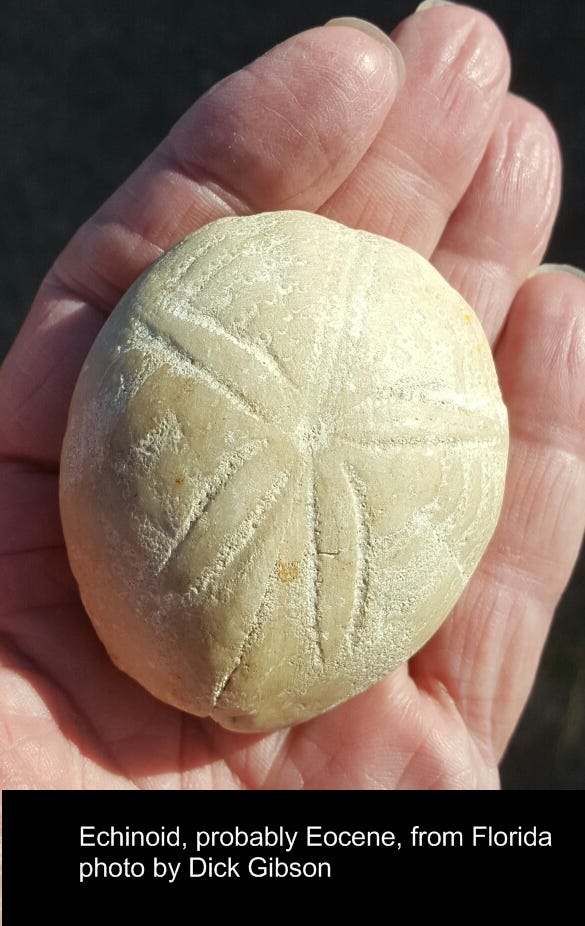
Echinoids, sea urchins, have been around since the Ordovician, about 450 million years ago, without any exceptional change. They were decimated by mass extinctions (only two lineages survived the great extinction event at the end of the Permian) but survived as a group, with about 900 living species and many hundreds of extinct species. They are members of the phylum Echinodermata, which includes starfishes, crinoids, blastoids, sea cucumbers, sand dollars, and other groups that are typified by 5-fold symmetry, reflected here in the five teeth of the urchin at top and the five-branched pattern in the test (body shell) of the echinoid from Florida above.
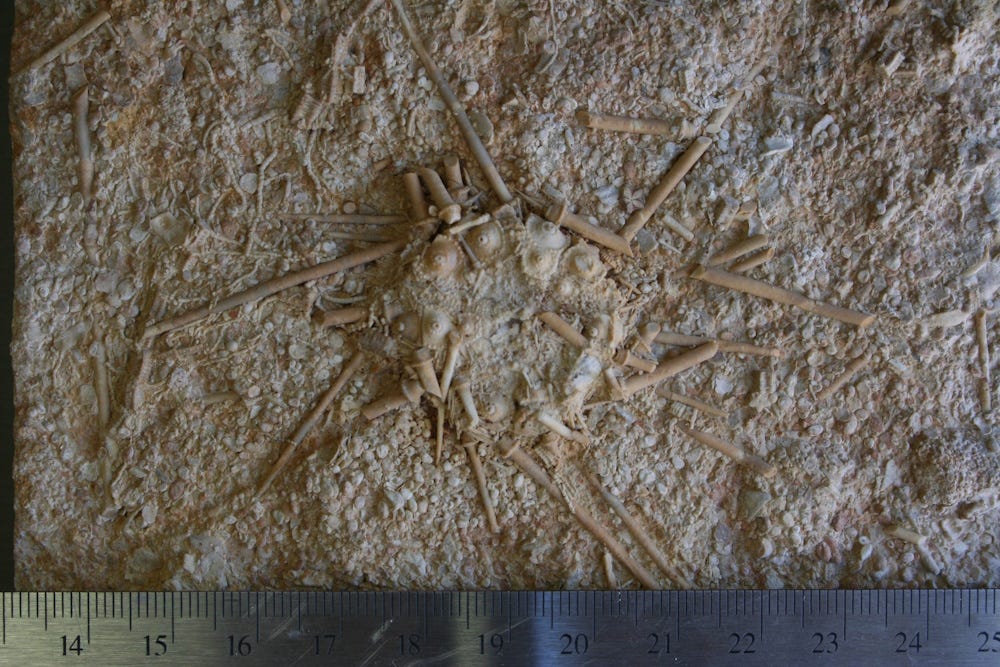
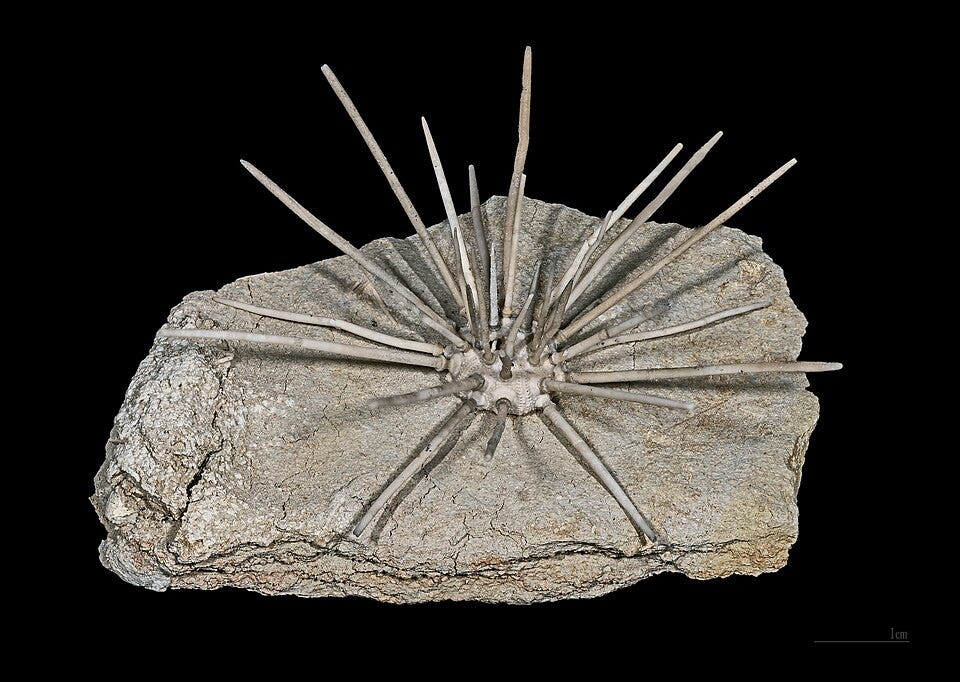
Cidarids like the one in my photo at top (probably Cidaris rugosa or a close relative) also secrete calcite as spines and plates covering their bodies. The specimen below, from my friend Stephen Henderson, is a Middle Jurassic echinoid from France, Acrosalenia hemicidaroides. The basic plan of echinoid spines and plates has not changed much in 170 million years. Beneath Steve’s specimen is a remarkably intact specimen of the same species, photo by Didier Descouens licensed under the Creative Commons Attribution-Share Alike 3.0 Unported license. (I’m pretty sure that’s a photo of a painstakingly prepared real specimen, not a reconstruction, but I’m not certain.)
So as far as I am concerned, the urchin teeth here are the mineral calcite. Your mileage may vary according to how technical you want the definition of a mineral to be, and it isn’t important enough to me to argue about it!
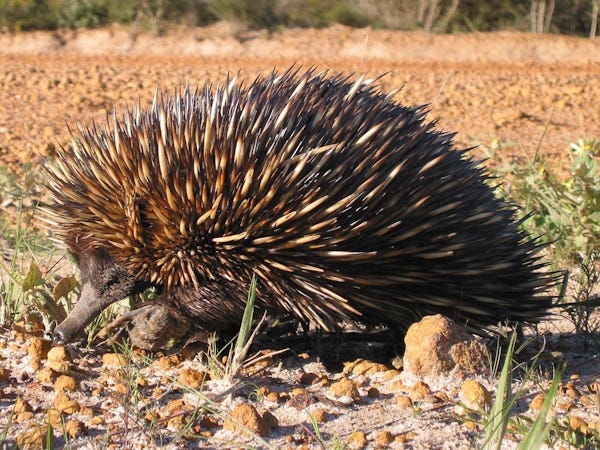
The word urchin is ultimately from Latin for “hedgehog,” from their spiny nature, and echinoid is from a Greek word for the same thing, and the echidna, the “spiny anteater,” has a name with the same derivation.
Quite fascinating. Always intrigued by the sea urchin but never enquired into the creature's ways and means of providing for itself.
But I like your summary too. Subdivide its definition wherever you want!