
Crocoite
The saffron mineral

Life in the USA is not normal. It feels pointless and trivial to be talking about small looks at the fascinating natural world when the country is being dismantled. But these posts will continue, as a statement of resistance. I hope you continue to enjoy and learn from them. Stand Up For Science!
I’ve been a little reluctant to post about crocoite, given the number of subscribers I have from Australia – but here it is. Knowledgeable folks should certainly point out my errors, or add other information in the comments (unfortunately, I think Substack still does not allow images in comments, neither from me or you).
Although crocoite, lead chromate, was recognized in the Urals of Russia (its type locality) in the 1760s when it was mined as a lead ore, by far the premier world-class location for it is around Dundas, Tasmania. Its modern name was given in the 1830s, from Greek κρόκος, krokos, meaning saffron (the spice derived from the crocus flower), for the mineral’s red-orange saffron-like color.
The intense color together with its common elongate crystal habit, arranged like jackstraws or bunches of uncooked spaghetti dumped into a box, make crocoite popular among collectors.
Tasmania is ranked the 26th largest island in the world, about the same area as southwest Montana bounded by lines from Missoula to Great Falls to Bozeman to Yellowstone, and the Idaho border. Given that size, it’s no surprise that it contains some complex geology.
Tasmania’s history before the middle Paleozoic is poorly understood. It may have been a discrete microcontinent, near Antarctica but potentially far from Australia, and some interpretations put it close to Laurentia (North America) about a billion years ago, when it might have undergone tectonic activity related to the well-known Grenville Orogeny of North America.
Tasmania may represent as many as seven narrow ribbon continents or separate tectonic terranes (Moore, Betts, and Hall, 2015, Fragmented Tasmania: the transition from Rodinia to Gondwana: Australian J. of Earth Sciences, 62:1, p. 1-35). They had probably come together by the end of the Cambrian, but the package may not have been accreted to Gondwana’s Australia-Antarctica margin until as recently as Devonian time, 400 million years ago. That activity resulted in granite intrusions, faulting, and some metamorphism.
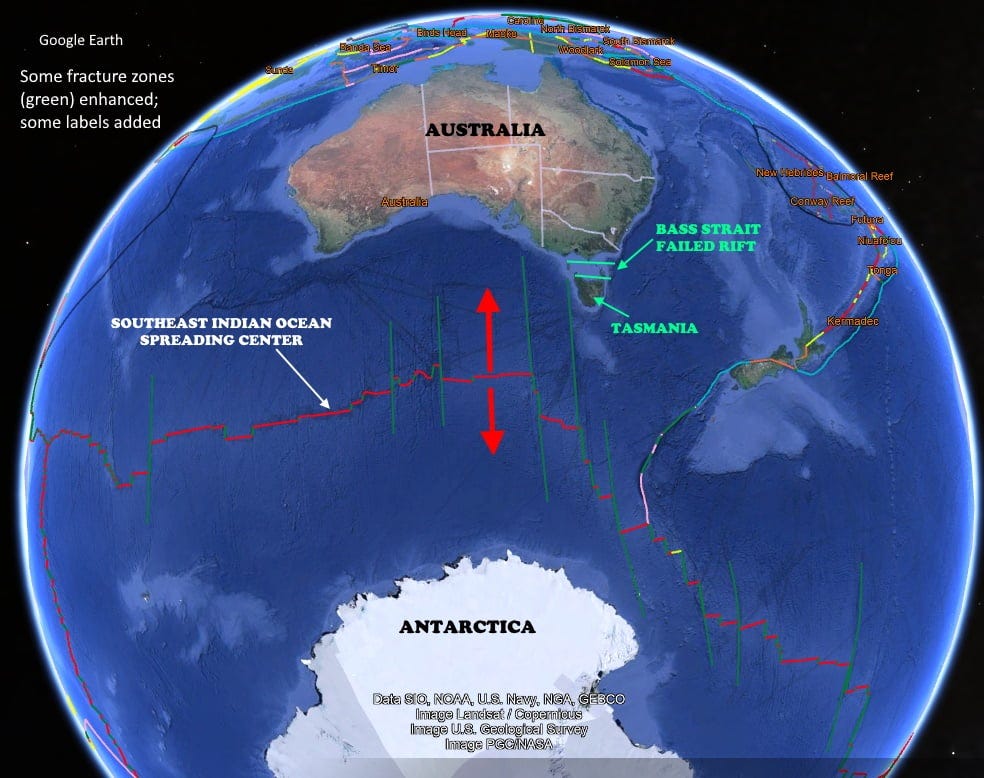
The most recent major tectonic action in the area around Tasmania took place in the Cretaceous, as Australia and Antarctica began to separate. Tasmania “tried” to break away from both Australia and Antarctica, and a rift developed between Tasmania and Australia in addition to the main oceanic spreading center between Australia and Antarctica. That rift failed, and is the Bass Strait today, and Tasmania is part of the Australian tectonic plate.
In any case, the probable Cambrian amalgamation of ribbon terranes in what is now Tasmania combined transitional continental blocks, island arc fragments, back-arc basin sediments, volcanics, and probable ophiolites (slices of oceanic crust emplaced on the continental or island-arc material). The result was the sequence of serpentinites (altered ultramafic ophiolites that contained abundant chromium) and Cambrian sedimentary rocks that host the crocoite-bearing zones in western Tasmania today. Lead may have come from or been mobilized by the Devonian granitic intrusions.
The abundance of crocoite over the more common lead minerals has been explained by 1) the abundance of chromium, derived from the ophiolite (oceanic) material, and 2) a rather complex situation of particular acidity in the fluids that carried the lead and chromium (Moore & Wilson, 2012, Major crocoite discoveries at the Adelaide Mine, Tasmania: Mineralogical Record 43). I offered some information about one of the other chromium minerals from Tasmania, stichtite, in a previous post.
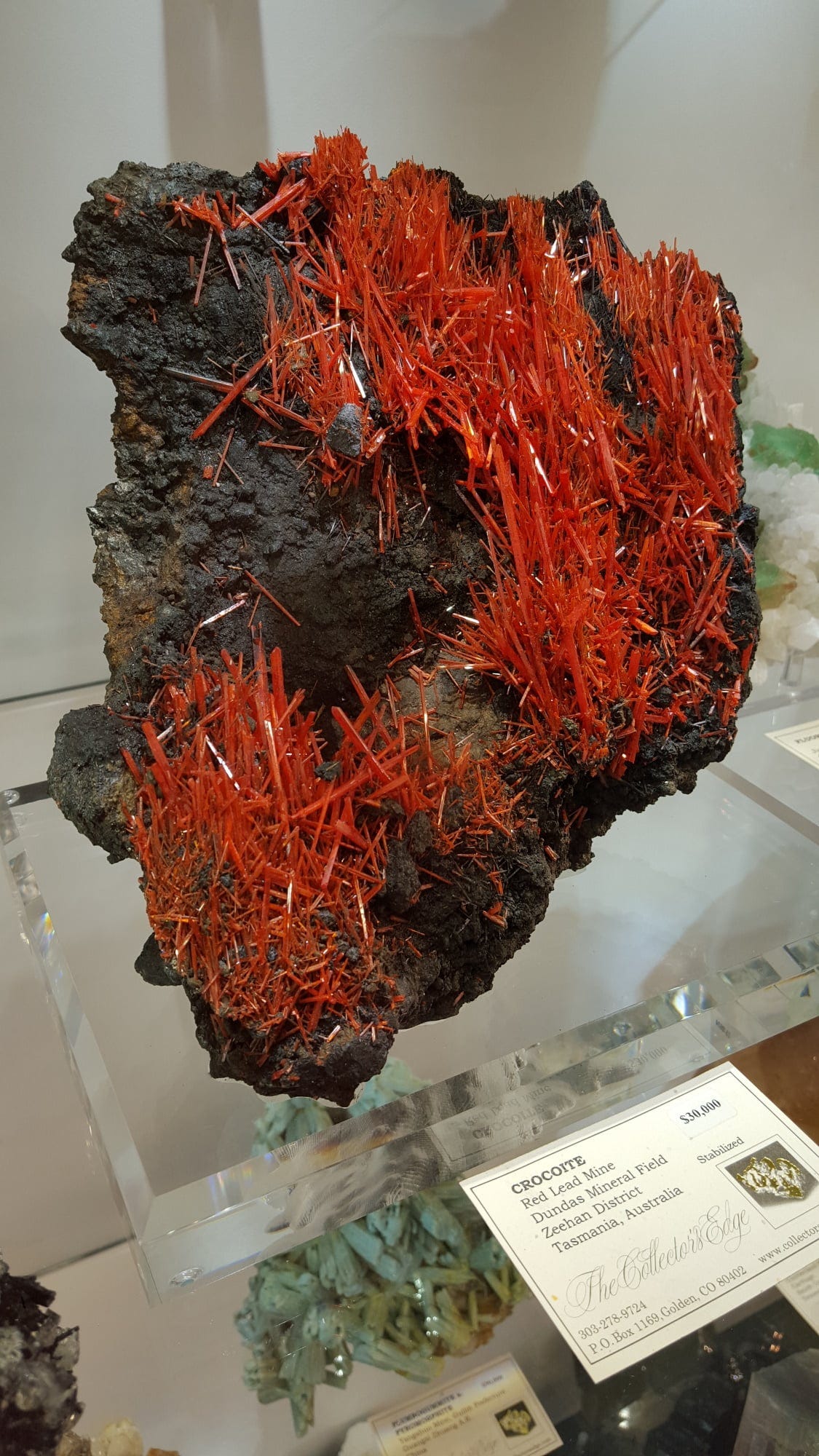
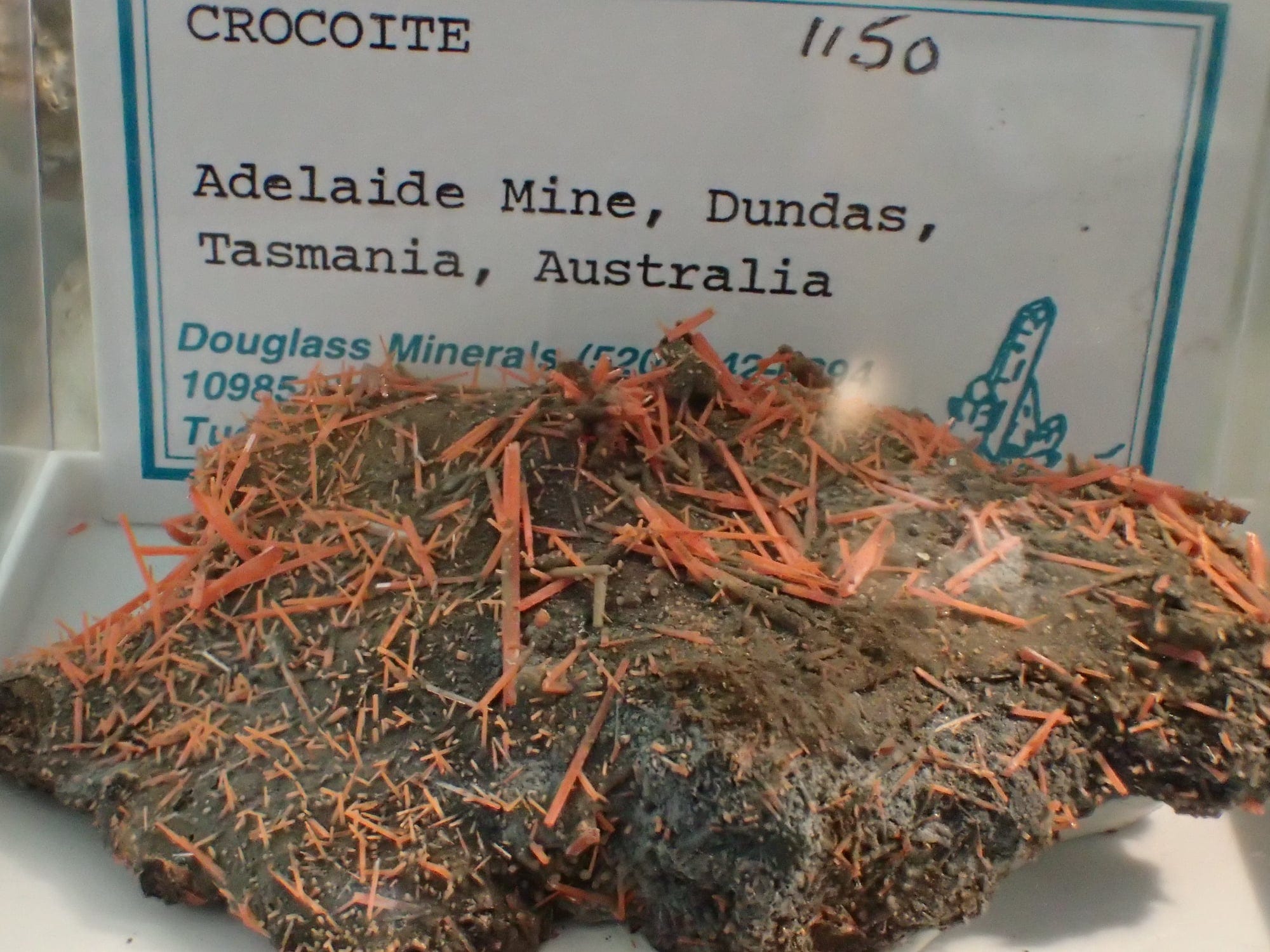
I share here at top a photo of a 40-cm+ crocoite specimen for sale at the Tucson show in 2016, for the fair price of $30,000 (USD). I wasn’t prepared to spend more on a mineral than I did on my house, so the one I got cost $40. A nice little piece of it broke off so now I have two specimens for the price of one. Catalog no. 1150.
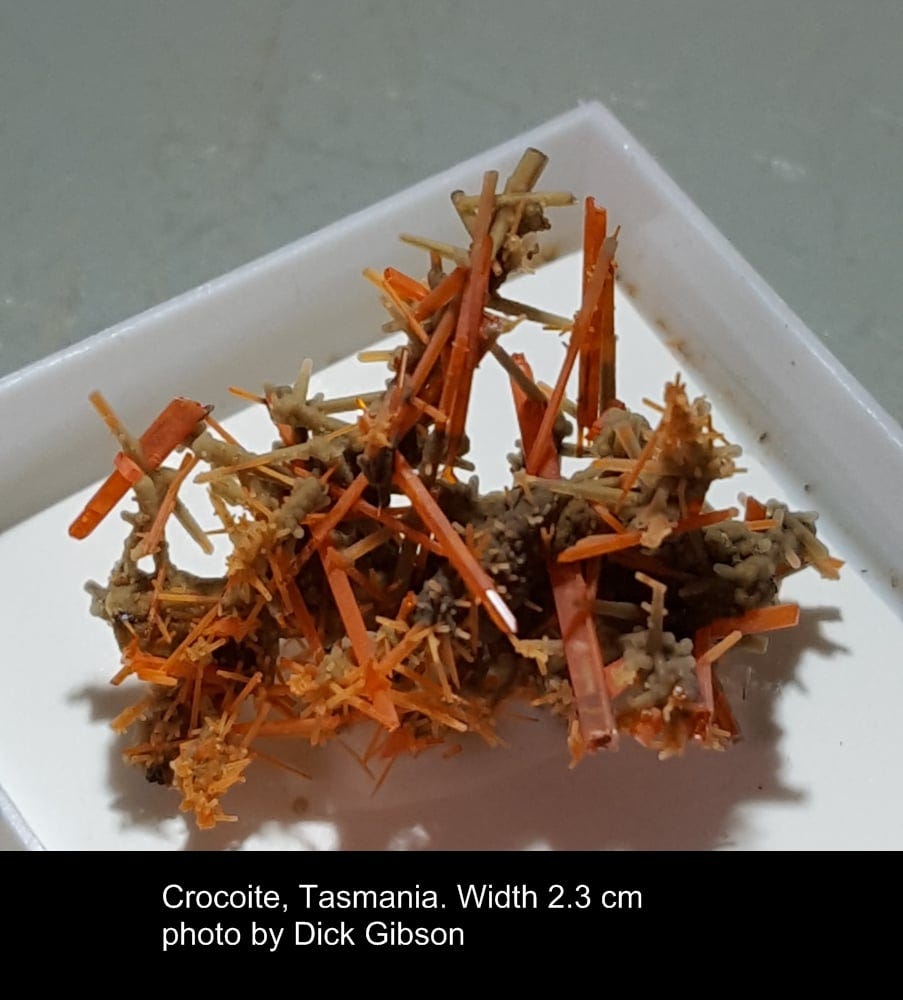
Crocoite needles are monoclinic crystals, but the elongate prisms typically have a nearly square cross section that would make you think they were tetragonal.
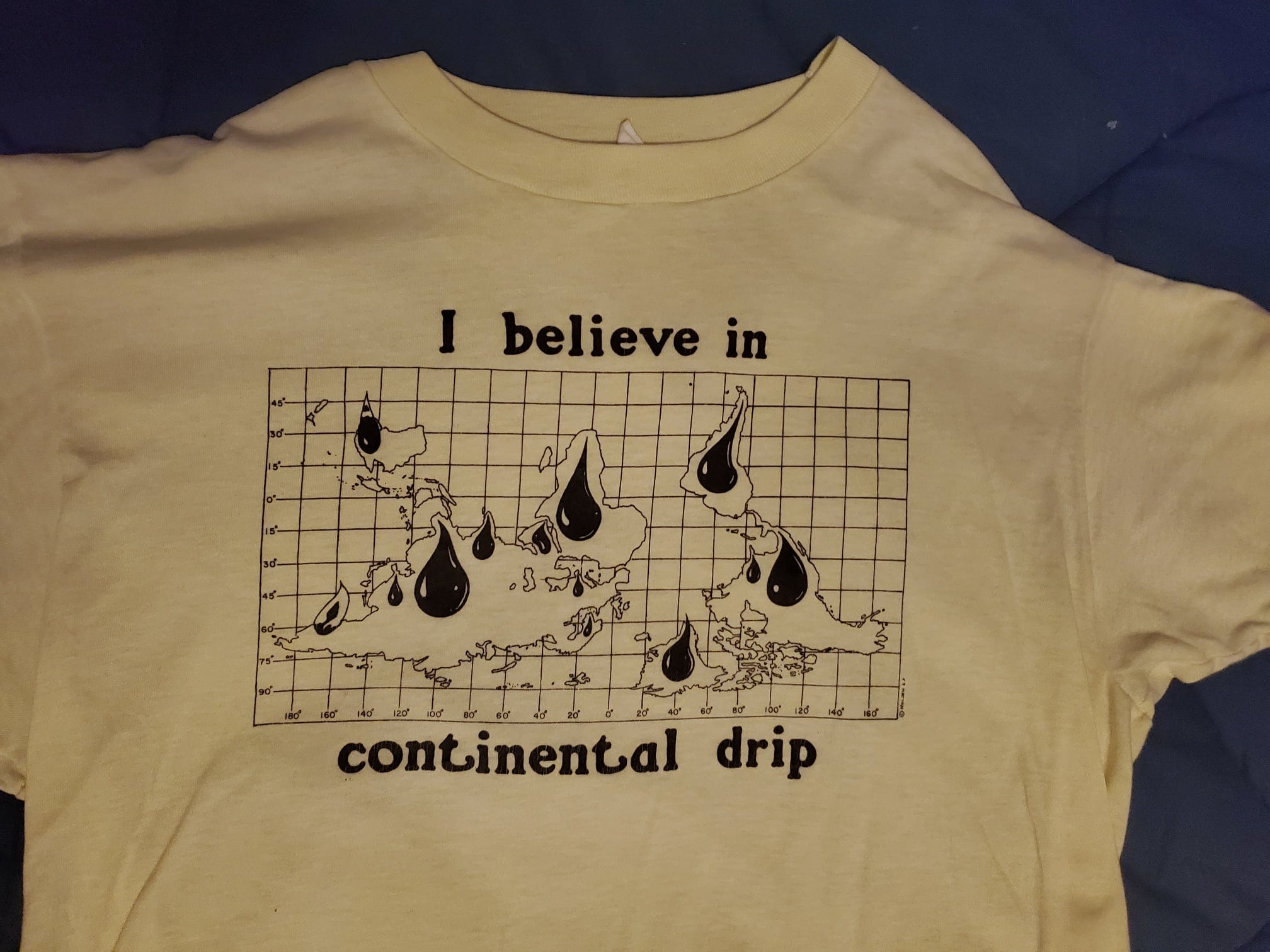
Tasmania is also an aspect of the Continental Drip hypothesis, illustrated on my t-shirt designed by John Holden.
Thanks Richard, great article.. BUT, did I miss something? :-)) What's this Continental Drip? have you written about it previously?
Pretty good coverage Richard! 😁 There are some Cambrian rocks in Victoria that are probably related to those in western Tasmania. But no crocoite! It is a bit more convoluted than originally thought.